“Sukaldea, arimaren erdigunea” –The kitchen is the center of the soul. In the Basque Country, this euskera proverb takes on its full meaning, as you can feel –or rather, taste– its authentic truth.
On a cloudy morning, I found myself facing La Concha, as locals call the vast beach where the Cantabrian Sea roars with all its intensity. Under a leaden sky and with the scent of rain enveloping the air, I introduced myself to San Sebastián –or better yet, Donosti– whose bay, with its near-white sands, the city seems to embrace.
Read in the magazine (rotate your device for a better reading experience):
By Sofía Ruiz
Master Habanosommelier
In the mid-19th century, Queen Isabella II turned La Concha into a popular destination after her doctors recommended sea baths to alleviate her skin ailments. Both the beach and the bay owe their name to the shell-like shape they form when viewed from above.
Our tour began here with Óscar, a one-hundred-percent Basque who, from the very first moment, showed us the soul of San Sebastián. Every city has its hallmark, and here, fine dining is a true art: a deep respect for the raw ingredients and, above all, their origin.
The land speaks, teaches, and gifts us great products which, along with a pinch of salt on the grill, can comfort both body and spirit on those days when we feel overwhelmed. Who hasn’t sat down to a good homemade stew and, for a moment, returned to being that seven-year-old child?
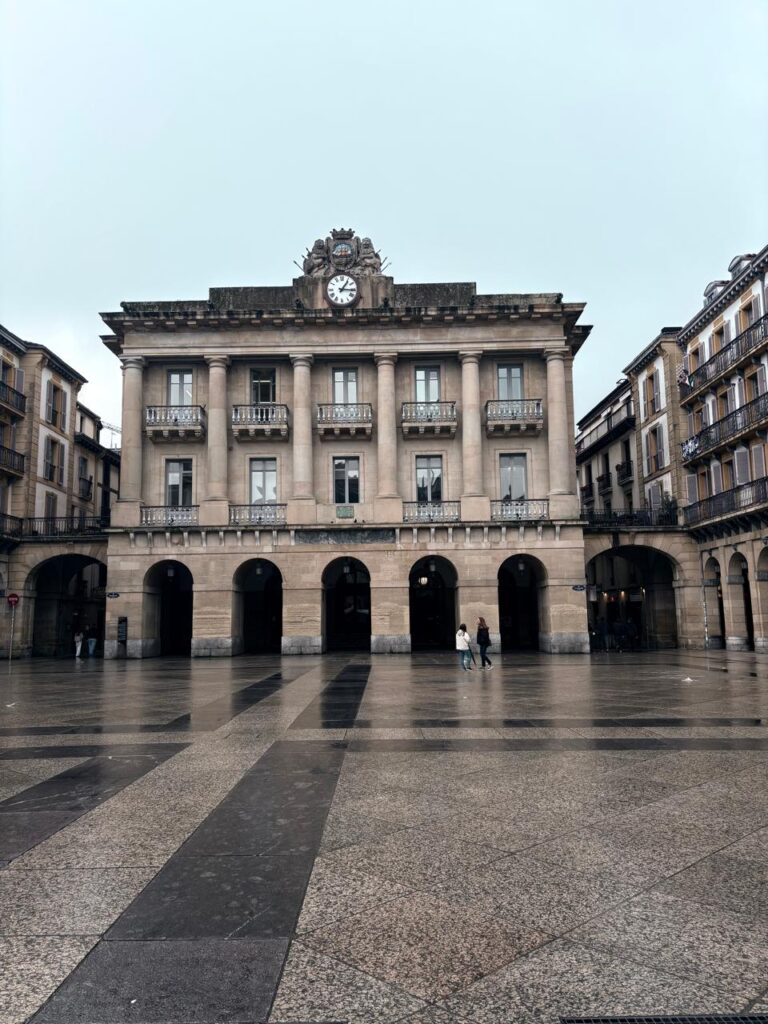
We started at Plaza Cervantes, located next to the San Sebastián City Hall –a grand Baroque-style building originally intended to house the city’s casino. Built between 1882 and 1887, its significance was recognized in 1984 when it was declared a Historical-Artistic Monument.
As we moved deeper into the city, I noticed the impressive real estate values: around 10,000 euros per square meter in the most prestigious areas. I found myself calculating how many Habanos or boxes I could enjoy with that amount. At the very least, my private reserve and other gems could be fully replenished… That thought reminded me of the Vegueros Centro Gordos I planned to enjoy once the tour concluded.
Amidst the morning greys, we reached Plaza de Guipuzkoa, which brought color to the day with its vast gardens and flowers brought from various regions of South America and Asia. It is one of the central parks, designed by the prestigious French gardener Pierre Ducasse.
Opposite the park stands the Victoria Eugenia Theatre, opened in 1912. Built in a Neo-Renaissance style, its facade features sandstone –a material used in most of the city’s historic buildings.
The upper section hides one of its secrets: the busts of legendary figures like the writer and musician Xavier María de Munive e Idiáquez (Count of Peñaflorida) and composers such as Juan Crisóstomo de Arriaga and José Juan Santesteban Iraola.
Suddenly, the first aromas of local gastronomy appeared, signaling the city’s transformation as lunch approached… but that would come a bit later.
Óscar explained, under the falling rain, that San Sebastián was founded around 1180 by Sancho VI of Navarre, “The Wise,” who sought to establish a port for the kingdom. However, it was conquered by King Alfonso VIII and annexed to the Crown of Castile in 1200. This led to the creation of naval forces by 1248, which helped disable the Moorish fleet and the Triana Bridge.
By the late Middle Ages, during the 14th century, San Sebastián was impacted by the Hundred Years’ War between France and England, which shifted Atlantic trade routes toward Bilbao.
We visited the site of the old city walls and, after traversing centuries of history, ended at the port, just blocks away from the Old Town (Casco Viejo). This place marked the beginning of my true connection with San Sebastián.
As a gourmet, I ran with my Habano through several bars to enjoy great moments of the palate. What would we be without them? Is it not our soul and personality that are woven together by these small pleasures?
Following Google Maps, I headed to the first bar I had been recommended… but as often happens in life, it was closed. So, I decided to enter José María, the first one I found in the area, and what an experience! I was greeted by a charming waiter and enjoyed the famous pintxo “La Bola de José María” –a crab tartare– topped off with a glass of Txakoli. Simply perfect.
My soul returned to my body after a three-hour walk. It was then I realized that the essence of San Sebastián lies in these bars, where through pintxos –miniature haute cuisine served on bread and held together by a toothpick– the city’s history has been told.
Moving on, we lost ourselves in the narrow streets until we reached Las Gandarias. Here you can go poteo –the local term for going from bar to bar for pintxos– or sit down for a full menu of seafood. A pintxo of baby squid (chipirones) and another of prawns allowed me to taste more local flavors.
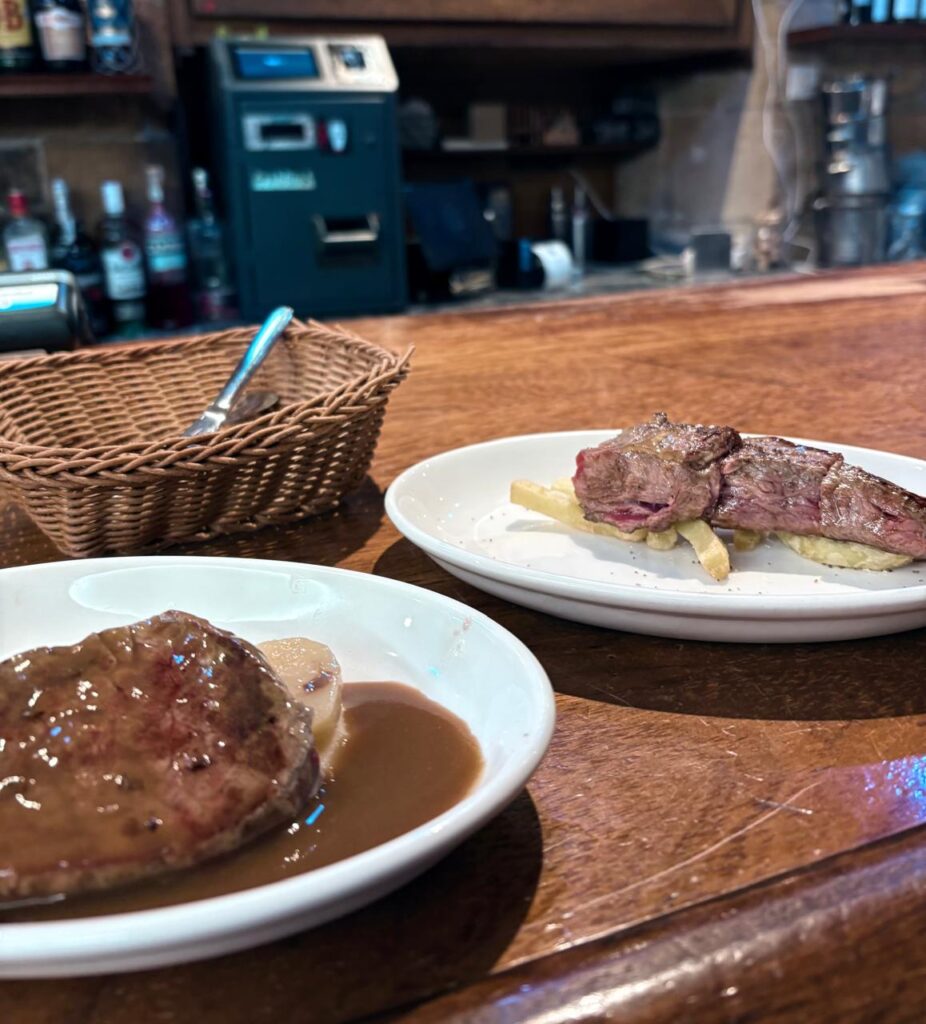
Amidst a mix of languages –English, Japanese, and “Argentine” (noted for its distinctness from Mexican Spanish)– I craved something more substantial. San Sebastián and the Basque Country are famous for grilled beef. Seated at the bar of Txapalo, I ordered the famous Txuletón (a thick rib steak) and a sirloin in Port wine sauce.
What a feast! For a carnivore like myself, these bites practically melted in my mouth.
The rain caught up with me at this bar… and to ease the wait, nothing beats a glass of red wine and Spanish music, which helped make room for what turned out to be a true gem: the cheesecake.
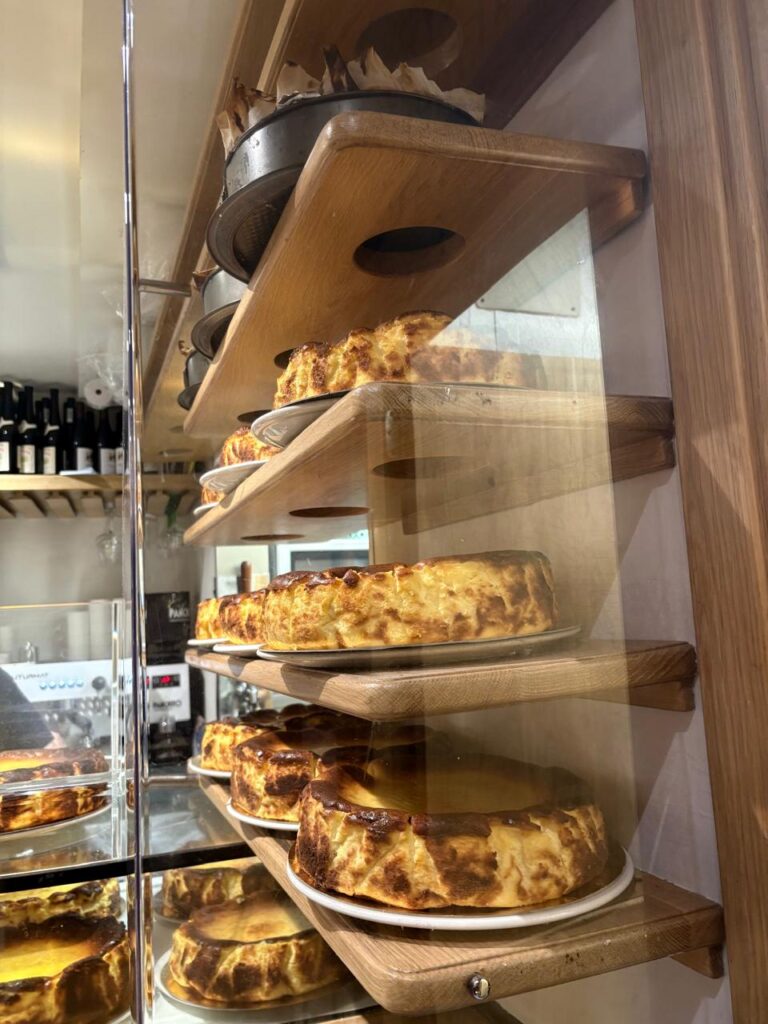
The walls of the famous restaurant La Viña hold one of the most recognized gastronomic treasures in Spain. To try it, one must wait and navigate the busy bar, but once the obstacles are cleared, heaven arrives in the form of a slice: the legendary Basque Cheesecake.
Created by Santiago Rivera, crustless and baked at high temperatures, it is distinguished by its creamy texture and a perfect balance of cheese flavor. The first bite tastes like glory –delicate yet deep, hitting the exact point where the palate always craves more.
I could not close this chapter without my black Cuban tobacco, which, much like Basque gastronomy, is a national emblem. To achieve a movie-like ending, I found a small terrace near the iconic Hotel María Cristina, which hosts celebrities during the San Sebastián Film Festival.
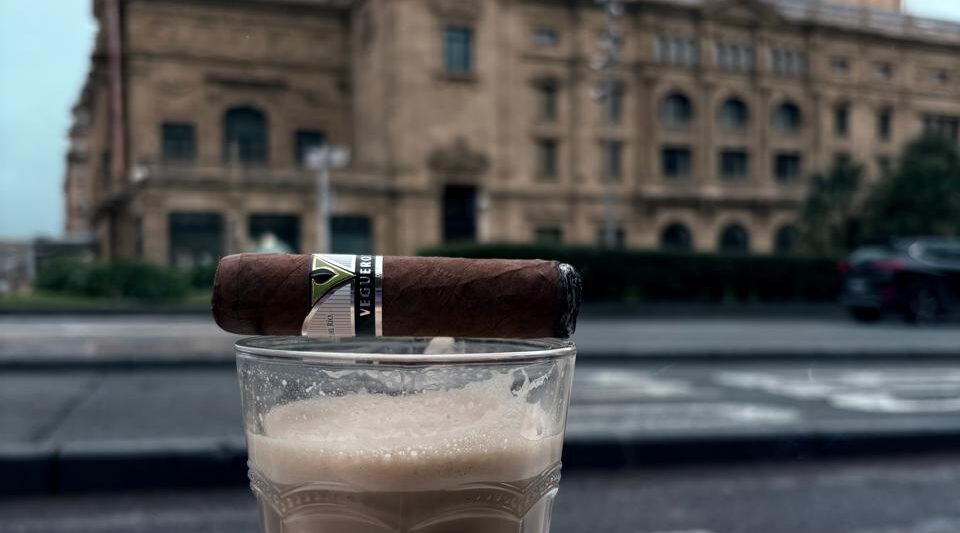
I lit the Vegueros Centro Gordos (100 mm, 54 ring gauge). Its initial aromas transported me to Pinar del Río, the heart of Cuban black tobacco. That red earth, full of passion, where the work of the vegueros (farmers) shines through.
Paired with a classic coffee, my palate was filled with spicy notes, wood, and subtle traces of coffee. Throughout its evolution, slight herbaceous nuances appeared, maintaining its strength across all three thirds. The oily wrapper, with a slight vein and a maduro color, is a hallmark of the brand.
Vegueros was established in 1996 as a tribute to the farmers who dedicate their lives to tobacco. Similarly, in Donosti, the people and their pintxos give life to the city and protect its culinary culture.
San Sebastián led me to say aloud a famous movie line: “This part of my life, this little part, is called happiness.”
Suscribe to our Newsletter