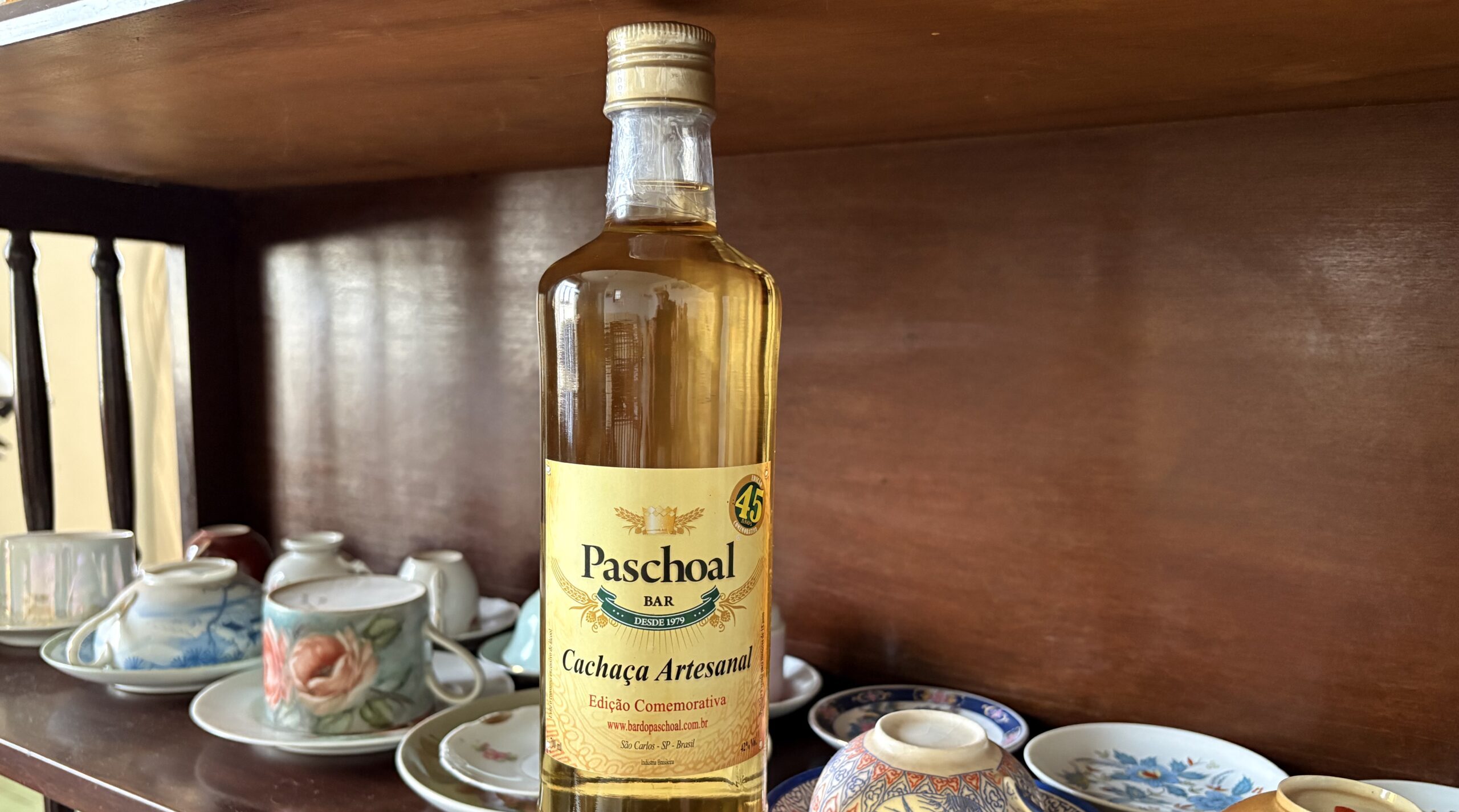
CLASSIFICATION: Artisanal Cachaça aged in Castanheira (Brazilian Nutwood).
COMPANY: Bar de Paschoal.
DISTILLERY: Gramático, Descalvado.
ABV: 42% Vol. (84 proof).
AGE: 2 years (6 months in oak barrels and 18 months in Castanheira vats).
MASHBILL: 100% Sugar cane juice.
COLOR: Pale gold.
Read in the magazine (rotate your device for a better reading experience):
Cigar, Malt & Pipe
Cachaça is one of Brazil’s most emblematic beverages and a fundamental part of its cultural, economic, and social history. Its origin dates back to the colonial period, directly linked to sugar cane cultivation and the plantation system.
Its history began in the 16th century, shortly after the arrival of the Portuguese in Brazil. Colonizers established mills (engenhos) on sugar cane plantations, the production of which was sent to Europe.
During the process, enslaved Africans and laborers began fermenting the leftover cane juice –or what spilled in the mills. Over time, that liquid began to be distilled in rudimentary stills, giving rise to a strong, aromatic beverage that became the first spirit produced on a large scale in the Americas.
During the 17th and 18th centuries, cachaça became popular among slaves, rural workers, and the common people. It was cheap, easy to produce, and abundant in sugar-producing regions like Salvador and Recife. However, the Portuguese Crown sought to ban it, considering it competition for Lusitanian spirits, especially grape pomace brandy (bagaceira).
These restrictions sparked a revolt in 1600 known as the Revolta da Cachaça. In Rio de Janeiro, producers and merchants rose up against the colonial government’s prohibition, and production subsequently grew throughout Brazil.
Over time, cachaça ceased to be a marginal drink and transformed into a national symbol. During the 19th and early 20th centuries, its distillation and storage processes were improved. Many producers began aging it in native Brazilian wood barrels, granting it unique aromatic profiles.
Today, it is considered the national spirit of Brazil, with thousands of artisanal producers and major industrial brands. Furthermore, it is the main ingredient in the country’s most famous cocktail: the caipirinha, prepared with lime, sugar, and ice.
Brazil produces more than one billion liters of cachaça per year, and the beverage is exported to numerous countries, gaining increasing recognition in the world of premium spirits.
NOSE: Predominant notes of oilseeds, especially Brazil nut (castanha-do-Pará) –also known as Amazon nut– accompanied by light notes of dried fruits and a subtle presence of black pepper.
PALATE: Creamy and smooth. The presence of castanheira is a fundamental part of its flavor structure, with light notes of semi-sweet chocolate and vanilla –highly likely originating from the barrel’s toast– as well as vegetal hints of cinnamon and clove, and a sugary profile that makes it dangerously easy to drink.
FINISH: Medium finish with a velvety profile that lingers on the palate, as do the sugar and vanilla notes; a slight dry touch, and the presence of spices and dried fruits.
COMMENTS: Cachaça is a unique spirit because it is produced directly from fresh sugar cane juice rather than molasses, as rum is. This detail completely changes its aromatic profile, which is one of the reasons it holds a distinct identity among Brazilian spirits.
PRODUCTION
It all begins with the sugar cane, which is cut when it reaches its optimal ripeness. In artisanal production, it is processed a few hours after harvest to prevent sugars from degrading or unwanted fermentation from beginning. This is key to maintaining fresh, herbal, and slightly fruity aromas in the drink.
The cane is fed into mills where it is pressed to extract its juice, known in Brazil as garapa –highly rich in natural sugars, aromatic, and slightly vegetal. At this stage, it is also filtered to remove fibers and solid residues.
The juice is placed in fermentation tanks where yeast is added. Depending on the producer, they may use natural yeasts present on the cane or selected yeasts.
Fermentation usually lasts between 12 and 36 hours, producing a “cane wine” with approximately 7% to 10% alcohol. During this phase, many aromatic compounds are generated that will define the final character of the cachaça.
The fermented liquid is generally distilled in copper pot stills, and there are two main methods:
Artisanal Cachaça: Distilled in batches, separating the fractions:
- “Head” (undesired volatile compounds),
- “Heart” (the purest and most aromatic part), and
- “Tail” (heavy alcohols).
In quality cachaça, only the Heart is used.
Industrial Cachaça: Distilled in continuous columns, which allows for the production of large volumes but with a more uniform aromatic profile.
After distillation, cachaça can be bottled directly (cachaça branca or prata), rested, or aged in barrels.
In the aging process, Brazil has enormous diversity because many native woods are used –something very different from the world of whisky or rum. There are more than 30 authorized types of wood, which creates very distinct aromatic profiles.
The commemorative edition for the 45th anniversary of Bar do Paschoal is produced in five different types of wood; the one reviewed here is finished in castanheira vats.
Suscribe to our Newsletter