Alberto Arizmendi
The story of La Perla, one of the emblematic cigar factories in this industry in Mexico and, for the time being, the longest-running, concluded in 2025 –after 127 years– with the sale of its last building in the city of Banderilla, Veracruz. A source of employment and wealth, it survived the Revolution and the labor union movements of the last century, interspersed with its initial boom and the prosperity that World War II brought to the sector.
Four generations of the Corrales family –now with five men named Andrés– and also women, wives, and daughters, were at the helm of the business, whose decline began in the 1950s after a temporary closure and an economic crisis, compounded by the popular consolidation of cigarettes, taxes, and a changing market whose modernization they could not keep up with, as well as the lack of definitive internationalization of their products and other factors, in a country where tobacco now only implies a past.
Read in the magazine (rotate your device for a better reading experience):
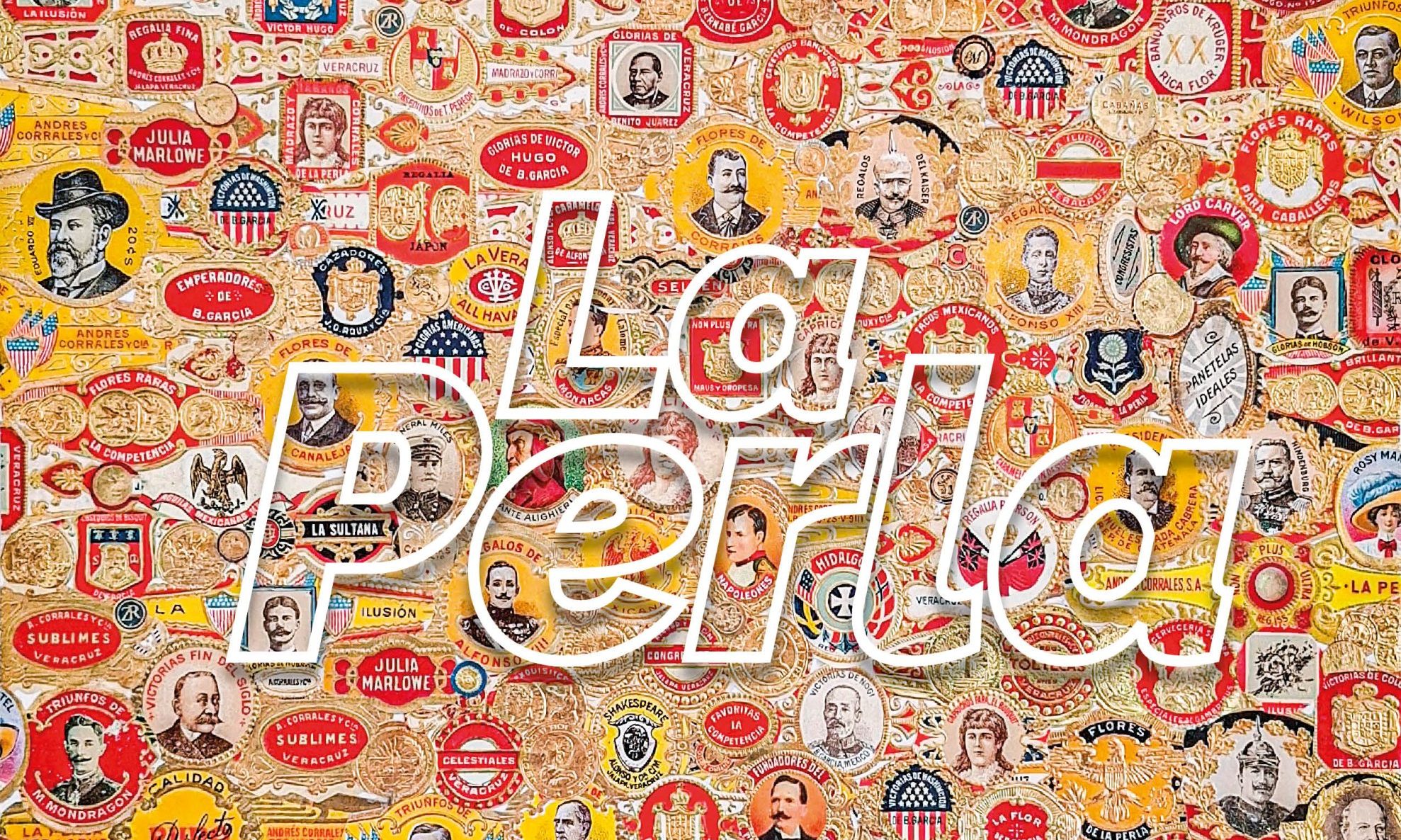
However, the leading role achieved by La Perla in other times is present in a rich historical legacy that survives in objects, images, and pieces of paper transformed into valuable art: rings, cigar bands, or vitolas that collectors –vitolphiles– have treasured over the years in Mexico and abroad, mainly in Spain.
A representative sample of the final stock of the company’s graphic materials, gifted to Humo Latino by Alejandra Corrales Amezcua, the founder’s great-granddaughter and the last person in charge of the factory, accompanies this story.
On May 12, 1898, the chief administrator of the Stamp Revenue in Veracruz certified registration number 155, corresponding to the La Perla “perilla” cigar factory of Andrés Corrales Corrales, established at 55 5 de Mayo Street in the city and port of Veracruz. Two months later, the Day Book was presented to the same authority, with stamps valued at 7.11 pesos and 144 usable, sealed, and signed pages for the company’s administration.
But he had already registered the name La Perla in 1896, as soon as he arrived in the country from Spain, according to his great-granddaughter Alejandra. This fact is confirmed by the inventory of the Patent and Trademark Office 1890-1902.(1) Andrés Corrales partnered with José Madrazo in 1897, when the brands Águilas Mexicanas, Regalía Pearson, Flores Americanas, Perlas Finas, and Regalía El Gran Pacífico were authorized in both their names.
On December 1, 1899, Madrazo and Corrales published a list of “Current Prices” headed by the images of La Perla(2) –a “tobacco factory and leaf warehouse”– and La Industrial Mexicana –”Cuban tobaccos and according to consumer preference”– accompanied by coats of arms that, it is understood, correspond to their surnames. They listed 86 regular vitolas (shapes and sizes), plus another 22 for export.
By April 1902, a new poster titled Gran Fábrica de Tabacos La Perla (The Great La Perla Tobacco Factory) included the portraits of the partners, flanked by the gold medals obtained at the Universal Exposition of 1900 in San Antonio, Texas, and at the Pan-American Exposition held in Buffalo, U.S., a year later. Announcing themselves as leaf tobacco warehousemen and tobacco manufacturers, they presented their annexed brands La Ilusión and La Camelia.
The price list, per thousand, included 99 vitolas for which they specified the container and its capacity, as well as the approximate weight in kilograms. They also detailed the cost for placing bands, shipping costs, and other charges, as well as the presentation of their products with lead foil and bands; bands only, and in bundles. The address of the establishment was listed as 27 Playa Street,(3) in addition to a warehouse at 1 Lerdo Street.
By then, they had also put a workshop into operation in the city of Xalapa, the state capital, at 2 Second Zamora Street. It is also recorded that in the same year, the construction of a full-fledged factory was completed at 82 of the old Colón Street, now Úrsulo Galván.(4) They maintained the slogan that appeared on the first poster: “Ready to give any requested order for fancy vitolas, for which we have the most skilled laborers in this area.”
It was shortly before 1907 that La Perla would move to Banderilla(5) –a small town, an “unimportant” municipal seat, but close to Xalapa and located on the main road between the port of Veracruz and Mexico City, where, since 1892, a station of the Interoceanic Railway operated, connecting it with the rest of the country.(6) Here, a building specifically designed for the factory was also constructed, at 92 of the current Benito Juárez Street.
This is confirmed by the attendance of its worker representatives at the First Congress of Workers of the Tobacco Industry in Mexico City in July 1906.(7) This was a time of growing social movements, which in this case favored the registration of the Tobacco Rollers Union of the La Perla factory by the Central Board of Conciliation and Arbitration, subordinate to the then-Syndicalist Federation of the Jalapa Region.(8)
Between 1911 and 1919, the area was affected by the revolutionary movement,(9) suffering the disturbances caused by carrancistas and zapatistas, joined by the hacendados’ “white guards,” until the Federal Army of President Venustiano Carranza finally managed to pacify the area.(10) In any case, the tobacconists included cigar bands with characters from one side or the other, which allowed them to navigate the changing situation.
Although cigarette factories had existed in the country since the mid-19th century, it was around 1910 that consumption became so widespread that companies like El Buen Tono were producing more than one hundred million packs a year. The technological development that accompanied the use of machinery allowed the multinational British American Tobacco (BAT), which entered Mexico through the Compañía Manufacturera de Cigarros El Águila, to almost completely dominate the market by 1928.(11)
Nevertheless, during the 1920s and 30s, the improvement of Banderilla allowed for industrial development, and La Perla’s production was high, as it not only supplied the national market but also engaged in export. Andrés Corrales Corrales had acquired the entirety of the company, and over the years, he had also bought and absorbed many others, remaining at the head of the business until his death in 1935.
As a product of his marriage to the Mexican Clara Sánchez, their only son, Andrés Corrales Sánchez, took charge of La Perla. Since World War II was also a period of prosperity,(12) the factory developed on a large scale: “Large quantities of quality Habanos were sent to the north of the country, and likewise, by rail, to Mexico City, as well as to private individuals in Oaxaca, Mérida, and abroad.” The raw material was obtained in El Valle Nacional, Oaxaca, and San Andrés Tuxtla, Veracruz, thanks to exclusive growers who guaranteed the quality of the tobacco.(13)
Rail cars full of cigars went to the northern border, where the largest buyer was the U.S. military. La Perla was a source of employment that even led to the migration of workers, but this phenomenon lasted for a short time, as unionists took the opportunity to demand improvements and progressively increase their benefits, so much so that between 1940 and 1950 they maintained a constant threat of a general strike that finally occurred in 1951, when the establishment remained closed for a year.(14)
Records show that Corrales Sánchez, a member of the Chamber of Commerce of Xalapa, stated that despite his benevolence toward his workers, he lacked the economic means to modify the collective bargaining agreement and satisfy their “excessive demands.”(15)
But the businessman’s life was brief, and in 1952, his wife, Julia Elena Correa Bretón, or Doña Julita, took the reins and integrated a new company: Andrés Corrales, S.A., with her children Andrés, Julia Elena, and María Concepción, as well as her nephew Ignacio Hinojosa Correa.(16) However, after its reopening, La Perla never flourished again: “A new, more severe economic crisis was generated between 1965 and 1968, when it almost disappeared. This situation, stemming from a lack of government support, transformed it into a traditional micro-business.”(17)
When Doña Julita passed away, in 1991, her son Andrés Corrales Correa took over the factory. After experiencing a “good” period during the sixties and seventies, with warehouses full, its final decline began in the following decade. The sale of its products decreased, and they were left only with the national market, where some distributors, like Casa Petrides, located in the Historic Center of Mexico City,(18) were promoting its flagship product: Canalejas.(19)
The account of this final era is provided by Lucía Alejandra Corrales Amezcua, the founder’s great-granddaughter, who, starting in 2007, was responsible for the family business after her father’s death. She explains that they simply stopped being competitive against other companies with more financial and commercial resources that were able to dedicate themselves to export.
Covering payroll forced her to reduce work hours to practically a half-shift, and this was compounded by the seniority of many cigar makers, who retired around 2012 after 40 to 50 years with the company. By buying less raw material, they also hurt the growers, from whom they primarily obtained the Sumatra variety, so she recalls her father getting tobacco from regions other than Los Tuxtlas.
On the other hand, she decided to keep her job as a professor and dedicate her free time to the factory. “Even in my dad’s time, the business wasn’t profitable. For years, he had owned a printing press in downtown Xalapa and used it to get resources to keep the company going, practically as a family memory.”
Although some of the retired cigar makers agreed to work on the side to earn extra money, the number of employees gradually decreased, and in the end, there were only four rollers, one packer, and an office assistant. The last sale to a distributor was in April 2013, shortly before it closed, although it should be noted that in the following years, small batches were sporadically made for weddings and other social events.
Despite the difficulties, Alejandra remembers that in return, she gained some joys, as happened at the Banderilla Fair, where they broke the record for The Largest Cigar in the World with a piece more than 26 meters long. Another, when she was younger, was the celebration of La Perla’s centennial, which took place on May 16, 1998 –four days after the official date– and included the unveiling of a commemorative plaque at its facilities.(20)