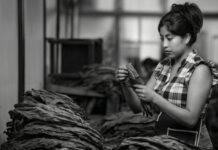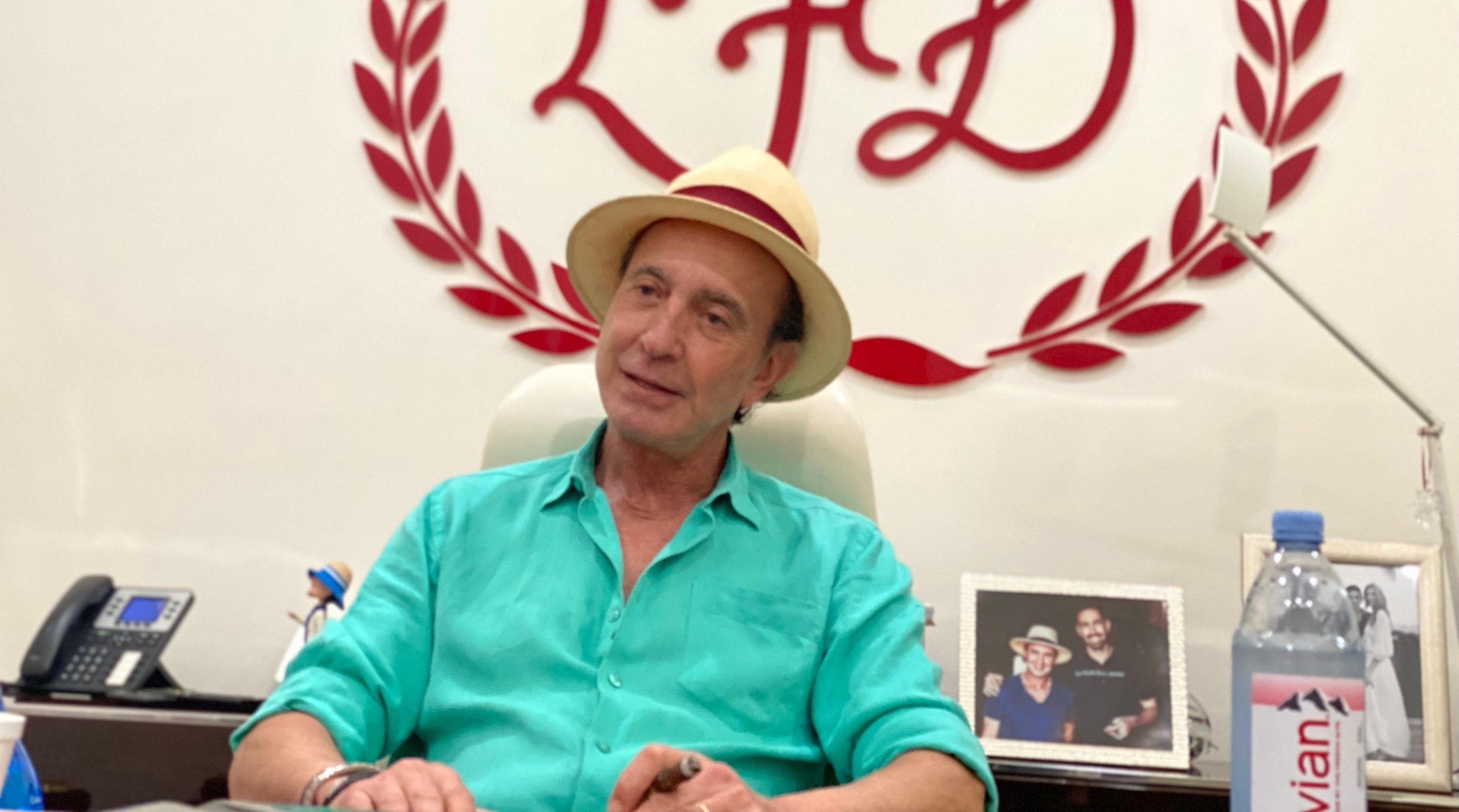
The handmade cigar market in Asia has and will maintain significant growth “but it won’t be a frenzy,” affirms Litto Gómez, CEO of La Flor Dominicana, adding: “Tobacco people in China are striving to create a market and starting to manufacture, but it will take years and even decades for them to establish a reputation.”
However, in the Asian market, especially in China, things are taken seriously and when they set a goal, they achieve it. “They are going to create a market, and they are going to manufacture cigars, but it will be in a manageable manner for everyone, we can grow together,” he adds during an interview with Humo Latino at his offices in Tamboril.
Read in the magazine (rotate your device for a better reading experience):
Despite this growth, the tobacco culture continues to expand worldwide, but he does not believe the situation could represent a crisis in the future, as it did during the boom of the nineties. Litto Gómez recalls that everyone wanted to smoke “because it was fashionable,” consumption soared, and traditional factories couldn’t meet the demand.
Established brands had suppliers who couldn’t sell them more than agreed upon, and companies like La Flor Dominicana were stuck in production, with no opportunities for growth due to material shortages. “It wasn’t because we didn’t want to produce more, but because the tobacco for my blends wasn’t available and I wasn’t going to alter them.”
Instead, he explains, dozens of producers took advantage by hiring labor and opening nearly a hundred factories, most in Tamboril, where they processed low-quality tobacco abundant in that oversaturated market. However, by the end of 1998, the trend ended, tobacco availability improved, and many of those new brands disappeared.
For Litto Gómez, these three decades in the industry have been the most fascinating years of his life, growing at his own pace and with steady progress. The company started in a small space that expanded over time, now including distribution offices in Miami, Florida, USA, managed by his wife and ally, Inés Lorenzo. “What we had at the beginning represents five percent of what this factory is today, and we don’t know what it will be like in a few more years.”
“If they prove that premium cigars are harmful, I’ll close the factory”
Litto Gómez is proud to be a cigar manufacturer, and as such, he has had to explain countless times the differences between cigarettes and cigars, noting that the former are laced with harmful chemicals to make them addictive, while the latter is a natural product from which chemicals are even removed during the aging process.
“There is no serious study proving or discovering that a premium cigar is harmful to health, and I promise that if someday it is proven that I am harming people, I will close the factory… I say this sincerely, from the heart,” he asserts.
He then gestures toward a wall honoring members of the Cigar Aficionado Hall of Fame. Among those figures are the first five, “old timers,” who lived to be over 91 years old, smoking more than ten cigars a day. “There’s your study,” he affirms.
“I will end counterfeiting”
With three decades in the industry and executive experience at ProCigar, Litto Gómez was elected by the General Assembly members as their President. Alongside the new Vice President, Ciro Cascella, who heads Tabacalera Arturo Fuente, he will lead the organization until 2026.
He explains that to belong to ProCigar, the requirements are simple but not easy: you must be a manufacturer and owner of an internationally recognized brand, and that is why since his beginnings in the industry in 1994, he knew that hard work was necessary to sit at the table with those whom he admired as an aficionado.
Litto started with no prior knowledge beyond enjoying a good cigar, and during those early years, he received invaluable advice from those who would later mostly become his friends. “There is a lot of cooperation, and that’s what made me fall in love with the industry, the camaraderie among Dominican manufacturers.”
A decade later, with a consolidated company that survived both golden and dark times, he received an invitation to join ProCigar. A moment he describes as “one of the most beautiful,” as it reflected the success of La Flor Dominicana and the opportunity to “be part of a group of people you admire and where you can contribute ideas… what an honor!”
Now, after his experience as Vice President of the organization, Litto Gómez succeeds Hendrik Kelner as President, who decided to retire after 32 years leading ProCigar, a position that entails great commitment and responsibility, which he faces with enthusiasm and hard work. Regarding expressions of support, “being told all those things flatters and strengthens me,” he emphasizes. “It reassures me to know that I haven’t come to solve problems, because there aren’t any, but to contribute ideas and continue to grow.”
He affirms that both the direction and goals are clear: promoting education in the fields and rolling tables; strengthening the image of the Dominican Republic through tobacco and cigars, as the country’s Cultural Heritage; and waging a frontal battle against counterfeiting and other ills that affect the industry and its prestige.
“I am going to end counterfeiting, that is a goal I have, and it has to happen, and I am going to make sure it happens. It’s the perfect opportunity to protect this heritage,” he concludes with a light tap on the marble block that serves as his desk. “Confiscation operations will start soon. We must end this evil, and I am going to ensure it happens,” he reiterates.