What is the relationship between Arab, Spanish, and Caribbean cultures? That was a question Amir Bouloma and Randy Ghraizy never asked themselves, but one for which they found the answer. Amir, a curious traveler of the world’s knowledge and stories; Randy, a talented architect specializing in natural materials like wood; and together, creators of the Perla by Miraath, a humidor that is also art—a true piece of functional art.
“Our love for culture and beauty will always overcome hatred and war.” — Amir Bouloma
ALHAMBRA
Amir Boulmona is a traveling soul who likes to spend time getting to know the culture of each place he visits, learning about history and gastronomy. During one of his trips, he found a special connection that struck him: “When Spain reclaimed its land from the Islamic Empire’s occupation after 700 years of war, they found a great cultural and artistic heritage. Far from thinking about destroying it because it belonged to the enemy, they decided to keep it, preserve it, and make it their own,” he recalls.
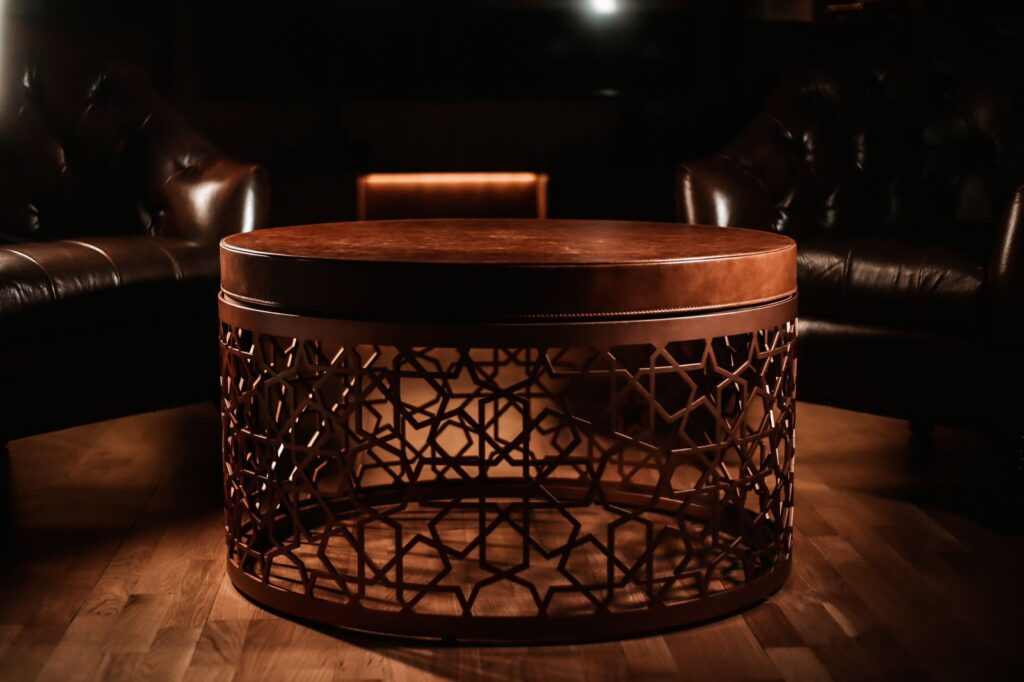
The inspiration for the design of the Perla by Miraath stems from the Alhambra Palace in Granada, Andalusia, Spain—its architecture and all the stories surrounding it—as well as the strong connection the entire palace represents among Arab, Spanish, and Caribbean cultures; something they also wanted to convey in their product.
“The leather and hides represent Spain and its galleons; the decorations represent Arab culture and its architecture, while tobacco represents the Caribbean. All of this makes Perla a tribute to this convergence,” explains Amir.
As a premium tobacco aficionado and member of various social smoking clubs, Amir knew that every smoker, once embraced by this passion, wants to own a good lighter, a good cutter, ashtrays, and other accessories that elevate the experience.
But he discovered that when it came to a good humidor, the options available at the time fell short: “I needed something that satisfied my needs from every angle. Sure, there were very nice wooden pieces, but they were just that—a pretty box in a corner standing alone, hiding the beauty of the cigars inside,” he points out.
According to Amir, when an aficionado has a large cigar collection, the first thing they want is to show them off and talk about the stories behind each one while their audience can appreciate them inside the humidor.
The Perla by Miraath is a piece of functional art, much like the Alhambra was between 1362 and 1391 when commissioned by Muhammad V—especially its famed Court of the Lions and its fountain, comprised of 12 lion statues and a unique hydraulic system that continues to intrigue today, not to mention the intricate patterns decorating every corner of the place.
Thus, Amir and Randy decided to bring this exemplary Arab art into the design of the Perla as a reflection of their culture and a reminder that once, this courtyard and the entire palace were the epicenter of a fusion between the Middle East and Spain.
Furthermore, according to Amir, the design of this courtyard—where Muhammad V met with chancellors and generals—was conceived as a way to show the world the empire’s cultural level compared to other European kingdoms of the time, something he wanted to reflect in his product as a display of sophistication for whoever acquires it.
Thus, Perla stems from a long friendship between the two, forged in childhood and strengthened by a shared passion for cigars. The creation of this humidor was approached like any other architectural project, complete with its challenges and specifications, resulting in a 100% customizable luxury product built to the highest quality standards.
AN ENGINEERING CHALLENGE
For Randy, one of the first issues to solve was the physical mechanics of the product itself, within a concept he describes as “The Illusion of Simplicity”—moving from a detailed, beautiful 3D model to a real-life piece.
The expertise of Lebanese artisans was enlisted to craft the prototype. They not only had to adapt to the wide variety of materials selected for the piece, but also to the extreme levels of customization the Perla can achieve.
“Changing the dimensions of the piece by just a few centimeters requires recalculating the entire structure, while also keeping in mind that you are working with wood, leather, mother of pearl, glass, and many other materials,” explains Randy.
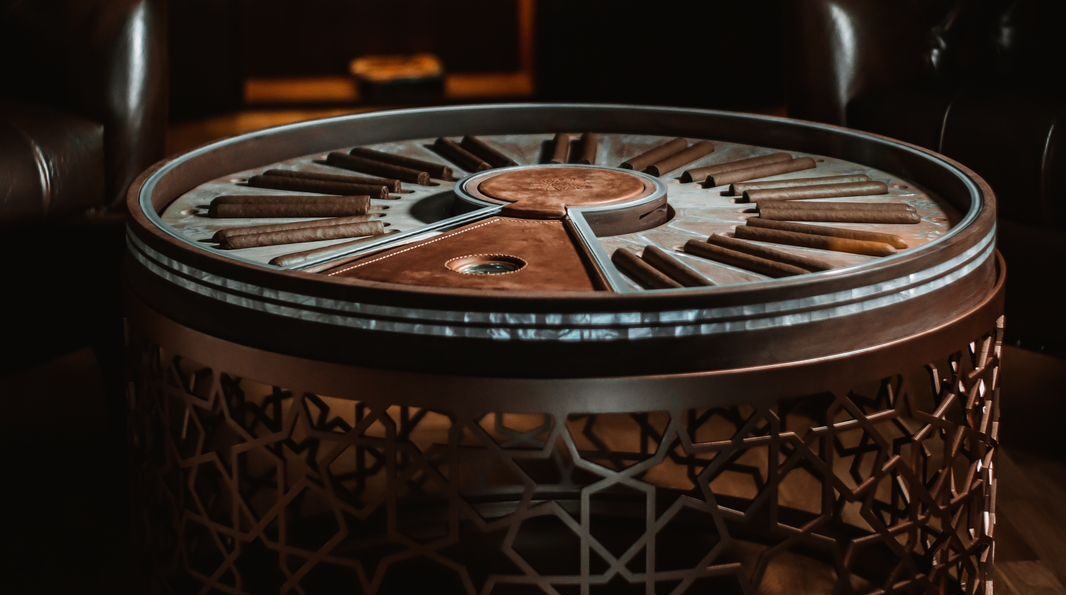
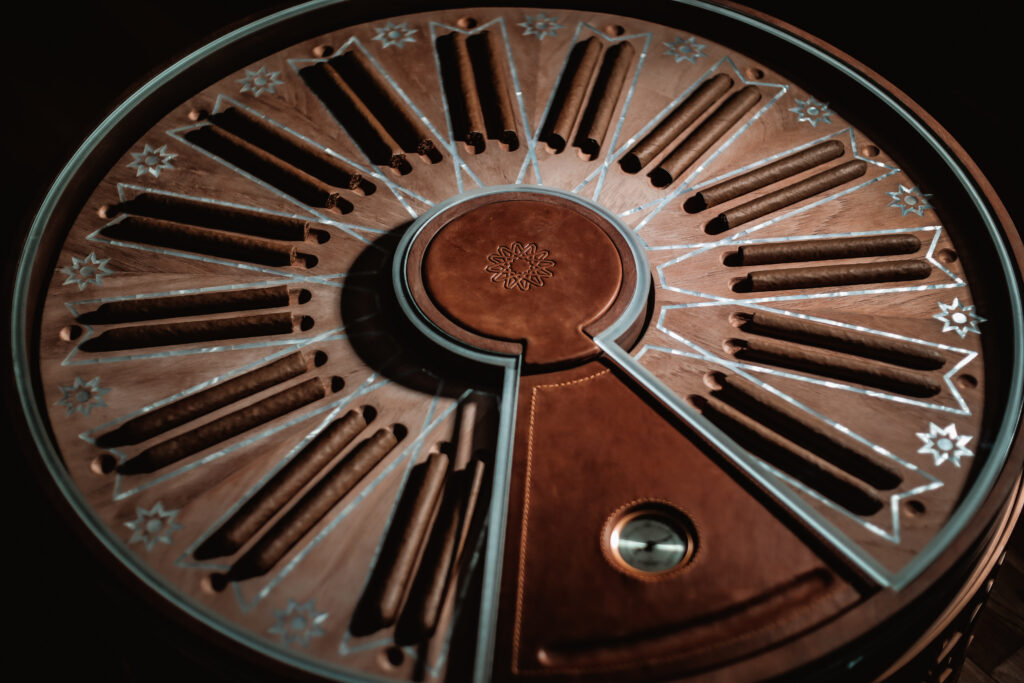
Among all these challenges, the rotating cedar platform holds a special place, as it is responsible for allowing you to retrieve and place cigars inside the humidor. Designed like a casino roulette wheel, its operation is as simple as it is precise, and the rest of the mechanism depends on it.
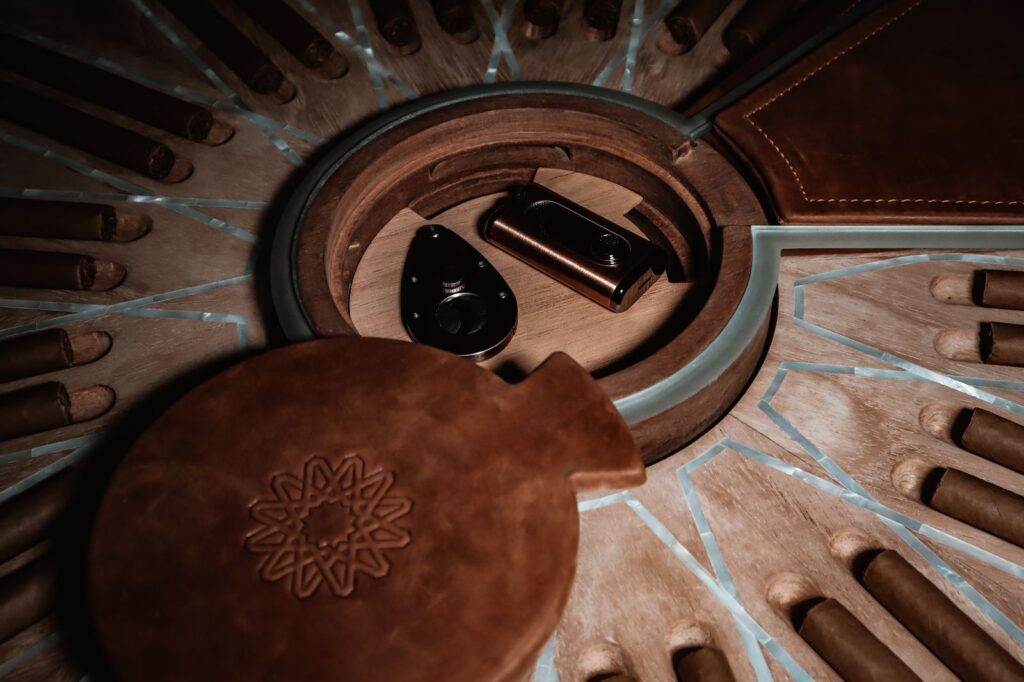
In that regard, Randy details that a fixed leather gasket, in addition to being an aesthetic element, provides access to the inside of the humidor while serving a function in controlling humidity and temperature.
Within the entire system and array of materials that make up the humidor, the hygrometer is the most tech-focused piece; yet, it remains as simple as a brass tool identical to those used in navigation in the early 1900s.
THE ROLLS-ROYCE OF HUMIDORS
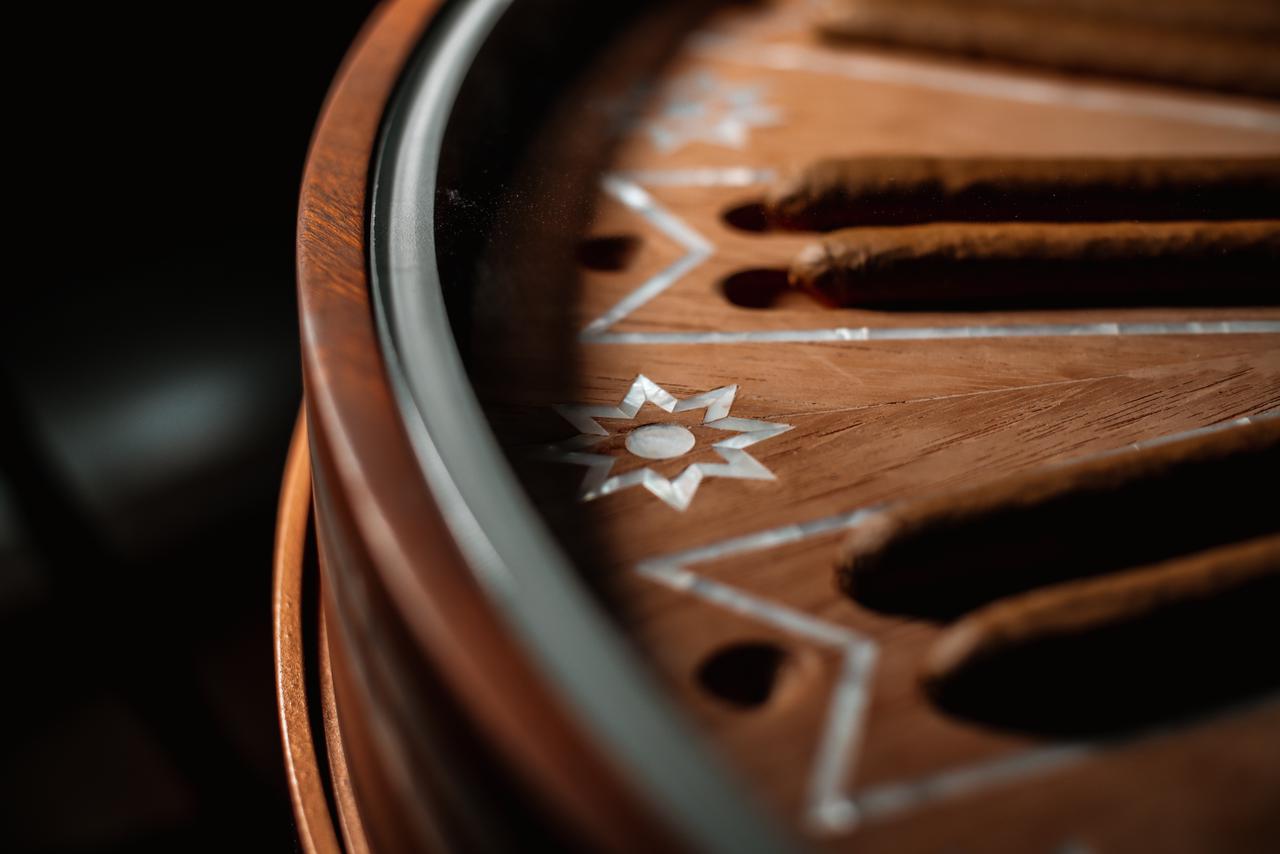
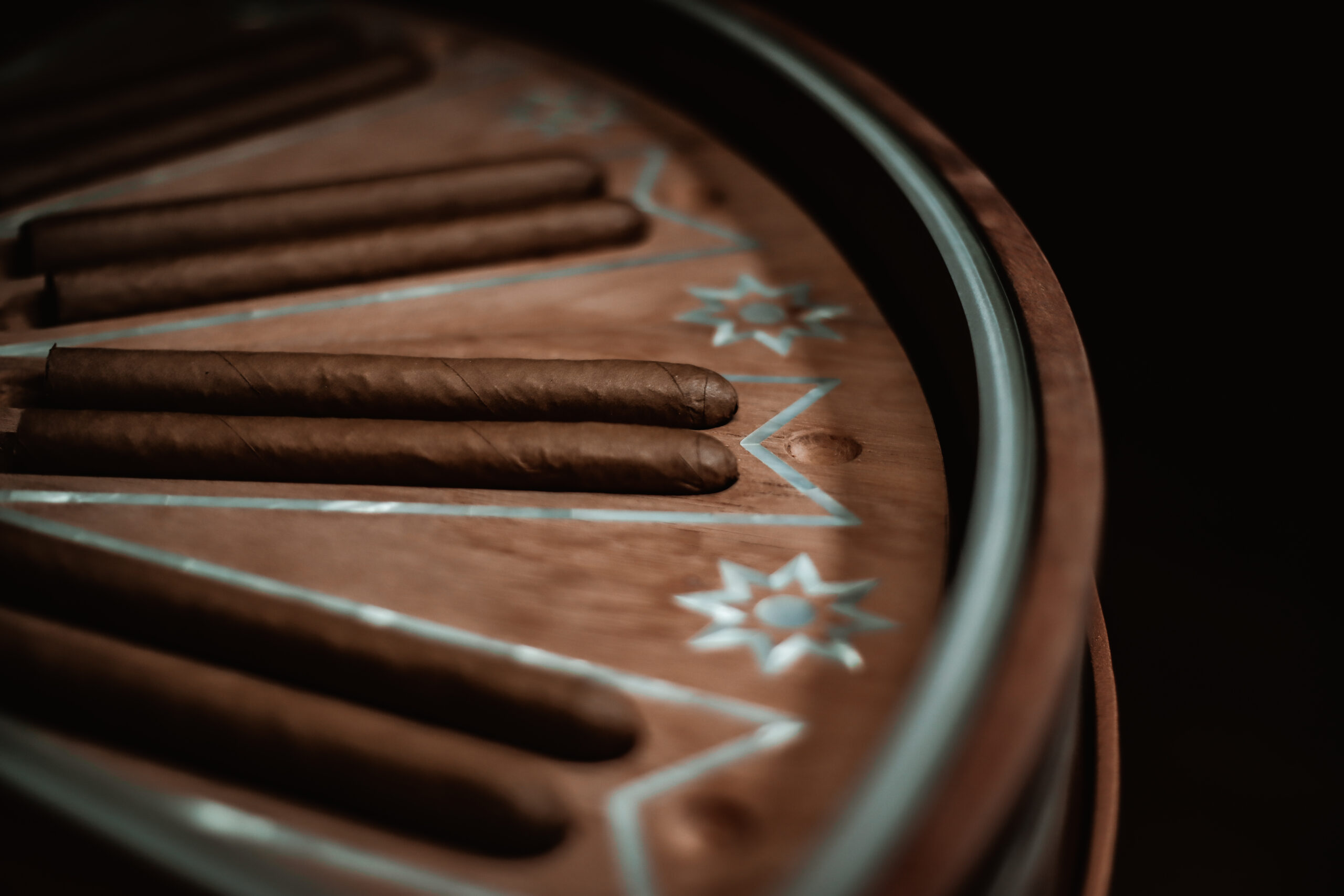
The Perla by Miraath is not only a formidable piece of engineering, but also a 100% handmade work of art, featuring carved cedar wood designs for the base, carefully crafted leather covers, and a rotating surface conceived in the shape of a rosette—like those found in the Alhambra—with 15 petals. One petal is reserved for the hygrometer and access point, while the rest can hold 28 cigars, “in pairs, to share,” its creators add.
But the essence of this humidor lies not just in the beauty of Arab art, but in its capacity for customization. If a client prefers a platform without dividers, it can hold as many cigars as fit within the circumference—an area that can also be manufactured to the buyer’s taste within specific parameters, up to a maximum diameter of 80 to 85 centimeters.
In addition, there is an option to add a leather lid to protect the cigars from light, and discussions are underway with more artisans so that even this lid can be decorated with an original painting that can be hung near the humidor when not in use.
“The leather pieces, the wood, the mother-of-pearl inlays—everything is a blank canvas that can be worked according to the client’s preference. We start from a mechanical design base, but the aesthetics are entirely customizable. Each piece is unique and special for every client,” explains Amir.
The manufacturing process for the humidor takes between 3 to 4 months. Since artisan capacity cannot exceed five pieces at a time, and taking into account a necessary rest period of nearly two months between production runs, Miraath can deliver only a very limited quantity of units per year, making it an item of high exclusivity.
In an era where everything is transitioning toward the digital world, biometric scanners dominate, and relationships are becoming automated, the Perla by Miraath remains simple and mechanical, while remaining beautiful and functional to enrich and become part of the experience and enjoyment of smoking.
Find yours here: Miraath.co