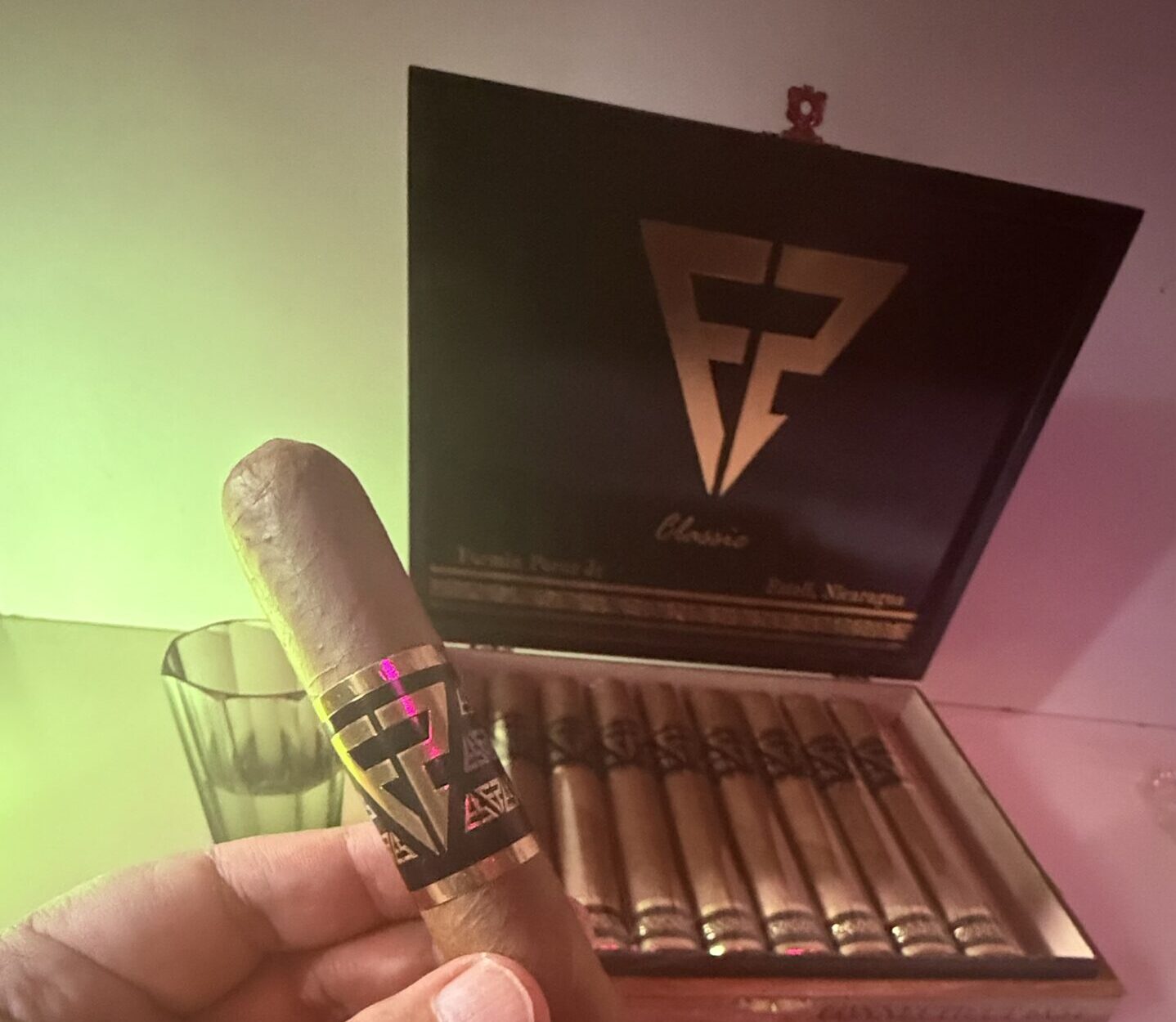
There are cigar boxes that are bought to be smoked; others are bought to be stored, and still others get trapped in a strange territory between the two. A year ago, I brought back from Miami a box of Fermin Perez Classic Connecticut, with a black lid and gold lettering, containing ten 6-inch, 54-ring gauge Toros: a promise of smoothness wrapped in a presentation that seems to ask for something else.
Although part of that story is also in the person behind the brand.
Gut feeling / Gastón Banegas(*)
I met Fermín Pérez Jr. in Miami, a city where tobacco still functions as a common language. That is where I first smoked his Esmeralda, and with it, a different relationship with the brand began, as it was no longer just a box in a humidor or another band within a rotation.
The family history enclosed within the brand seems built between two geographies familiar to any smoker: Cuban roots and Nicaraguan production. Today, from Estelí, the factory develops lines ranging from mild proposals, like the Connecticut, to more intense profiles.
Perhaps that is why the brand always felt coherent to me. I had smoked other lines from the house –Habano and Bold Maduro– always finding accessible profiles, careful construction, and an evident search for balance over impact.
But the box in question remains closed. Not because I saved it for a special date or because I forgot about it… Simply, its time has not come.
In the Tobacco World, there is much talk about the aging, fermentation, or storage processes, but not as much about another process: the aging of our expectations, because every unsmoked cigar accumulates something. Sometimes memory; other times anxiety, or simply a story that has not yet happened.
There is also something particular about the word Connecticut, as over time it stopped describing a wrapper and became an expectation. Many smokers, upon hearing it, imagine mildness, linear profiles, or low-intensity cigars, as if the light color of a leaf could summarize the entire experience.
However, it has been a while since Connecticut tobacco wrappers necessarily meant simplicity, especially when they appear in modern Nicaraguan blends, whose creaminess usually coexists with spices, texture, and a significantly greater complexity than the color anticipates.
Perhaps that is why this box also accumulated expectation and over time transformed into the memory of a conversation in Miami, the trust placed in a brand I knew, and the silent memory of a pending experience.
An uncomfortable question then arises: how long can a box remain closed before it stops talking about the cigar and starts talking about us?
I always thought that cigars should not be saved for special occasions, because often they never arrive. But something different happens when instead of waiting for occasions, we manufacture them. Perhaps certain cigars, or certain boxes, end up forcing us to create the moment to finally open them, without involving a celebration, a birthday, or an important bottle. Perhaps something simple, like sitting down to write for Humo Latino.
Because after years of silent coexistence, the box stopped being a closed box and transformed into a pending question, which as such demanded an answer. Opening it to write these lines seemed, finally, reason enough.
Obviously, the cigar in question is the Fermin Perez Classic Connecticut Toro, a generous vitola for a proposal that, at least from the presentation, seems to bet more on elegance than on potency.
Visually, the wrapper shows the expected profile of a modern Connecticut: a uniform light brown tone, silky texture, and discreet veins. Unlike oilier or rougher leaves, here the first impression seems to be built on neatness: in the hand, it feels firm, presents few visible imperfections, and has a silky touch.
Before lighting, the first clues appear. Cold, aromas of hay and nuts predominate, especially a lot of walnut. The cold draw brings cereal and a very subtle white pepper, building an expectation quite different from what is suggested by the black and gold box where it waited for a while.
Lighting it begins to resolve the tension, as the box promised solemnity and the cigar responds with balance. The initial profile moves through more contained, but not necessarily simple, places: cream, cereal, light wood, and a delicate spice begin to define a more textured profile than might be expected.
During the first minutes, something recognizable to anyone accustomed to Connecticuts appears: that combination of smoothness and creamy texture, which is often interpreted as simplicity. Here, however, the experience seems to be built from another place, with small aromatic layers, contained spice, and a less evident, though present, evolution.
As the smoke progresses, the cigar gains some structure. The nuts present in the cold find continuity, and wood begins to gain space. There are no abrupt changes or dramatic twists, and the evolution involves small shifts, where texture and transitions weigh more than contrasts.
Toward the final stretch, the blend concentrates its character a bit more. The spice becomes more evident, the creaminess loses some ground, and the strength moves just slightly above where it began, without abandoning that logic of balance that characterizes the cigar.
Due to its profile, the Classic Connecticut allows itself to be paired easily, without demanding the spotlight. Coffee works almost naturally: a short espresso, an americano, or even filtered coffee, where the creaminess of the cigar finds continuity. Perhaps the most honest way to smoke it is with water, as the creamy texture, cereal notes, and mild spices are more exposed.
For those who prefer other combinations, a light rum with moderate aging, a bourbon with a vanilla profile, or even a mild black tea could accompany it without overwhelming the delicate character of the blend.
If the experience ends up resembling other lines of the brand, the result will probably be easy to summarize: an honest, well-constructed cigar with a cost-benefit equation that is hard to ignore.
But reducing this box to a relationship between price and quality would fall short. For years I thought I was storing ten cigars, when in reality it was a pending conversation, an expectation, and the excuse to manufacture a moment.
Smokers often fill humidors with possible futures, save boxes for later, and postpone openings. But sometimes, without realizing it, time transforms simple objects into small personal stories, and perhaps that is why some boxes remain closed for so long… And when opening them, it is never just about a cigar.
(*) Gastón Banegas. Habano sommelier and enthusiastic smoker, he is passionate about whiskey and pairings. He lives in Buenos Aires, Argentina, and writes about premium tobacco and sensory culture.
Suscribe to our Newsletter