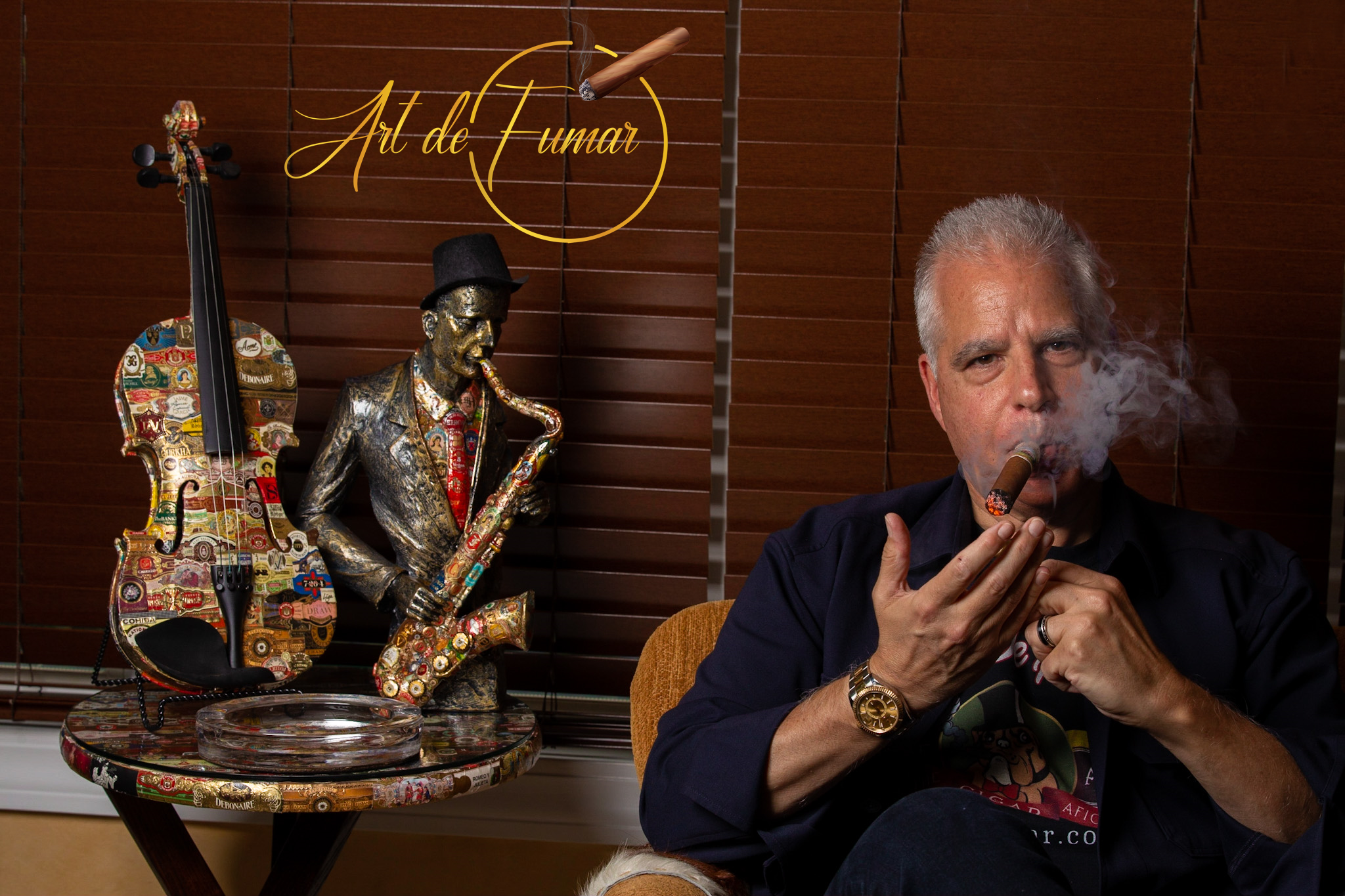
An attorney with a law firm in New York, where he has practiced his profession for over three decades, Robert Glick is a cigar aficionado. At the age of 25, drawn by the beauty of their gold details and die-cut reliefs, he began to collect the cigar bands of the cigars he smoked. For some time, a glass container was the destination for dozens of bands that shone inside like coins, but when it exceeded its capacity, Robert had an idea that would change the course of his hobby.
Read in the magazine (rotate your device for a better reading experience):
Raúl Melo
On a table, something as simple as a coaster inspired the lawyer’s artistic heritage to turn it into something more, helped by the aesthetic and elegance that cigar bands could provide. Thus, this piece of wood became the first object his curiosity “intervened upon,” and the result was satisfying.
Over time, Robert’s technique evolved into a kind of puzzle that takes shape piece by piece, with no lines or edges that make it obvious that they are bands. This is how he seeks to set himself apart from other artists and continues to learn to improve.
Born in Queens, New York, and a fan of the Mets, he went to law school in Massachusetts and has no artistic training whatsoever. But he does have the influence of his mother, a woman with a very good eye for art, as well as his father, who for many years was dedicated to graphic design and the creation of various works focused on advertising.
At first, his designs were linear, but then he experimented with more complex objects, expanding the range of materials for their preservation and learning something new with each new piece.
This led to the creation of a home studio and Artdefumar, the Instagram account where it all began, where a sudden flood of followers appeared to enjoy what Robert was doing.
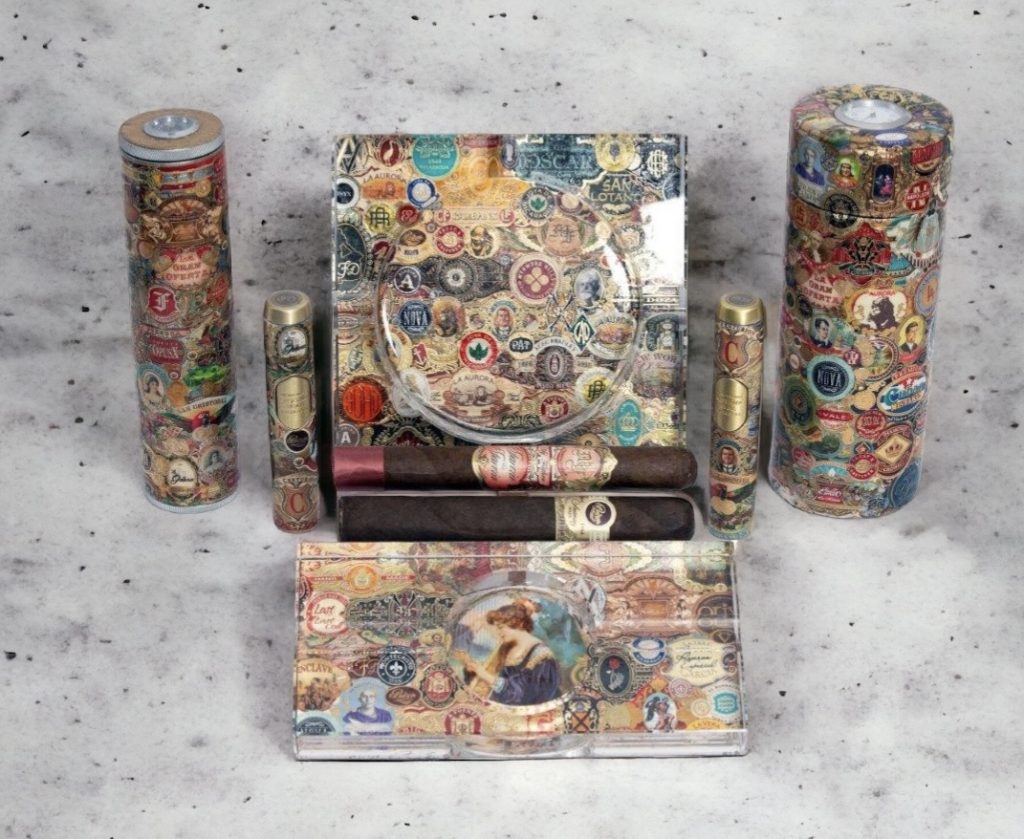
He created pieces on humidors, ashtrays, cutters, and lighters that were a great success among his friends at the Cigar Lounge. Thanks to the industry events he has been invited to, he met and became friends with many of the sector’s leading producers, for whom he has done special work –a list that includes Tony Gómez, Eladio and Emmanuel Díaz, Jorge Padrón, Carlito Fuente Jr., and many other people with whom he slowly connected so that his art would reach such levels that he is now part of the global tobacco family.
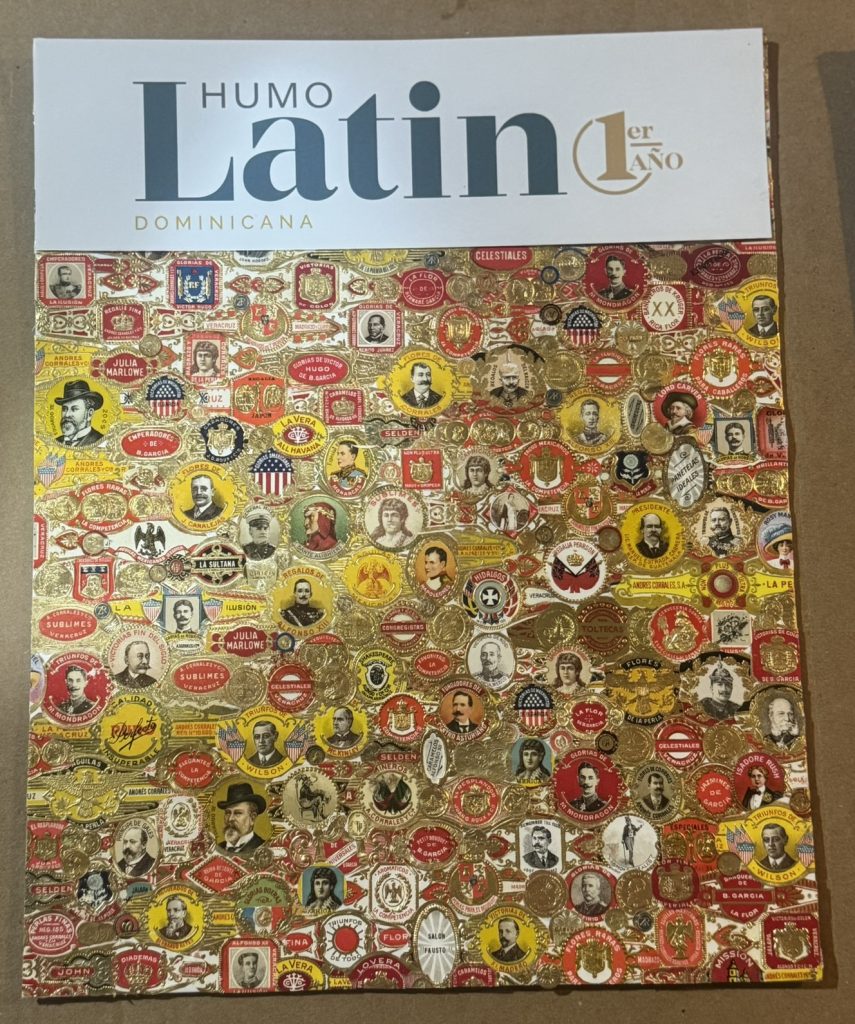
For Robert, the most attractive elements of a cigar band are the textures, the gold applications, and the small medals or coins that many include in their designs. This is something that stands out in the vintage style of the La Perla bands selected to adorn the cover of this Special Edition, pieces that date from between 1889 and 1972, “with majestic details that recall royalty,” Glick shares.
At Art de Fumar, the key to the designs lies in the connection that Robert achieves between each band, pieces that –although they have their own discourse and tell a story on their own– are turned into a single work of art by being brought together as one, “in the same way that the industry becomes a big family.”
When working on a flat surface –as in the case of this cover– Robert’s goal is to work with as many different pieces as possible, making sure each one has its own visibility and space, while maintaining a balance that respects its identity.
In contrast, when creating a 3D work of art, such as the selection we previously presented in the Anatomy of a Piece of Art section, the bands lose their individual identity and collaborate with the overall piece. “Maintaining the authenticity of the piece on a cover like this is a challenge, because the goal is for each band to be present, but at the same time form part of a work with others.”
Palpable Evolution
Throughout his years as a smoker and an artist, Robert has had the opportunity to witness the evolution of the premium tobacco industry through the bands of each cigar he has enjoyed. According to his experience, technology has played a fundamental role in these changes.
For him, the technology used to print them, for the die-cutting, and even for cutting them, in addition to the paper and inks used, all make a difference. He points out that there are particular cases like the bands of Arturo Fuente Cigars or the Diamond Crown from J.C. Newman, which, although belonging to the modern era, retain classic and nostalgic designs.
However, in comparison to the bands of La Perla, the textures and paper thickness are very different and make you feel their historical value when you hold them in your hands and work with them with a subtle touch of the fingers. “What I try to do is maintain a balanced mix of old and modern styles when I design, and with that, in addition to expressing something as a whole, I can tell part of the history and evolution of cigar bands over time.”
In this sense, Robert says that the La Perla bands are an example of a style that has unfortunately been lost in the modern era, and for that reason, he especially enjoyed creating this cover. He took the opportunity as a celebration of a past era within the industry, reserving some pieces in his collection of “oils and watercolors” to continue honoring the past through their inclusion in future works of art.
Paper Art
Robert Glick’s studio resembles a small factory with perfect order. Shelves, drawing tables, and workspaces show all kinds of tools and materials, surrounded by dozens of boxes filled with bands sorted by shape and color, as if they were tubes or pots of paint.
In a way, the objects he covers are like 3D puzzles. “The secret is that I take any band and separate the design elements that compose it, which are of various sizes, and organize the pieces. It’s very detailed work, a process that many people would find tedious and that requires special equipment like magnifying glasses, adhesives, tweezers, and so on…”
To achieve perfect designs without borders or blank spaces, Robert uses small clippings from parts of his bands, and during the process, tiny pieces of paper become scraps that invade and dirty the piece. “And instead of using my hand, I intentionally chose to use a paintbrush to clean the surface. With that detail, I create a sensory connection that makes me feel like a painter. It’s the way I express my intention.”
Once the bands are placed, the coating depends on the piece. For example, on an ashtray, he uses a heat-resistant epoxy resin, and on glass pieces, he sometimes adheres them from underneath and then covers them in a different way. He sprays boxes and other objects with matte or high-gloss lacquer, and when he wants the textures to be felt –especially when he’s using bands that contain reliefs and a lot of artistry in their design– he follows a different process.
This is the case with lighters and cutters. He protects them so finger oils don’t ruin them, but if he’s working on a table or a chessboard, he looks for a mirror finish, a leveled surface, that allows them to continue being used for their original purpose. “I feel that each band must be in a certain position that I cannot predetermine. It’s as if they were guiding me, and that’s why I sometimes play a game of cutting a piece and waiting for it to tell me where it wants to be.”
Among many other things, he has covered musical instruments, furniture, masks, shoes, hats, posters, paintings, ceramic figures, antique objects, toys, clocks, and even created advertisements for cigar lounges. When asked directly, he responds that each work is like a child, and although he is very satisfied with his trumpets, shoes, and flags, if he had to choose just a few, the chessboard would definitely be among his favorites.
Robert works alone, with the television on in the background, and when he is not in his role as a lawyer, any place is good to develop his art: the waiting room of an airport, or while traveling on a plane… “in hotels, I get up every morning and work on something, because it’s what I love to do.” In fact, it is his habit to “keep six or eight projects going at once,” because each one requires its own time to be analyzed, to make changes, and even to be discarded. “There are pieces that can take me hours, while others need several months.”
Robert Glick is a perfectionist who performs delicate work with a steady hand and a lot of patience. He is an artist whose greatest pleasure is to observe and listen to the impressions his pieces awaken in people, “because there is no greater reward than enjoying what you do when others enjoy it too.”
For him, working with the La Perla bands was a special challenge because of how old they are and the delicate paper, which, beyond its age, is a finer and thinner material. “A special mention must be made of the fact that there are no more of them, and while I work, I also show respect for their history. Speaking of modern bands, they can be obtained very easily, but that possibility does not exist when you work with such old materials.”
Finally, Robert says he is satisfied with the result obtained for this cover, both as a piece of special edition work and for what it represents as a reflection of the industry, of the different manufacturers, as well as of his passion and performance as an artist.