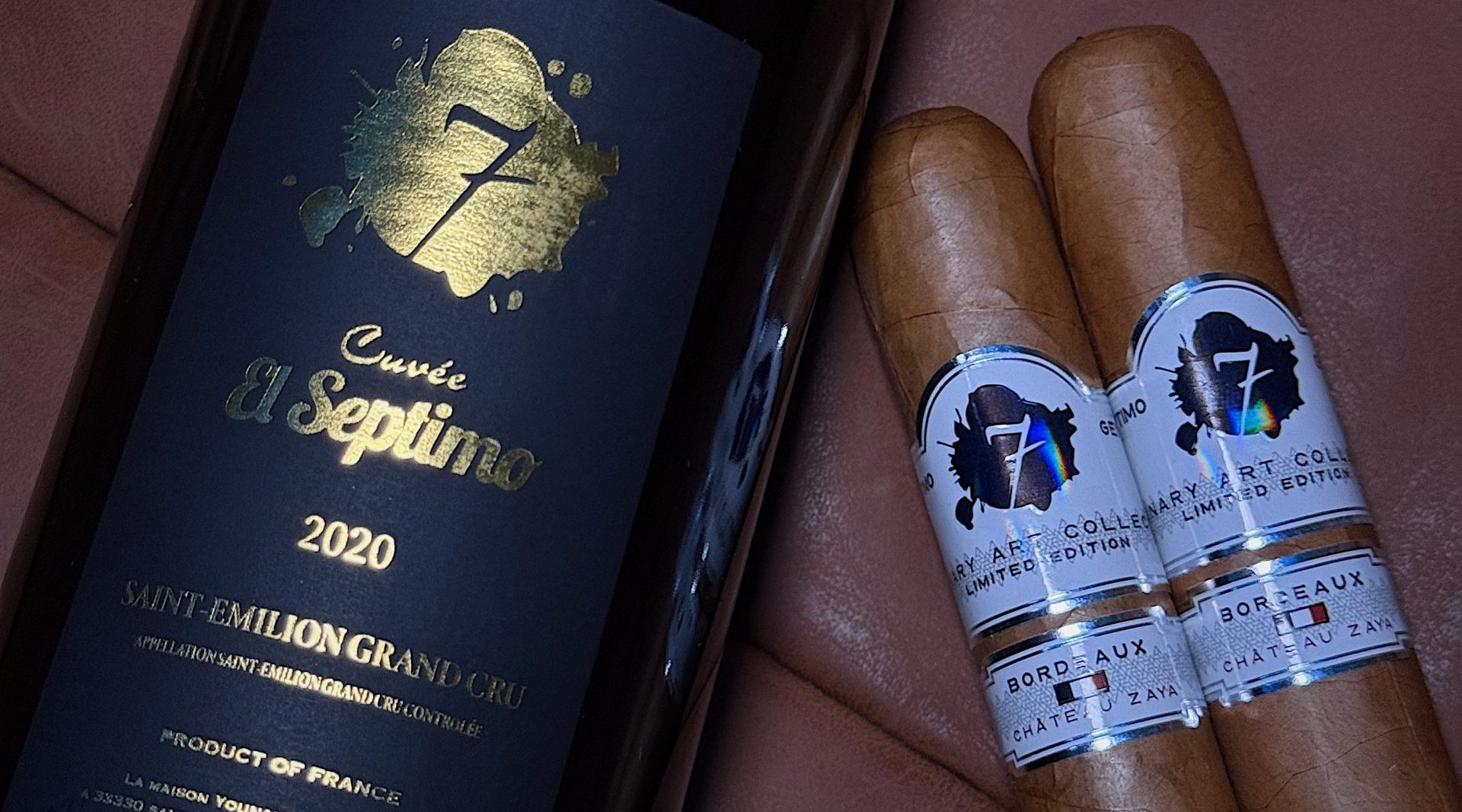
Few arts dialogue as naturally as wine and tobacco. Though they are born in distinct territories –one on temperate hillsides and the other in tropical lands– both share the same calling: to convey the voice of the earth to the senses. Terroir, time, and the human touch converge in both. The vintner and the master blender work under parallel principles: observing, interpreting, and revealing, rather than intervening. Their task is not to create flavors, but to allow flavors to express themselves.
Read in the magazine (rotate your device for a better reading experience):
Cándido Alfonso
Smoke Columns
In wine, the grape is shaped by the season, altitude, soil, and climate of a specific year. In tobacco, the leaf responds to the humidity, the sun, the fermentation, and the care with which it is cured and classified. In both cases, origin is not a technical detail but the starting point of an identity. From this comes the complexity of a Bordeaux or a Tuscan wine, just as it yields the depth of a tobacco from Vuelta Abajo or the Dominican valleys.
But their parallelism goes beyond the raw material. Both arts rely on patience. Wine requires resting in the barrel and bottle to achieve balance; tobacco needs long fermentations, delicate curing, and aging that smooths its edges. Time is an ally, never an enemy. Nothing is rushed because accelerating would be betraying the product’s essence, and every minute of rest adds nuances; it is the silent science of flavor.
The language is also shared. We speak of body, bouquet, persistence, and evolution, the finish. A wine can open with fruit and close with leather or earth; a cigar can start with creaminess and end with deep spice. Both are read in sequence: sip by sip, third by third. One who knows how to taste a wine understands the smoke; one who knows how to smoke a puro understands the glass.
In recent years, this natural bond has begun to be explored with greater intention. El Septimo, for example, not only experiments with tobaccos aged in wine barrels but also belongs to the same group that controls Vignobles Younan, a collection of wineries in Bordeaux and Saint-Émilion. This coexistence between vineyard and cigar factory is not an artifice or a marketing strategy, but an immersion in both traditions from the inside. When the same company works with the vine and the leaf, it better understands the sensitivity that both require; it understands the importance of the vintage, the climate, and the wood; it recognizes how time transforms and softens, and it discovers, almost inevitably, how these two worlds reflect each other.
It is not about mimicking a wine in a cigar or turning a wine into smoke. The goal is more subtle: to explore the dialogue between two arts that share the same search for balance, depth, and emotion. Wine teaches that flavor is a journey; tobacco confirms that this journey can also be written in smoke.
Perhaps that is why, when both meet in the same ritual –a glass poured calmly, a cigar lit without haste– a harmony emerges that is difficult to replicate. They are arts that celebrate time and pause. They demand attention, invite conversation, and encourage introspection. In a world that runs without rest, both return us to the natural rhythm of the sensory experience.
Wine and tobacco remind us that the best experiences are not consumed, they are lived. They are discovered with patience, interpreted with sensitivity, and appreciated with respect. As long as there are hands that devotedly care for the vine and the leaf, we will continue to find in both not only pleasure but a cultural and emotional bridge between people, lands, and traditions.
Two distinct arts united by the same heartbeat.
Suscribe to our Newsletter