He graduated as an engineer in Cuba, his native country, where –through internships and work in sugar mills– he learned about the fermentation and distillation processes for rum production; a spark that ignited in Misael Plasencia the desire to produce a spirit under his own brand at some point in his life: Zarova Vodka.
That idea had to wait more than two decades, as he and his wife, Neydis Rojas, arrived in the United States on February 19, 2003, to settle in Florida. There, as a team, they found the possibility of a successful career in Real Estate, and thanks to that, Plasencia Enterprise Group –their master company– now presents Zarova Vodka, a brand with premium expressions aimed at the high-end market.
Read in the magazine (rotate your device for a better reading experience):
The Road to Vodka
As an idea, the project started towards the end of 2023, but it was the following year when they decided to produce a Cabernet Sauvignon red wine with a company in Napa Valley, California. The goal was to gift it to their clients and friends, who encouraged them to commercialize it. But although they had a name, Bodegas Plasencia, they lacked a label, suitable bottles, and the corresponding permits.
In an effort to advance the process while completing the paperwork, they considered including a rum or a tequila, but through the wine houses and distilleries, the opportunity arose to produce vodka with an individual Misael describes as a “master of spirits.” With him, they devised three expressions of the drink: based on corn, blue agave, and French grapes.
Although vodka is traditionally obtained from grains or tubers, Misael explains that any fruit or element that ferments and produces alcohol can actually be used. “It is true that Russian vodka, the most famous, uses potatoes. But with the extinction of the Soviet Union and the loss of the Designation of Origin, this spirit is made in different ways and in various countries.”
A vodka is considered good from four or five distillations, “but ours are distilled eight times, and we use state-of-the-art filters certified by NASA (National Aeronautics and Space Administration). So we are several levels above in terms of distillation and filtering.”
Premium Category
According to Misael, for their corn vodka, selected grains with gluten-free, kosher certification, and genetic integrity guarantee are used. The blue agave vodka is processed in Tequila, Jalisco, Mexico, and the grape vodka is obtained from fruit in the Champagne region, France, where it is distilled. The latter two possess a Designation of Origin.
The blue agave vodka is a novel product. “We are the first to bring it to market at this level, as in Mexico, white tequila is typically distilled twice –regardless of whether it is later reposado or añejo. Ours is distilled eight times to turn it into vodka, but it retains the characteristics of tequila, with those notes of pepper, earth…”
Regarding the Champagne grape vodka, people ask him if it has bubbles. “I have to explain that no, because it is a vodka and not champagne. In fact, I would say it is very suitable for women, because it is a soft expression that appeals to those who are not accustomed to drinking strong spirits.” However, like the corn and blue agave expressions, it has 40% alcohol by volume (ABV).
Unlike many vodkas used for mixing or in cocktails, those from Zarova Vodka were made to be drunk neat. “They don’t burn or feel unpleasant, but are slightly softer, sweeter, or fruitier, yet at the same time distinct. Most people, even those who aren’t experts, try them and say: ‘Hey, I like this one, but it has nothing to do with this one, which I also like, and this one too, and it has nothing to do with the other two.'”
A Perfect Dressing
As part of product development, Misael took on the task of designing a bottle in parallel. He says that in addition to consulting antique books, for months he visited the main liquor stores looking for ideas, but found nothing because, in the case of vodka, all bottles are similar: simple and even using the same tones. So he took pen and paper to draw something different.
He took the idea to an industrial engineer, who created the 3D model and determined its capacity. But the desired result, due to its complexity, could only be obtained from perfume packaging manufacturers. So he had to find a supplier in India –a country famous for the development of this industry– who is also involved in making their boxes. “These bottles are unique, patented, and made of blown glass. There is nothing like them on the market,” he affirms.
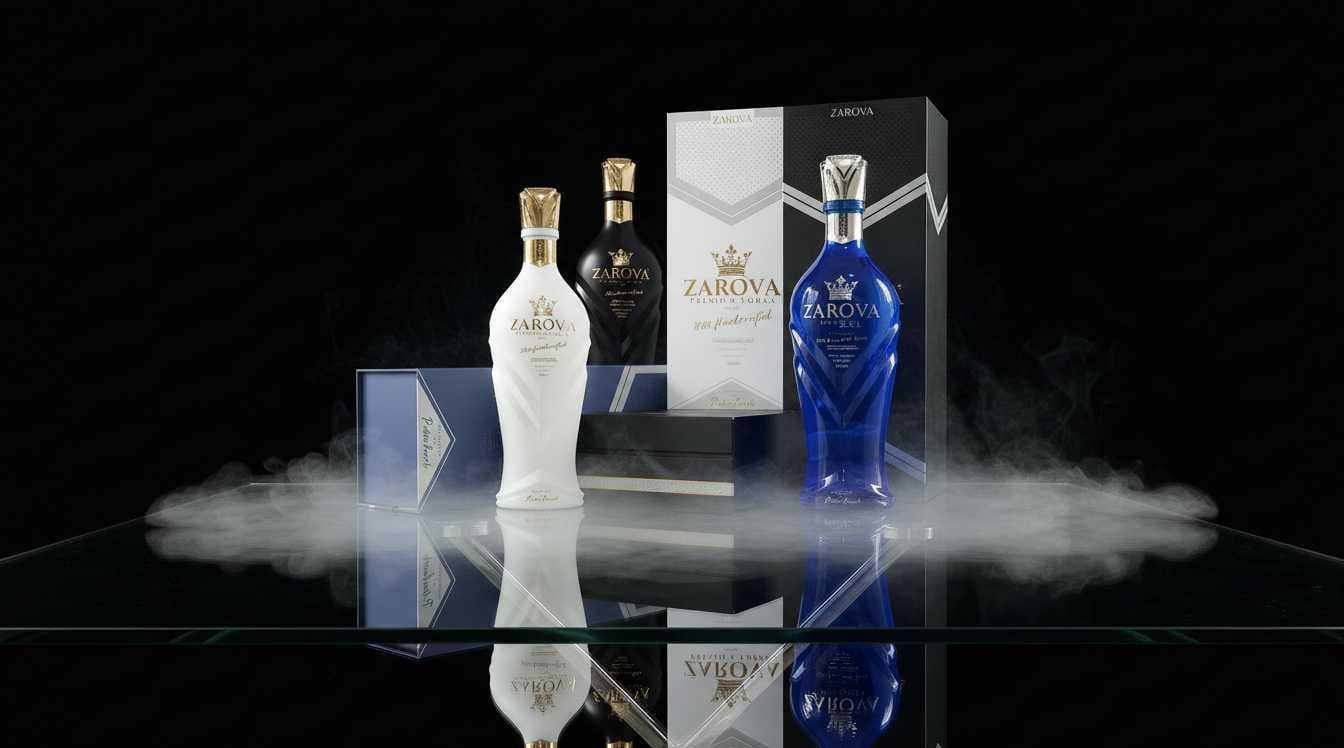
During the nights and early mornings, due to the time difference, he supervised the process of creating the bottles and packaging. When agreeing on the final colors of the samples, he requested a blue, a black, and a white one, which, upon arrival, he decided to keep exactly as they were –advised by his wife– to give each product its own identity: Black for the corn vodka; blue for the blue agave; and white for the champagne grape vodka, with silver or gold elements, as the case may be.
The design, based on inverted triangles, lends itself to subjective interpretation: “It’s like standing in front of a painting; everyone can see something different. I simply liked it, and I ended up devising a cap that fit the same idea,” Misael adds. A QR code appears on the label of each piece, leading to the storytelling, information on its contents, and corresponding certifications.
Inside the boxes, where luxury also predominates, information on the three expressions is visible. “That is to say, if you buy one, you have two more to buy. It’s really like a collection that we wanted to imbue with that touch and take the product to total luxury.”
Name and Market
Misael relates that Palm Beach –where his company is based– has served as a refuge and retreat for former presidents of many countries, or their families, who came to the United States under different circumstances. A tale that survives in the area is that the youngest daughter of the last Russian Tsar, Nicholas II, was brought in 1917 by an escort or military close to the ruler to save her life.
Although the story is not real, it is assumed that she remained there under another name until her death in the seventies or eighties, and that she was known as Zarova. “True or false, this belief persisted in the collective imagination, and the name seemed interesting to me. Beyond the fact that our products are not Russian, they do have that origin.”
This nominal link to royalty or magnificence “is what identifies our products in their unique character. I define them as the blue label of vodkas; the drink you buy as a gift and share with the person gifted. It’s not just a bottle and a box, but something of excellence, with a high profile, which implies luxury and enjoyment.”
Therefore, its distribution is handled by renowned companies that place high-profile beverages in yacht clubs and private airports across the United States, as well as exclusive online product stores and liquor stores that cater to these market segments. Similarly, they are presented through tastings at private clubs, cigar lounges, and major festivals.
Shared Future
Neydis and Misael have been together for 26 years, and as a team, they complement each other in business development, marketing, and administration. They share the vision and mission of bringing Zarova Vodka to Dubai early next year. “We are already in negotiations with a company, and in the same way, we will seek to enter India.”
He maintains that currently, “Dubai represents the highest luxury market on the globe, and it is important to be there because although Arabs do not consume alcohol, tourist traffic is very high and experiencing constant growth. In the case of India, its population quadruples that of the United States, and as an emerging country, it is poised to be a powerhouse in the years to come.”
Furthermore, he announces that during 2026, they will launch a fourth expression of Zarova Vodka, made from potatoes grown in Idaho, and Bodegas Plasencia will revitalize wine production, not only with their Cabernet Sauvignon but by expanding the lines to a white, a rosé, and a blend. The company’s growth also contemplates the inclusion of a 100% agave tequila, called Gran Zafiro Azul, in its blanco, reposado, and añejo versions.
Thanks to the path traveled and the experience gained with their first premium products, Misael and Neydis decided to continue working on their new projects in the so-called luxury sector. They clarify that this does not imply disregarding the rest of the market sectors, but a taste for maintaining the level of excellence in the beverages, their presentations, and everything that entails.
Suscribe to our Newsletter