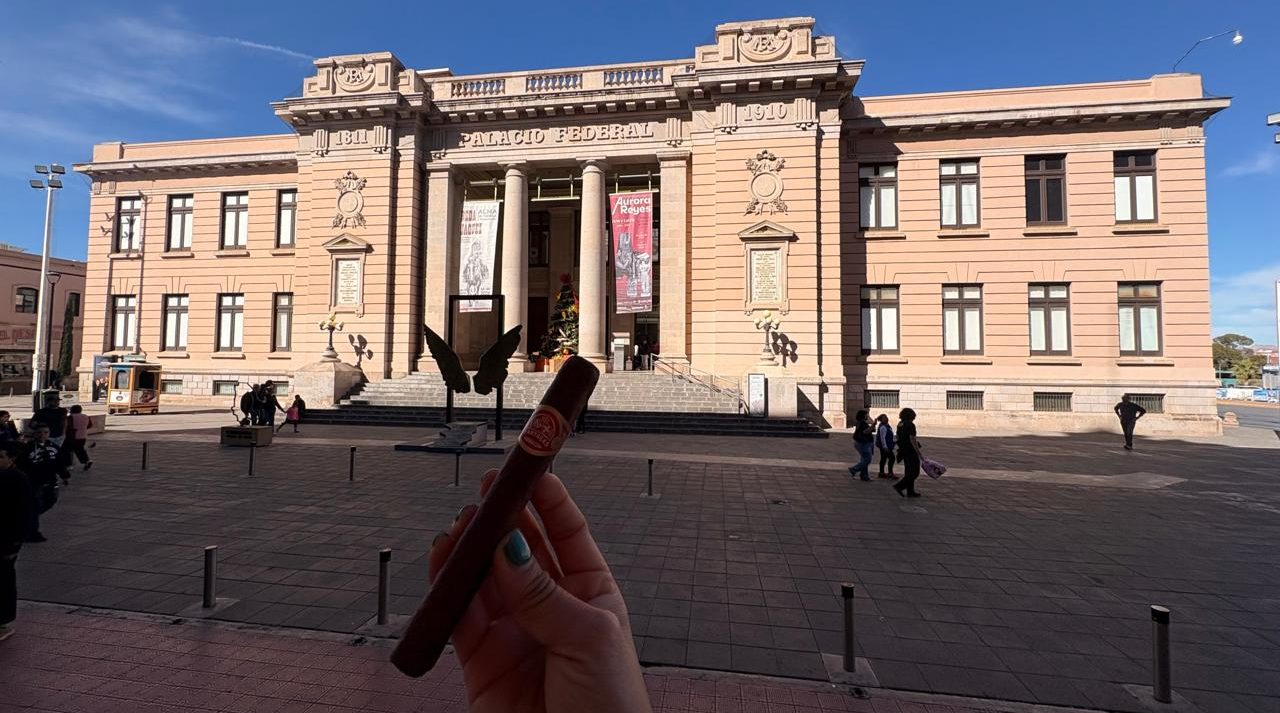
Among the mountains, the desert, and the nobility of those who inhabit my state, we begin the first column of this 2026. A Northerner at heart, Chihuahua undoubtedly represents the noblest meaning of the word “origin.” Just as the start of a year leads us to reconnect, this journey marks the union between my roots and the love for my family –much like Cuban tobacco represents the origin and the love of an entire country for its national emblem: the Habanos.
Read in the magazine (rotate your device for a better reading experience):
Sofía Ruiz
Master Habanosommelier
Madrid, Among Smokes
Founded on July 6, 1824, Chihuahua is the largest of the 32 states that make up the Mexican territory. Spanning over 247,000 square kilometers, it is divided into 62 municipalities; its territory is so vast that it would cover half of Spain, or entire countries like Romania, and even more than two if we combine, for example, the territories of Austria and Ireland.
Bordering the United States –primarily Texas– life is always lived with “el otro lado” (the other side) in mind, as residents of border regions call our neighboring country. Living and growing up here creates a mixed culture that intertwines customs from both sides.
I still remember my Christmases, running around on December 25th because Santa Claus arrived with gifts and the turkey was ready for the recalentado (leftovers), while on January 6th, Three Kings Day, most of us children would receive coal, as that tradition and celebration are more prevalent in central and southern Mexico.
We light the first Habano of 2026 at Casa Chihuahua, a museum located in the heart of the capital city’s historic center (of the same name), dedicated to preserving and promoting the history of this great territory. Within the walls and ceilings of a European-style building that originated as a school during the colonial era, I began a tour that led me to value my Chihuahuan roots and identity even more.
I have always said that the people of Northern Mexico are like its climate: extreme, very similar to the city of Madrid, with intense summer heat and cold winters with snowfall. We are warm and welcoming, but we also anger easily and “explode” like a Chihuahua dog –a breed which, by the way, originated precisely in our Sierra Tarahumara.
On some of the museum walls, videos are projected showing the state’s different climates and zones. The emblematic desert lies between the Sierra Madre Occidental and Sierra Madre Oriental and is the largest in North America, extending into New Mexico, Arizona, and Texas.
The desert is harsh. However, it is not a place devoid of life; it is inhabited mainly by birds, reptiles, and rodents. The most famous tourist area is the Samalayuca Dunes, where sports like sandboarding are practiced, with competitions drawing many locals and tourists, especially during Holy Week.
Water scarcity is a constant factor, particularly for livestock ranching, one of the state’s main economic activities. The average annual rainfall is only 200 millimeters.
The videos showcase sandy and mountainous areas such as the Santa Elena Canyon, the Pegüis Canyon, and the Naica Mine.
The state’s origins lead us back to the great Sierra Tarahumara. Pre-Hispanic cultures in Mexico were divided into two regions: Mesoamerica (home to the most prominent civilizations, like the Mayans and Aztecs) and Aridoamerica, where despite extreme weather and infertile soils, some of the territory’s first civilizations developed.
In Chihuahua, there are four indigenous peoples: the Ódami (Northern Tepehuan), O’ob (Pima), Ralámuli or Rarámuri (Tarahumara), and Warihó (Guarijío). Distributed across the Sierra Tarahumara –which covers 64,000 square kilometers in the western part of the state– each has its own language, territory, and customary laws.
The Tarahumara ethnic group is the most representative. Dressed in their beautiful and colorful attire, they also reflect my family heritage. My great-grandfather, a native of Batopilas –a small town nestled between two canyons– belonged to this people, whose name in Spanish means pies ligeros (light feet).
Their people are famous for running great distances, and some have excelled in international marathons. An example is the great María Lorena Ramírez, who runs in huaraches (traditional sandals) and has won competitions like the Gran Ultra Trail Cerro Rojo; in 2025, she became the first indigenous woman to receive the National Sports Award. In fact, Netflix produced a documentary about her story.
Yet they do not run only for a prize. Between the cliffs and endless trails of this mountainous zone, they do it to survive and perpetuate their culture and traditions.
Ancient civilizations managed to survive thanks to the type of constructions they developed and the occupation of caves. One of the best-known archaeological zones is Las 40 Casas (The 40 Houses), a magnificent site of the Paquimé culture (1205–1260 AD) in the Casas Grandes region. There is no certainty regarding the exact period it was inhabited, but some remains suggest human presence from more than 12,000 years ago. One can still see the dwellings inside the caves: very small houses that protected them from the extreme cold.
After touring these rooms, I thought about our evolution as a society, for better and for worse. On one hand, we have achieved a connected world thanks to technology, but we are also a more selfish society, self-centered in this technological jungle called the Internet.
In ancient times, teamwork was necessary for survival. What if, for this year, we aimed to evoke this principle in some way? Perhaps each of us can contribute a grain of sand and end the year with a different perspective and a sense of empathy (a word that is very difficult to turn into reality today).
If you visit Chihuahua, do not miss the chance to travel through the Sierra Tarahumara, to marvel at the Copper Canyon Park (Barrancas del Cobre), discover the Basaseachi Waterfall –the tallest in Mexico– and stroll along Lake Arareco. These sites show the soul and spirit of the mountains.
The next space in the museum brought me to an encounter with the Old Continent. Europeans arrived in 1530, and the first Spaniard to have contact with this region was Álvar Núñez Cabeza de Vaca, who described the mineral wealth he observed in his chronicles. From then on, the state acquired an identity based on that industry.
I had some notion of the importance of mining for the city, but I was unaware that some towns developed entirely because of it. Cities like Santa Bárbara, San Francisco del Oro, and the most famous, Hidalgo del Parral, which owes its fame to the La Prieta Mine, named for its massive silver production that earned it international renown.
But another figure put Hidalgo del Parral on the historical map: José Doroteo Arango Arámbula, better known as Pancho Villa –who was killed during an ambush in this city. An emblematic leader of the Mexican Revolution, he was a brave man who, to the sound of gunfire, led the north of the country in the social movement that overthrew the dictator Porfirio Díaz.
This is why I say that the people of Northern Mexico are strong, resilient, and of intense character.
After finishing the first floor, I headed to the basement to explore the heart of Casa Chihuahua. Speaking of representative figures, through a dark path between stone walls lies a small room where Don Miguel Hidalgo y Costilla, the Father of Mexican Independence, was imprisoned shortly before his execution by royalist troops on July 30, 1811.
Some of the hero’s belongings and documents are kept here, along with two bronze reproductions of the verses he wrote with a piece of coal on a wall the night before his death, thanking his jailers for their kindness. Also present are a crucifix, the cot, the table, and the candelabra used by the priest.
Chihuahua is not as internationally well-known as Cancun, Guadalajara, or Mexico City, but it has been the cradle and refuge of great men who forged the country’s history. Because of this, the people of the north carry a light in their souls and eyes that shines in moments of resilience.
Local culture is reflected in clothing, customs, and lifestyle. Livestock ranching, the engine of the economy, brings with it the Northern “cowboy style” tradition. I still remember coming home and seeing my father in the afternoon with his boots, or my grandfather with his hat when going to Mass on Sundays.
Ranching in this territory dates back to the 16th century, when Christopher Columbus introduced the first horses, cattle, and goats to America. Starting in 1519, livestock expansion began, and during the 17th and 18th centuries, Jesuit missions consolidated this activity, which keeps Chihuahua as the national leader in cattle exports.
The cattle production base consists of a herd of over one million head, with 19 municipalities providing 78 percent of production. This has been favored by the export market and geographic proximity to the United States, which has oriented producers toward breeding high-genetic-quality livestock.
There is a pinnacle festival for ranching in the state and its cowboy culture: Expogan, which brings Chihuahuan society together for cattle exhibitions, rodeos, games, and concerts. Naturally, everyone wears cowboy or western attire, which originated precisely on the Chihuahua-Texas border.
One room in Casa Chihuahua displays the painting collection Alma de Tierra y Tradición (Soul of Land and Tradition) by Beda Jáquez, who captures rural life and ranching, as well as the identity of the cowboys –figures who become symbols of nobility and perseverance, described in the following lines:
“Between dust, sweat, and courage, the cowboy does not stop. The lasso spins, the horse responds, and the gaze announces he is ready. In the ring, there are no pauses or waiting: every moment demands a decision. The cowboy knows there will always be a new challenge, a new catch, a new horizon.”
Filled with emotions and memories, I left this great manor and closed this journey through my origins at home, surrounded by family –the engine of my life. Night caught up with me, and I chose to accompany it with smoke that reflected that same intensity. What better than the strong blend of Partagás? With every puff of a Mille Fleurs, I enjoyed the woody and spicy flavors of a Habano that presents itself frankly on the palate and announces the arrival –especially toward the final third– of the true heat of Cuban flavor.
Its character and strength remind me of the gaze of the Chihuahuans, my roots… And as the song goes: “How I love the eyes of that dark-haired girl / Just looking at them, my soul rejoices / See you there, through the streets of Chihuahua…”
Suscribe to our Newsletter