MAKING FRIENDS INTERNATIONAL
A PERSON, A CHARACTER, A FRIEND
“I sacrifice myself daily for my personal and spiritual growth. I don’t want to be someone else, I want to be myself.”
I have a habit, almost a self-imposed obligation, of personally meet those people we contact through social media. Now, my instinct tells me that this person has something more, much more.
My story with Rigoberto begins with the contact of a friend. He was the one who pointed me toward a character who immediately caught my attention: Rigoberto Carceller.
Read in the magazine (rotate your device for a better reading experience):
“He captivated me from the first conversation with this phrase: ‘It is the mark of a good person to be grateful.'”
He is cultured and fond of quotes and phrases full of meaning. As if in each sentence, he wants to make you reflect on life, the good life, and the search for inner peace.
Rigoberto is a cartographer. He arrived in Spain in 1993 at the age of 29, thanks to efforts made by Manuel Fraga, the Spanish and Galician minister. Because of this, upon arriving in Spain, he settled in Pontevedra (Galicia). Today, he lives in Madrid and is a sommelier.
But I don’t want to get lost in an easy narrative of compiling data and résumé quotes that, by the way, are already on the internet. Because the Rigoberto of today is nothing like that past. In a simple enumeration of his long history as a political activist, I am left with this reflection:
“Since I am so committed to my neighbors and citizens, I always got into trouble. I couldn’t see an injustice and just stand by or look the other way. I always got involved in all the messes, and I was arrested many times.” Another problem in Cuba is “speaking your mind.” “And since I can’t lie and I’m very critical, more problems.”
EL PATIO DEL INDIANO
“I don’t make artificial smiles”
The Indiano in La Palma Island has a special meaning. In fact, the third Monday of February is celebrated (within the winter festivities or Carnivals) as the Fiesta de los Indianos.
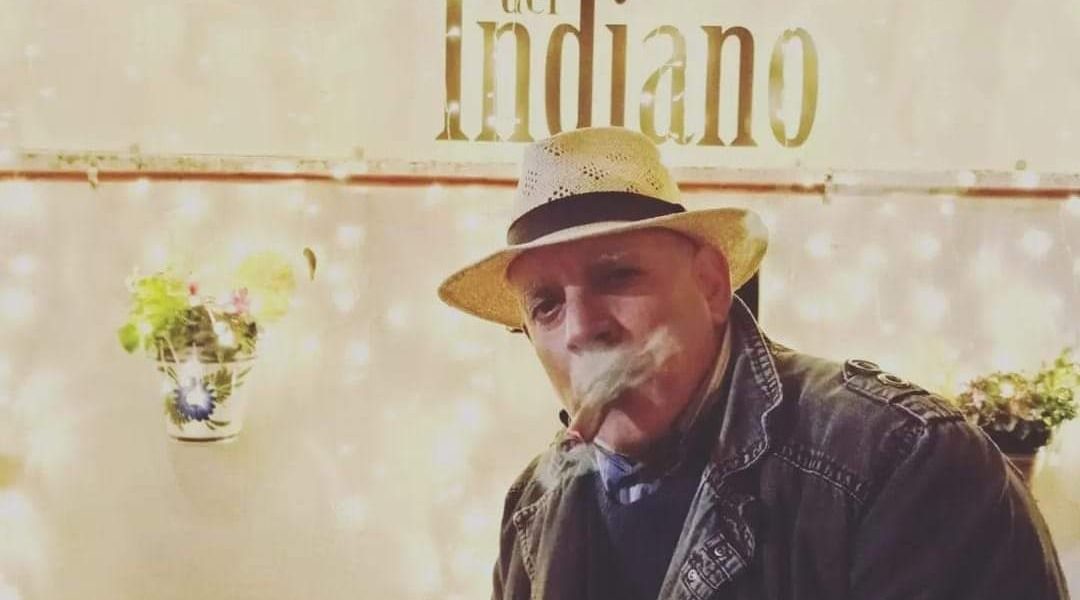
The psychotavern El Patio del Indiano –as he defines it– and the wine culture were the birthplace of El Capellán de las Indias.
El Patio del Indiano is a space for cultural events, concerts, academic presentations, tastings, and pairings. And all those things that always make us feel magnificent and transport us to another dimension of good living.
“My Patio, psychotavern, I manage it day by day. I don’t make plans. There are always artists and different people from the cultural or academic fields who propose things to me. I live off my work and I don’t have ambitions. I have projects. Today, I will enjoy what I’m going to take with me.”
This feeling makes me agree to meet, and I travel to Madrid for a live encounter, to see each other and look into each other’s eyes. If he had already conveyed to me –in our video calls– his calm, tranquility, vision, and experience of moments that must have been hard to bear, to live, now it was even stronger. Always offering a positive take, a philosophical quote to remember and keep growing, personally and spiritually.
An exercise only a few know how to do. The live conversation feels too short, and we both agree that we will need more time to enjoy moments and cigars.
THE GREETING RITUAL and THE CAPELLÁN DE LAS INDIAS
“The wise man forms himself.”
Rigoberto is culture, he is spectacle, and above all, he is the one who creates the good moments. From the start, he makes the visitor feel enveloped in his aura of carefree joy, shared happiness. There is an overwhelming desire in the air to make you have a moment of fun, a break from constraints, where the main rule is not to be boring or “bring problems.”
“Choosing friendships wisely and knowing how to detect superficiality are the foundation of my life today.”
His welcome ritual is a Cuban Santería custom; starting with a greeting that has much to do with tobacco: “It is about blowing the smoke towards the companion to attract good spirits.”
WHEN AND WHY YOU SMOKE A CIGAR
Smoking by the book or smoking freely.
“These moments are what we take with us from this life.”
Tobacco brought us together, and it was the bonding agent that moved us to enjoy each other’s company. I smoke cigars to have a good time, whether alone or with company, and Rigoberto:
“I first started smoking cigars at 18 with my father. I seek very personal and spiritual moments to be with myself, although most of the time I like to smoke with friends. It’s an excuse to share a relaxed, deep conversation and enjoy affinities with friends.” “But above all, I smoke for pleasure, I smoke to feel free. I don’t share the smoking of trivialities or ostentation of smoking cigars. For me, it’s more of a spiritual act, whether alone or with friends.”
Smoking invites us to stop time and enjoy spaces. Spaces that are increasingly restricted, so when you manage to be in a space with no restrictions to smoke, you unlock all the muses of the soul. Whether alone or with company.
CUBA vs CANARY ISLANDS
The Eternal Challenge
In the Tobacco World, talking about Cuba means talking about the Canary Islands. And talking about the Canary Islands means talking about Cuba.
A Cuban cigar, Hoyo de Monterrey Serie Le Hoyo Robusto, versus a Canarian cigar, Un Gran Toro from La Rica Hoja Tabaco.
The conversation lasted two short hours, which barely allowed us to review the evolution of the tobacco that accompanies us. Pedro diving deep into the soul, letting the cigar just be a complement, something we didn’t pay much attention to because Hoyo de Monterrey and La Rica Hoja share common roots and “don’t disagree,” they complement each other.
Clearly, this conversation wasn’t about tobacco; it was just an excuse to get to know each other better and compare Cubans and islanders, but as people: I notice that the Cubans here on my island have a very acceptable cultural level.
Rigoberto: “60% of Cubans come from European, Spanish culture. And 40% are black and were slaves, now low-level workers.”
Time flew by, and we’ll let the next time be the one where tobacco occupies our thoughts. This time, I take with me a piece of a warrior’s heart and a clean, loving soul, full of love for others. A friend of friends, open like an abandoned prison, where walking through each corner of the old building tells you a lot and evokes memories. Memories that today bring only good things.
“My life is marked by the search for truth and justice.”
“You are reborn with wounds, that sets the rhythm of my life.”
Good smokes and “I no longer defend illusions. I’m tired of unfulfilled promises.”
A PART THAT IS NOW HISTORY
“I owe my liberation to the Cuban church. A Cuban bishop friend. When Felipe González was in power in Spain, he was more of a friar than a bishop. Due to his austere life and dedication to seeking good for others.
He handled the arrangements for me to be ‘freed’ since, in reality, I was deported or ‘invited to leave Cuba.’ They used the most visceral and infallible blackmail: to meet with my family and make them realize that all my troubles were dragging them down too and that the best thing was for me to leave Cuba. Because I never wanted to leave, and my intention was to keep fighting against injustices.”
THE ANECDOTE OF HIS WEDDING
He has a wife, Idamis, three sons, and a daughter. He married her in a Cuban prison, bypassing obstacles. When he entered for a visit, along with his fiancée, there was also a priest.
“I told her: we’re getting married today. I had arranged the ceremony with a priest friend, and we took two passersby who happened to be there at the moment as witnesses.”