Cigar box guitars have a deeply American origin: they were born from the need of impoverished people to create music in the face of adversity; built by the first British settlers, African-American slaves on plantations, and soldiers during the American Civil War and World War I, they sought to combat nostalgia and maintain morale.
Before 1864, cigars were sold in barrels or loose bundles. The United States government enacted the Revenue Act of 1864, which forced cigars to be packed in wooden boxes of 25, 50, or 100 units to facilitate tax collection.
The first cigar box guitar was the Diddley Bow, made with a single string, a metal wire tensioned over a stick, using a cigar box as a resonator. The secret was cedrela odorata, cedar, a light, porous wood with a magnificent natural resonance.
The guitars born from the spirit of the Diddley Bow sowed primitive blues, the Delta Blues; they were played with a glass bottleneck or a knife, generating that typical metallic sound.
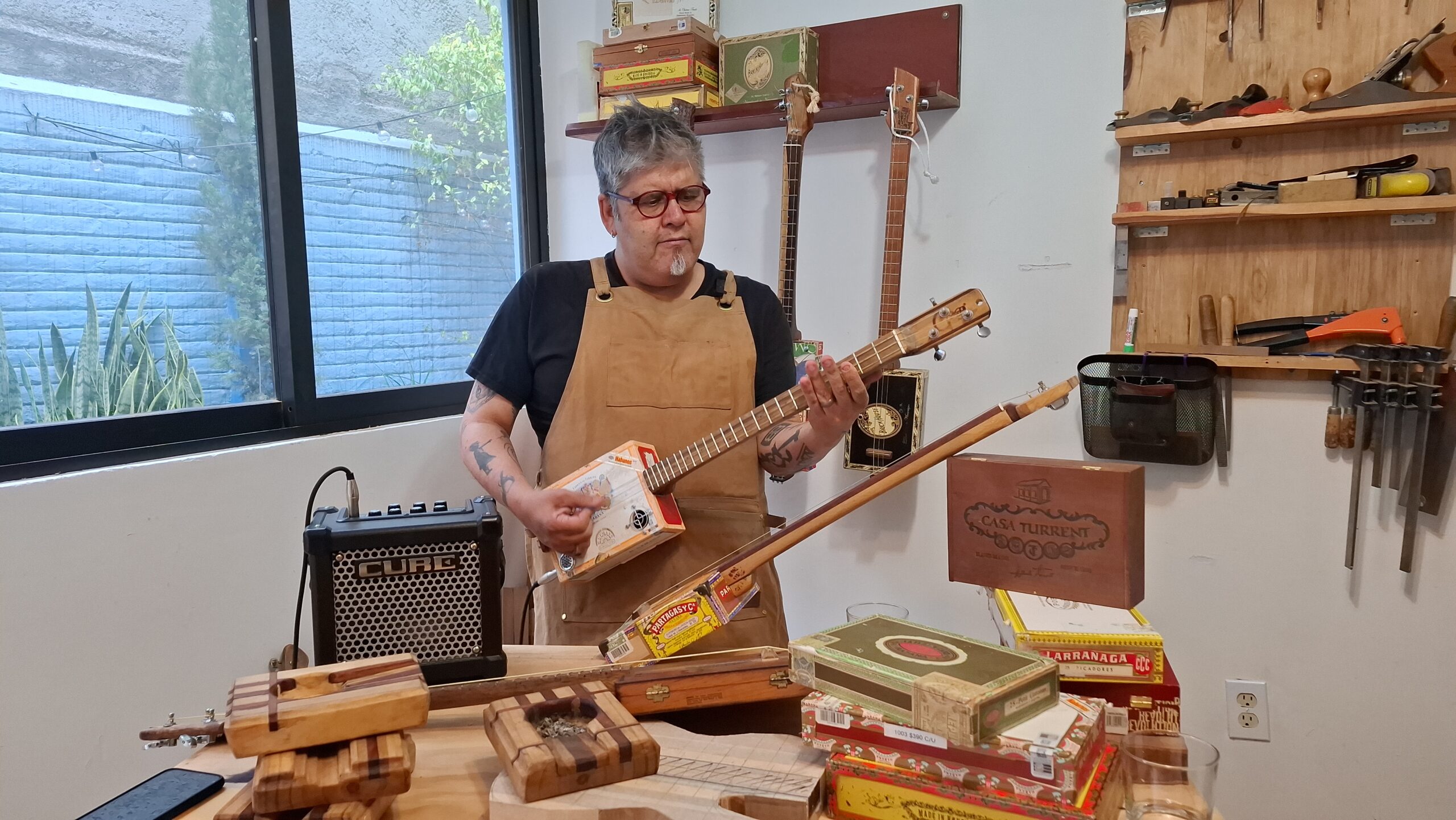
In Mexico, I met a luthier who makes cigar box guitars. His name is Ricardo Toledo Saucedo, he lives in Mexico City, he is an advertising editor, and he says it all started with a midlife crisis at 40, a hand saw, a Black & Decker jigsaw, and two cigar boxes that were sold to him for 30 pesos at a tobacco shop.

Sound Archeology
Ricardo was born and raised in Mexico City, he is 57 years old, works as an advertising editor, a frustrated rock musician, studied the organ, plays guitar, bass, and some piano; he is a father and a man who learned to practice detachment by burning wood at the end of every year. But above all, he is an artisan who transforms an object that lost its purpose of holding cigars into a musical instrument full of history and resilience.
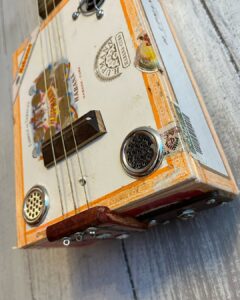
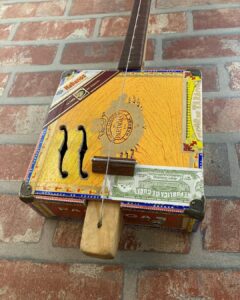
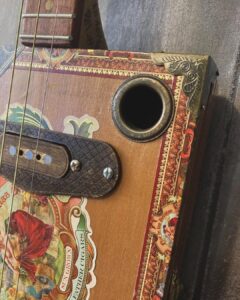
My “midlife crisis at 40 was making guitars,” he says as he remembers how it began. Ricardo wanted to have many guitars, so he started making them by watching YouTube videos, using the carpentry knowledge his father passed down to him. It was one Christmas when he wished for his first guitar, a Strum Stick, which is practically “a little three-string box,” and he ended up making it himself. Interviewed in his workshop, he says that the first guitar he made didn’t work and he almost gave up on continuing, but then came the second one, made without pretensions, and that one did “sound really beautiful… This isn’t just carpentry, it’s a kind of sound archeology where the sound isn’t manufactured, it’s rescued. They are not mass-produced. Each box sounds different. They are unique and unrepeatable.
A Fender or a Gibson are mass products of impeccable engineering; Cigar box guitars, on the other hand, are imperfect by design, they don’t seek harmonic perfection, but rather emotion.
Making these Cigar box guitars “is my love, it’s what I can give to life in response to the skills it gave me. That’s why all the guitars I’ve made are worth more than they cost; it’s my participation in this world.”
Fantastic Zoology
Through his life passes a fantastic series of characters like Jack, a Polish living in Chiapas whose magical appearance straddles the line between Harry Potter, Gandalf the Grey, and a 1970s Californian hippie with a velvet shirt, a top hat, and long, red hair.
“But nobody has made my guitars sound like that bastard. He played every single one I brought that day to sell. He chose one, paid for it via PayPal. And that’s it, he’s probably in Poland playing right now.”
Or the story of a renowned oncologist who rides a Harley-Davidson and has a habit of playing blues with a cigar box guitar for his patients before administering their flu vaccine.
And within this web that was being woven, Ricardo connected with Jonás González from the Mexican rock band Plastilina Mosh, for whom he built a rustic, crude, solid-body guitar that Jonás himself affectionately dubbed the Tabla de Picar (Cutting Board).
Equipped with a 1969 Gibson pickup, that piece went viral when the musician uploaded a video showing his collection. The Tabla de Picar stole the spotlight. The connection was so genuine that it led to an historic jam session in Monterrey and a New Year’s Eve dinner shared like brothers.
And among the many anecdotes he has, he remembers that time he was pulled over on the highway to Morelia, Michoacán, by a National Guard patrol. And what could have ended differently ended with Ricardo showing them his guitars in the trunk and playing a jam session for the officers.
There is a great irony in all of this: Ricardo doesn’t smoke, cigars hurt his larynx, but he loves the aroma… and the boxes of course, which he recognizes by thickness, density, and the manufacturer’s history.
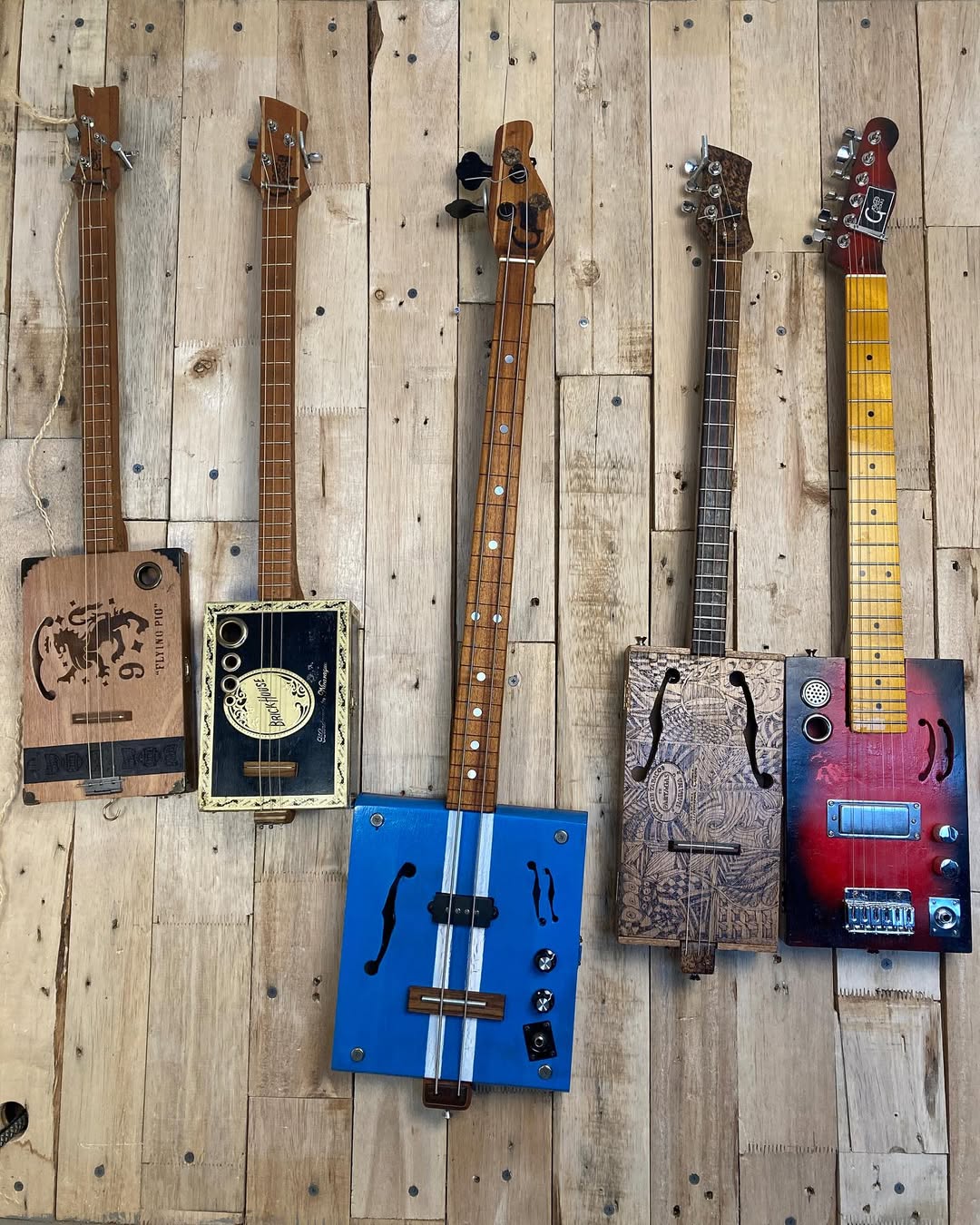
“Each guitar has its voice,” he states. For example, the Brick House from JC Newman Cigar Company “sound sweet,” but above all of them rise the Macanudos, which Ricardo calls the “Stradivarius” of cigar box guitars.
Showing some of the boxes he has in mind to convert into guitars, he highlights one from Flor de Cano dated April 1980, meaning it is 46 years old: the natural drying process of the cedar over nearly five decades has completely eliminated the internal resin from the pores, leaving the cellular channels empty and ready to act as natural amplifiers. Without a doubt, it will be a great guitar.
Here and now
An incredible thing is that every December Ricardo gathers in his workshop all those woods, bridges, and cigar boxes that did not meet the required acoustic or spiritual standards.
In order instead of storing them or selling them off, he surrenders them to the fire in a bonfire ceremony: what was born from the earth as tobacco and cedar and could not become music. For him, this act is about a radical detachment.
For Ricardo, making guitars out of cigar boxes has been a journey of epic anecdotes, much satisfaction, and happiness; that fulfillment of knowing you are here, and now, doing what you love.
Suscribe to our Newsletter