At just 16 years old, Murphy Quint found himself immersed in the world of craft distilling when his parents opened Cedar Ridge Distillery in 2005. Though he initially had no long-term plans to join the family business, Quint’s fascination with the industry grew over the years, leading him on an impressive journey through various roles within the spirits world.
Read in the magazine (rotate your device for a better reading experience):
Quint’s passion for the craft of distillation is evident in every bottle that leaves the Cedar Ridge facility. By combining traditional techniques with innovative approaches, he continuously strives to capture the unique flavors and character of Iowa’s rich agricultural heritage. As a true artisan of his craft, Quint’s dedication and expertise have cemented Cedar Ridge’s reputation as a leader in the Midwest’s thriving spirits scene. Nestled in the heart of Iowa, Cedar Ridge Distillery is a beacon of craftsmanship and innovation in the world of spirits. Established in 2005, it proudly holds the title of Iowa’s first legal distillery since Prohibition. With a commitment to quality and a passion for tradition, Cedar Ridge produces a diverse range of award-winning spirits, including bourbon, rye whiskey, and vodka, all crafted from locally sourced grains.
What sets Cedar Ridge apart is its dedication to the art of distillation and aging. The distillery’s picturesque setting, complete with a state-of-the-art facility and scenic views, invites visitors to experience the magic of the distilling process firsthand. Whether you’re a seasoned connoisseur or a curious newcomer, Cedar Ridge Distillery offers a warm welcome and an unforgettable journey into the world of handcrafted spirits. With a commitment to sustainability and community involvement, Cedar Ridge is not just a distillery –it’s a celebration of the spirit of Iowa.
- Can you tell us about your background and experience in the distilling industry?
I had an interesting entrance into this industry. In 2005, when I was just 16 years old, my parents decided to open Cedar Ridge Distillery. It was a very small business at the time, and I’d help out after school and on weekends. I really enjoyed it, but at that point in time I had no intention of doing this long term. It wasn’t until I was in my early 20’s when I really fell in love with this industry. I had moved to Colorado and gotten a job at a Stranahan’s Colorado Whiskey. While I was there, I was captivated by the experience –the people who I got to work with, the products we were creating, it was all very interesting to me. While I was there it got in my blood. It didn’t take long for me to realize that I wanted to pursue long term. Eventually, I moved back to Iowa and came back to Cedar Ridge. I spent a couple years developing distribution networks and focusing on brand development before eventually getting back into production. At this point, I’ve been doing this for 20 years and I’ve had the pleasure of working in almost every field in this industry, from production to distribution to sales and marketing.
- What inspired you to become a master distiller?
Early in my career, I had the pleasure of working with Rob Dietrich, who was the Master Distiller at Stranahan’s the time. I was about 25 years old and he was the first Master Distiller I had ever met. I became fascinated with his role and how good he was at it. He oversaw the production operations and created all of the final blends, but he was also very good engaging with customers and promoting the brand. I always had an interest in the marketing and brand development side of the business, and once I realized that a Master Distiller gets to do both production and promotion, I was hooked.
- What sets Cedar Ridge Distillery apart from others in the industry?
A number of things set us apart from other distilleries in the industry. Firstly, we’re a winery and distillery combination, which in itself is very uncommon. There’s also our location. We’re based in the great state of Iowa, which is somewhat unusual. But ultimately, it’s our team and our mentality that sets us apart. We have 55 employees, half of which are full time, and every single one of them essential to our operation. When someone takes a day off, the rest of the team feels it. We’re a tight-knit group and we heavily rely on one another.
We also have a classic Iowan mentality and work ethic. When something breaks, we attempt to fix it ourselves before outsourcing the project. When the weather is brutally cold and miserable, we keep working. Ultimately, it’s our team and their resilience that has led us to success and set us apart from others.
- Can you walk us through the distillation process at your distillery?
We start with whole kernel grains, typically corn, rye and malted barley. We then run those grains through our hammer mill and into our mash tun. After that, we take a different route from most distilleries. We utilize a mash filtration system to separate our grains and liquids. Everything that we produce is fermented and distilled off-grain. Typically, our fermentations last about 4-4.5 days. We then double distill everything in pot stills. We have an 800-gallon CARL pot still that we use for our alpha distillate. Then we finish everything in a 200-gallon CARL pot still. Once we have done that, the distillate is ready for barreling. Our barrel entry proof is almost always 120 proof.
- How do you ensure the quality and consistency of your spirits?
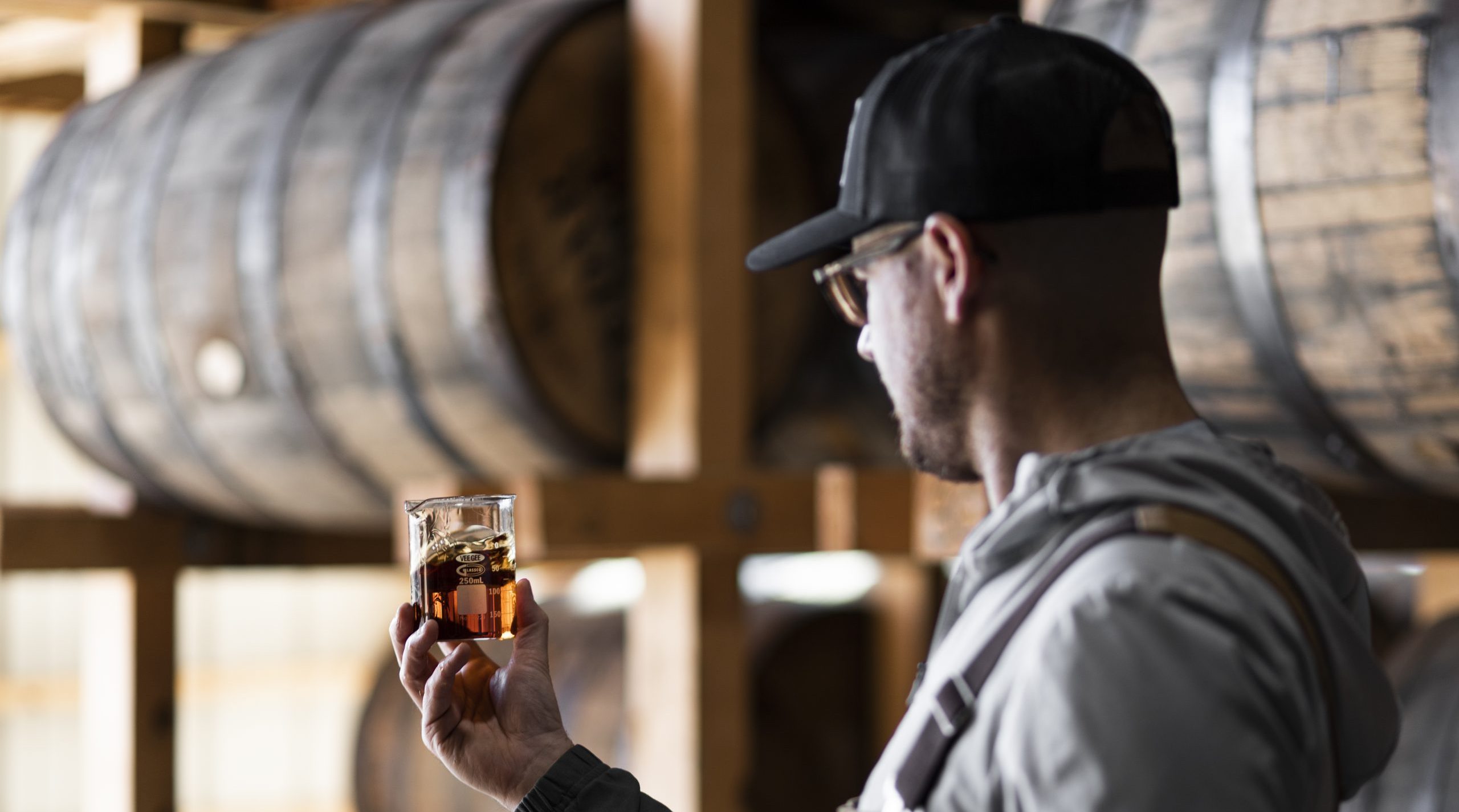
The quality is something that we’ve dialed in on over time. We’ve found the mash bills, distillation techniques, and pieces of equipment that work best for us. That’s something that every distillery slowly dials in on over time. As far as consistency goes, that mainly comes down to blending. The reason I say that is because there are so many variables throughout the maturation process (temperature swings, humidity fluctuations, rickhouse placement, barrel character, etc.) that it’s virtually impossible to create a fully-control environment. So, you have to create consistent blends at the end of the process. When I’m doing this, I like to taste through each barrel and pinpoint their individual strengths and weaknesses. Maybe one barrel is big and bold up front, but lacks character on the finish. If that’s the case, I’ll look for a different barrel that is quiet up front but has a lot of character on the back end. Those two barrels will typically work together to create balance and consistency.
- What is your approach to creating new and unique spirits?
When I’m creating something new for example our QuintEssential Special Release, which is an American Single Malt that we release twice per year –I’m always trying to create something that hasn’t been done before. I’m aiming for a flavor profile that doesn’t exist in the market yet. When I’m doing this, I have to walk a fine line. If the general concept of the product is too crazy and out there, people will write it off and consider it a novelty product. So, the flavor profile has to be unique, but in order for people to take a chance on buying the bottle, the product concept can’t be too bizarre.
I usually navigate through this by blending different finishing casks together. For example, I might blend together single malts that have been finished in sherry, rum and white port casks. Any whiskey consumer will be familiar with these types of casks, but there’s a good chance that they’ve never had them blended together before. By doing this, I’ve avoided creating a novelty product, but it’s still unusual and intriguing. The final, and most important step is to make sure that the final blend is of the highest quality. And that’s just something that comes along with experience.
- How do you stay current with industry trends and innovations?
Honestly, the trick is to not worry about staying current with market trends. If you get too focused on this, you end up becoming a trend follower. As a producer, we have to stay focused on our own style. If we stay true to ourselves, and the product is of the highest quality, we will be trend creators rather than trend followers.
- What challenges do you face as a master distiller and how do you overcome them?
In this game, patience is both the problem and the solution. It’s very complicated. The team that I manage is operating several years down the road. When it comes to things like product development and innovation, humans have a natural tendency to want to innovate right now. We want things to happen in this moment. And when it comes to whiskey production, that’s simply not possible. If we put something new in a barrel today, there’s a chance it won’t see the light of day for 7+ more years. At times, that can get overwhelming. It can almost feel like a lack of control over our own destiny. At the end of the day, the only thing you can do is trust in the process and remain patient.
- Can you share a memorable moment or accomplishment from your career as a master distiller?
In 2023 we came out with our first QuintEssential Special Release. Keep in mind, we are primarily a bourbon distillery that offers whiskey at a fairly modest price point (between $35-$49 per bottle). So, we were nervous about releasing an ultra-premium single malt for $99 per bottle. We were taking a big chance on this. Not only did we end up selling out the entire batch in less than a week, but the product went on to win Best American Single Malt at the World Whiskies Awards. This completely changed the trajectory our distillery and turned a lot of heads along the way.
- How do you see the future of the distilling industry evolving, and what role do you see yourself playing in that evolution?
It’s an interesting time in our industry. There has been an incredible boom in distilleries opening up and/or expanding over the last 20 years. Hopefully the market can continue to support it. With the massive amount of bourbon currently being produced in the United States, bourbon exports will have to grow dramatically in order for it all to be sustainable. So giant strides will need to be made overseas.
An interesting, and potentially conflicting element to all of this is that single malt interest in the United States is on the rise. Personally, I’m passionate about both bourbon and single malt and I hope to play an important role in growing both categories domestically and overseas.