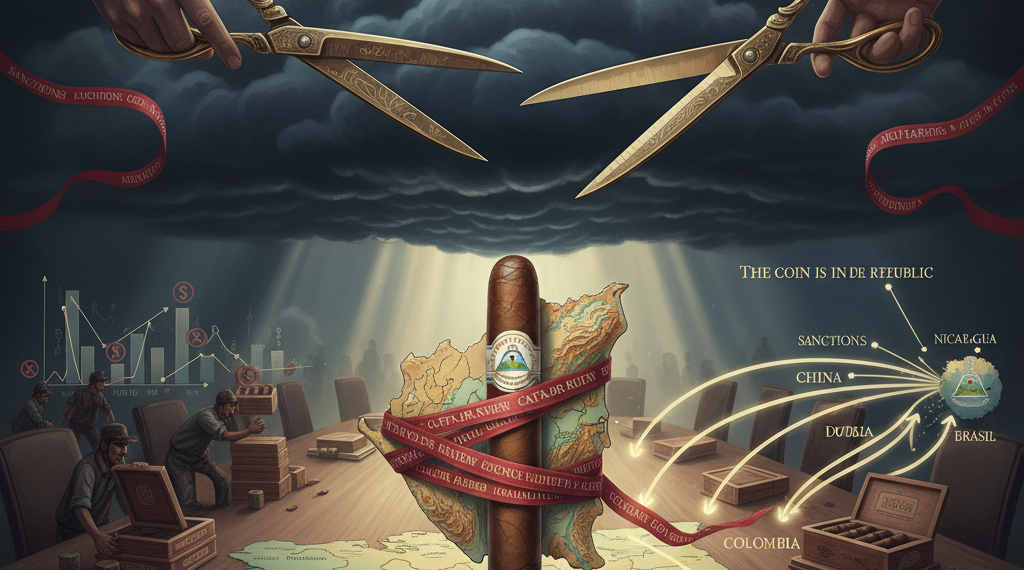
For the past month, the U.S. Government has been analyzing the possibility of imposing “additional tariffs of up to 100 percent on some or all Nicaraguan products,” either “immediately or in phases, over a period of up to 12 months.” Should the proposal, put forward by the Office of the United States Trade Representative (USTR), be implemented, it would reconfigure the premium cigar market in the U.S., which is the largest market in the world.
Read in the magazine (rotate your device for a better reading experience):
Why? The reason is simple: in 2024, the United States imported 430 million premium cigars, of which almost 60 percent came from Nicaragua. This means that six out of every ten cigars smoked in North America are Nicaraguan, and the impending measure would mean a severe blow not only to the Central American country but also to the internal U.S. market, at least in terms of its logic or operation in the short term.
The tariffs would mean, for example, that a Nicaraguan cigar that a smoker currently buys for, say, $12, would suddenly double in price, losing competitiveness and, consequently, sales.
For now, producers are preparing. We have spoken with several friends and clients who comment that they are currently increasing their production and exporting the largest possible quantity of cigars and tobacco to their warehouses, seeking to have maximum product inventory ahead of the possible entry into force of the measure, or even the possible expulsion of Nicaragua from the Central America Free Trade Agreement (CAFTA).
But where there is uncertainty, there is also opportunity. The global premium cigar market is currently moving in ways that have not yet fully consolidated. Suffice it to mention the opening of the Asian region, which is gaining more relevance day by day, as well as the entry onto the scene of markets such as the Arab world, which this month celebrates the second edition of The World Cigar Show in Dubai, or even Africa, as an option.
There is also Latin America, which is gaining increasing relevance with countries experiencing a rise in consumption, such as Colombia, Venezuela, Chile, Argentina, and Brazil; destinations increasingly considered by different brands.
Of course, these are alternatives that involve long-term investments and practically represent a bet that not many are willing to make when faced with a consolidated market like the United States. Nothing has been decided yet, but the shadow of the threat looms over the leading premium cigar producing country.
In contrast, the measure would open the doors for producers in the Dominican Republic and Honduras to increase their exports to the U.S., which could lead to companies based in Nicaragua deciding to move their operations to those countries, for example.
The coin is now up in the air.