Summer knocks on the door in Madrid and, along with it, the first rays of light transport us to an almost magical state of mind. People smile and in their eyes appears that brightness that, many times, the harsh winter makes disappear.
Sofía Ruiz / Master Habanosommelier
It is that brightness that arises when you feel how the spark of romanticism ignites in the soul; the “good morning” message that draws a big smile on your face; that natural state of rebellion that surfaces when lighting up, from a terrace, an art expressed amid Cuban ash and smoke.
About love and the marks it leaves on life, it has not only been written; great works have been created, and it has even defined an entire era in the history of art. So, determined to discover how far this feeling can go, I wondered if love also evolves, just like a habano. I found the answer at 13 San Mateo Street, right in the center of Madrid.
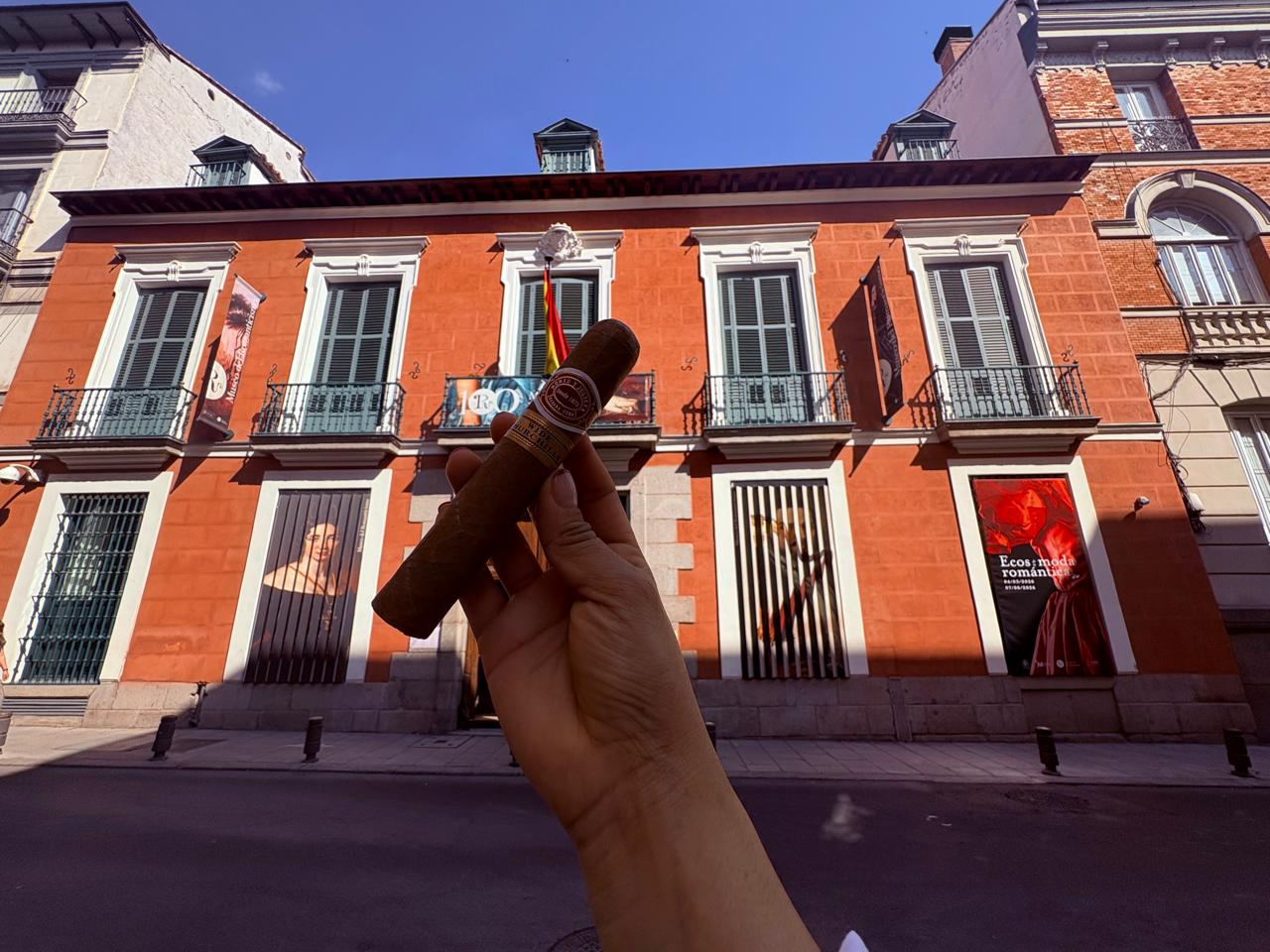
I am talking about the Museum of Romanticism, a classic of the Spanish capital, at whose doors I arrived accompanied by a Romeo y Julieta Wide Churchills. It is a small palace that makes you fall in love at first sight, as the intense red of its facade fills the eyes with a warm, almost romantic sensation, even before crossing the threshold.
Upon entering the lobby, I was transported to the mid-19th century, when aficionados of fine smoke wore white gloves and held their habanos by the bands –known in Spain as vitolas– in a gesture as elegant as it was distinguished. It was then that the first bands were placed to dress Cuban dark tobacco, becoming not only a functional element, but a symbol of refinement and prestige.
This space was created by the Marquis Benigno de la Vega-Inclán y Flaquer, a great promoter of tourism in the country, who in 1921 donated to the State an important collection of paintings, furniture, and objects of his property, which he had presented before a close audience as a preview of what the future museum would be.
The opening of the site, in 1924, was based on the painting collections of its founder, which were later complemented by works of the painter Leonardo Alenza and objects belonging to great writers, such as Mariano José de Larra and José Zorrilla, among other figures.
Upon climbing the white stairs dressed in a red carpet, the first floor welcomes you with a collection of paintings corresponding to the romantic movement of the era. Melancholic faces, seductive characters and, at times, marked by a subtle pessimism, show the genius of the artist, capable of offering an intimate look into an idealized past: the spirit of Romanticism.
Each work seems to remind us that love, nostalgia, and passion are not just feelings, but ways of contemplating the world.
The first stop is in the Costume and Customs Room (Sala VIII), where one of the iconic works of Spanish Romanticism is exhibited: Satire of Romantic Suicide for Love (circa 1839), by Leonardo Alenza. The room also houses some portraits of the childhood of Isabel II.
As I moved among the paintings, like someone advancing through the different stages of love, I stopped in front of a work that deeply impacted me. I believe that the melancholic gaze of María Luisa Fernanda de Borbón, Duchess of Montpensier, found its way into my soul in a way that is difficult to explain.
The portrait reveals the wide range of nuances with which art can express itself. Its gray tones seem to dialogue with the ash of a habano: in the first third, the lighter nuances begin to form slowly, like an ash under construction, delicate and promising. It is the moment when both art and love begin to reveal their true depth.
The first room is subtle. Little by little, it shows us the characteristics of an era and the artistic movement that found its maximum expression in emotions. The same happens with love: first dates are the initial sketches, showing small signs of who we really are.
Similarly, the first third of a habano delivers in its first aromatic and flavor notes the elegant prelude to the unmistakable character of Cuban tobacco. Nothing is revealed immediately; love, art, and the habano all require time to unfold their essence.
During the tour, I discovered a rich collection of sculptures, decorative arts, and photographs that portray the sensitivity of the era. Among them all, several hand fans representing scenes of daily life in the 19th century especially caught my attention. Each one seemed to tell a story, reflecting customs, aspirations, and ways of understanding the world.
Those pieces inevitably reminded me of the universe of habano bands. Just as the fans illustrated the life of their time, the lithographic workshops of brands like Romeo y Julieta, founded in 1875, came to produce thousands of designs reflecting the aesthetic trends, famous figures, and lifestyle of the era. More than a simple ornament, they were small works of art that accompanied the smoking experience; a testimony to history.
Like Cupid’s famous arrow, a ceiling crossed my path that made me fall in love without even looking up. The work is Angels with Musical Instruments, an elegant and delicate oil painting that represents four cherubs suspended over a blue sky covered in clouds. Two of them play a violin and a mandolin, while another two hold a music sheet, suggesting a celestial theme.
There is nothing like music to frame those moments of reflection amid smoke that we have all had… Some melody that reminds us of the sadness of an old love, or makes us vibrate with the butterflies of anticipation at the beginning of a romance.
Under the characteristic red color and gold medals that adorn the emblem of Romeo y Julieta, I discovered a curious historical coincidence: during the peak of Romanticism, major international exhibitions dedicated to tobacco also flourished. Cities like Paris and Antwerp hosted prestigious fairs where the latest innovations of an industry living a true golden age were exhibited.
And it was precisely from Paris, the eternal city of love, where my Wide Churchills and I continued our journey to what, in my judgment, is the most imposing room in the museum. We had reached the second third of this experience, that moment in which both the habano and love reach their greatest balance and depth.
Crossing the threshold of Room IV, I was surrounded by an extraordinary gallery of portraits reflecting the splendor of romantic Spain. On its walls, one can view works by prominent artists such as José Gutiérrez de la Vega, Ángel María Cortellini, Francisco Lacoma y Fontanet, Antonio María Esquivel, and Federico de Madrazo, among others. The portraits of Isabel II, Infante Francisco de Paula, and various figures of the aristocracy and bourgeoisie of the era seem to observe the visitor with a mix of solemnity, elegance, and mystery.
In this second third of the tour, emotions acquire a greater intensity. Just as occurs with a well-constructed habano, the nuances become more complex, the aromas more defined, and the experience deeper. In addition, there was a series of decorative art collections such as a clock and pairs of porcelain vases in the Old Paris style, 19th century, and white and blue porcelain vases.
In the center of the room, lavish evening gowns are part of the guest exhibition, Echoes of Fashion, which displays haute couture collections by designers such as Balenciaga, Pertegaz, Pedro Rodríguez, or Bibian Blue, who stand out in 20th and 21st-century fashion and seek to reinterpret romanticism.
As occurs with the second third of a good habano, in which flavors and aromas reach their maximum expression –toasted notes, cedar, spices, damp earth, and even nuances of cocoa emerge clearly– the tour through the following rooms becomes more intense and revealing, unfolding all the richness of Romanticism before the visitor.
Collections of ceramic tableware that accompanied daily life of the era appear, alongside paintings exalting the art of bullfighting, a tradition deeply rooted in Spanish culture and still very present in Madrid.
Little by little, the end of the tour began to announce itself. Walking through the rooms dedicated to Andalusian costumbristas, literature, and the old bedrooms of the palace, the feeling was similar to approaching the final third of a habano: a stage of reflection, where every detail acquires a special meaning.
Between rooms charged with history and emotion, the museum reveals part of the more than 17,000 pieces that make up its collection. Every object, every painting, and every piece of furniture contains a story, reminding us that Romanticism, more than an artistic movement, was a way of living, feeling, and understanding the world.
Between the echoes of Romanticism, 19th-century life, and the sensation of lighting up a fine smoke, we close this last third of the walk on a casual Madrid terrace.
My Wide Churchills accompanied me, and our romance began. Its factory name, Montesco –a last name that is familiar to every romantic and lover of tragedy– offered me its toasted notes, nuts, and some hints of vanilla, along with a long finish, thanks to its 55 ring gauge and a length of 135 millimeters, which transported me to the 19th century, when enjoying the world of the habano was a true art.
During this final third, my habano showed itself to be as frank –with those traces of Cuban tobacco and a medium strength that opens up– as love when it is consecrated in the gaze of the person who gives themselves to the beloved, reflecting their true personality. It is that moment in which masks vanish, like the last wisps of smoke from the habano.