Darío Procopio
The three men arrived on horseback at the Sad Hill cemetery. The place is located in some desolate spot in the old and Wild West. They are alone; anyone who has dared approach has perished at the hands of their bullets. The adventure that brought them here found them joining forces and pistols by chance, although none of them trusts the other even a little. All three know where the false grave is, where the Confederate soldiers buried a fortune in gold. They also know that only one of them will leave the cemetery with the prized golden metal. The year is 1862, and the hour has arrived.
Read in the magazine (rotate your device for a better reading experience):
The men part without affection, all knowing what is about to happen. One of them remains standing while the other two move off in different directions without turning their backs on one another. When the separation is just right, the three are equidistant and facing each other. One of them shifts his poncho, revealing his Colt. The other two do the same. The air is thick with tension; eyes dart between threats, hands trembling as they approach their weapons. A single drop of sweat or a blink will unleash chaos, with the tombs as the only witnesses.
One of them is a Mexican bandit named Tuco Benedicto. Another is a former sergeant turned hitman known as Angel Eyes. The third is a bounty hunter, a soldier of fortune, always ready to seize an opportunity at gunpoint. They will pass into eternity as “The Good, the Bad, and the Ugly”.
The truth is that Sad Hill is a fictional cemetery, just gravestones and crosses in the rugged landscape of Burgos, in southern Spain. It’s not the Wild West, but some regions outside Almería. Italian filmmaker Sergio Leone, with a European production (from Italy, Spain, and Germany) and little money, directed the filming of a Euro-Western All’italiana or Spaghetti Western. The original title would be “Il buono, il brutto, il cattivo”, and when the world laid eyes on the film, nothing would ever be the same for the genre. Filmed in 1966, it is the third and final installment of the Dollars Trilogy, following A Fistful of Dollars (1964) and For a Few Dollars More (1965).
Regarding the three characters, the “Ugly” is portrayed by comedian Eli Wallach, and the “Bad” is played by actor Lee Van Cleef. However, the character who would become iconic is the “Good”, who, more than embodying goodness, is a perfect antihero portrayed by an unknown and young television actor, Clint Eastwood.
Eastwood brought to life a character with unbelievable traits. To begin with, he is a nameless character. Never, in any of the three films, is his name mentioned. In the credits, he appears as “Joe,” but only as a single reference in the first film. “Joe” is a name often used in English when someone’s real name is unknown. His companions call him alternately “The Manco” (Il Monco) or “The Blond” (Il Biondo). The character never introduces himself or mentions his origins, another of his peculiarities. The Nameless Man rarely speaks or does so very little in the three films he stars in.
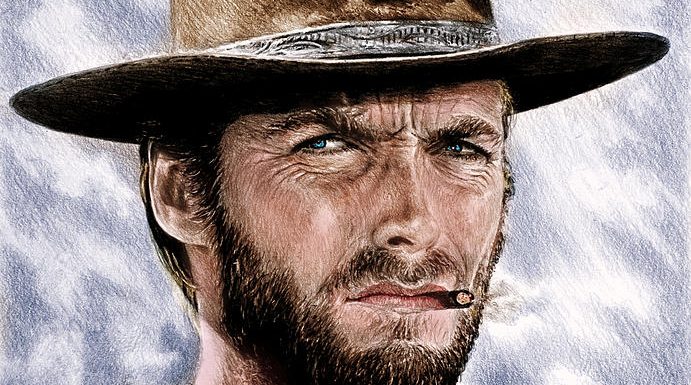
Moreover, “Uomo senza nome” is anything but good. He has a cold stare and seems motivated by nothing more than his desire for money. He has no qualms about killing or betraying. He is a solitary man, carved from ice. His likes, affections, or emotions are rarely predictable. He is thin and always wears an old, dusty, tattered poncho, in which he hides his hands and dangerous Colt.
However, the antihero created by Eastwood and Leone is a full stereotype, a source of inspiration for characters in multiple universes and formats. It’s impossible to search for Westerns without stumbling upon the emblematic image of the Nameless Man. In 2008, the American Film Institute ranked him number 33 among the greatest fictional characters of all time.
To perfect the persona of the gunslinger, Sergio Leone insisted that the character should smoke. Thus, the mask of the Nameless Man is not complete without a cigar firmly held between his teeth, accompanying him in every shootout, both in sunlight and shadow.
When bringing the character to life, neither Leone nor Eastwood imagined they were creating a universal cinematic icon, and perhaps that’s why neither of them paid attention to the brand of the cigar used. However, the Italian origin of the production and the omnipresence of the cigar in the scenes are enough proof for experts to conclude that it was an Italian Toscano cigar, or its original precursor, an Asian Cheeroot.
Toscanos and Cheeroots have similar characteristics in color, shape, and size. However, as they have different origins, the type of tobacco varies. While Cheeroots use Asian tobacco (Thanat leaves) and were introduced to Europe from India or Burma by Portuguese traders (in Portuguese, charutos) and English sailors (in English, whiffs), Toscanos, promoted in 1818 by Fernando III, the Grand Duke of Tuscany, use tobacco imported to Italy from Kentucky plantations in the United States.
Burley tobacco from Kentucky was the first introduced to Italy and became popular through the making of Toscanos. It wasn’t until 1850 that Italy began cultivating its own Kentucky-type tobacco, a hybrid of the typical tobacco imported from the U.S. and local tobacco varieties better suited to the soil and climate.
Kentucky or Burley tobacco is brown when fully matured and darkens after the direct-fire curing process, where wood smoke penetrates the leaf cells, giving it a distinctive flavor. Originally, it was used for chewing and later for strong-flavored cigars. Besides Kentucky, it is also grown in Virginia, Tennessee, Mexico, Poland, and various African countries.
Both Toscanos and Cheeroots are dark cylinders, made without filters and open at both ends. Both are fine cigars (diameter between 13mm and 16.5mm) and of similar length (155mm or 6.1 inches to 163mm or 6.4 inches). This is why the greatest mystery regarding the favorite cigar of the Western icon is, in fact, the brand.
There are two brands that are attributed the honor to this day. One of them is Avanti with its Parodi Ammezzati line, and the other is the Toscanos line from De Nobili company. Both were founded in the United States to meet the demand from the thousands of Italian immigrants arriving in America. Avanti was founded in New York in 1901, and its competitor, De Nobili, dates back to Pennsylvania in 1896.
However, when asked in a recent interview, Clint Eastwood himself provided a definitive clue about the matter by saying that he only remembered the cigar box indicating that it came from Virginia. This detail points all the focus to the pioneering tobacco company Marsh Wheeling, founded in West Virginia in 1840, and one of the most popular in its time.
Besides being the only brand available in the film’s 1862 setting, the Virginia company offered rustic, affordable Toscanos that could well have been consumed by a marginal character of the Wild West. A curious detail is that Marsh Wheeling used Dominican tobacco and offered flavors like almond, anise, bourbon, cherry, and vanilla. Yes, dear reader, it’s hard to imagine the Nameless Man executing an adversary coldly while savoring a cherry or vanilla-flavored cigar. But that is the history.
The scene of the triple duel at the Sad Hill cemetery is perfectly completed as the cherry on top with the exquisite music of Ennio Morricone. When Leone’s camera flies over the eyes of the gunslingers and the musical piece The Trio erupts, nothing would ever be the same. The scene would not only be the climax of a trilogy of Westerns but also the climax of the Spaghetti Western genre’s history.
After this scene, the quirky Italian subgenre would overshadow traditional Westerns and awaken a genre that would mark a style of Western that endures to this day. After that scene, beloved fictional characters like Ringo or Django, artists like Franco Nero, Claudia Cardinale, and Terence Hill, and stories like Once Upon a Time in the West (C’era una volta il West), I’ll Go, Kill Him, and Return (Vado… l’ammazzo e torno), and its incredible sequel Go, Kill Them All, and Return Alone (Ve, ammazzali tutti e torna solo) would follow.
For Clint Eastwood, it meant his rise to stardom, and no doubt an image for which he will always be remembered. Perhaps that’s why, in his many decades of success as an actor and director, he would return to the genre. And though his later characters had names, all film lovers see the Nameless Man in Hang ‘Em High, Pale Rider, and Unforgiven.
In fact, it is in the last of these films (Oscar for Best Picture, 1992) that, in the final scene, Eastwood’s character enters a saloon to settle the conflicts central to the film. There, the sheriff and a dozen deputies are planning his manhunt. It won’t be necessary; the prey has come to hunt them instead. It’s 20 against 1, and outside it’s pouring. Inside, a flash of lightning illuminates the door of the hall and there is The Nameless Man who, pointing his weapon, says: “I have killed men, women and children; I have killed almost everything that ever walked or crawled on this earth. And I am here tonight, to kill you.”
What follows is a fierce shootout in which our antihero kills the sheriff and six deputies. The rest escape. The gunman pours a couple of glasses of whiskey and before leaving he threatens: “I’m going out, if I see anyone, I’ll kill them. If someone shoots me, I will kill him, his wife and all his friends. Oh, and I will burn down your house.”
Needless to say, he leaves calmly and slowly in the middle of the storm. His silhouette is lost in the darkness, in one hand he carries a gun, in the other a bottle and on his lips a smoking Toscano.