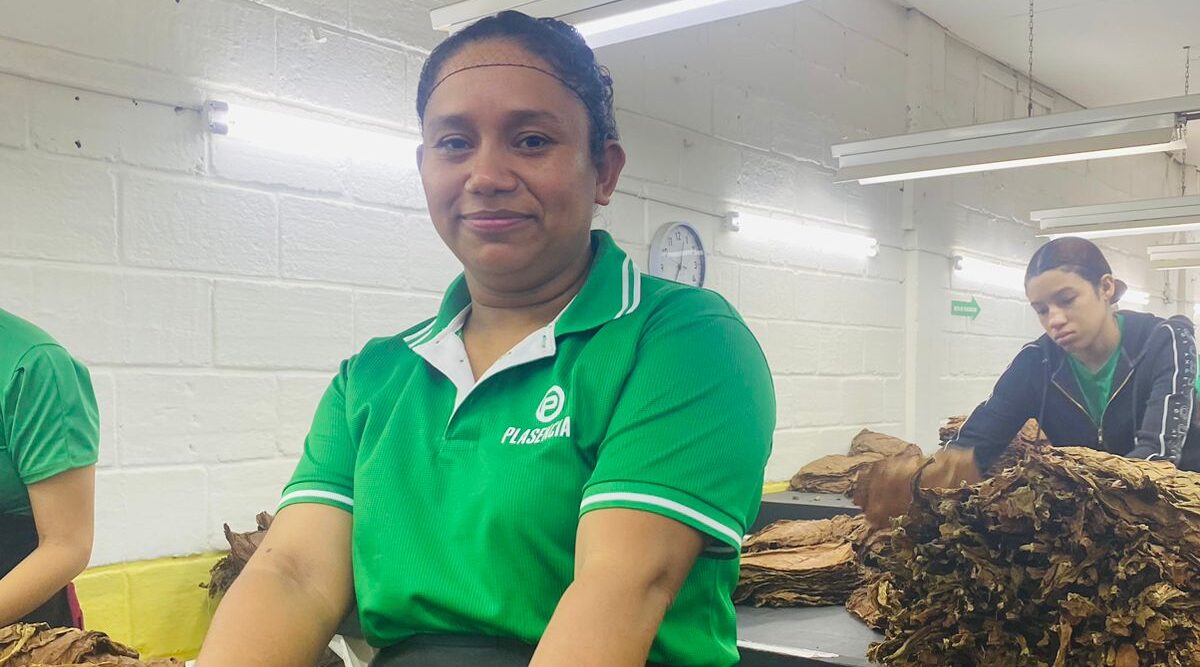
Her father planted corn and beans on other people’s land, where he also harvested tomatoes, chili peppers, and coffee, while her mother took care of the home. together they had nine children, who, like Ada Ávila Chavarría, had to work in the fields from a very young age. Ada started at age eight, and because of this, she describes her childhood as sad and very poor: “a struggle just to sustain ourselves.”
Read in the magazine (rotate your device for a better reading experience):
She was born and raised in Barrio Las Lomitas, a town in the department of El Paraíso, Honduras, where she managed to finish sixth grade. She then moved to Danlí and found work in a kitchen where she helped very little, “because I was so small and there were things I didn’t even know existed.” In exchange, she looked after two children, managing to stay there between the ages of 12 and 17.
She eventually returned to her parents, but soon entered a relationship that resulted in a son. Her partner also worked in the fields, “and so we went back to the same thing, to the same life,” until six years later, both the job and the relationship ended. In 2016, she sought employment in Danlí and arrived at the Clasificadora y Exportadora de Tabaco, a company belonging to the Plasencia Group.
She started that very day in the moñeo (hand-tying) area: “The moños are the tobacco leaves that you place here in your hand, forming and counting them. Once they are even, they are tied; that is the job.” She explains that the number of leaves depends on their quality and variety. If the Connecticut is filler (tripa), 45 leaves; but if it is a wrapper (capa), XL, or binder (banda), 40. Habano consists of 35 leaves, whether wrapper or filler, but if it is tripa ligera (light filler), it only contains 30 leaves.
Ada remembers being surprised to see all that tobacco together, but also by being in a place with so many people. In this sector, there is also an area where leaves are measured and classified by size, and another where they are differentiated by quality. She learned both tasks but spent little time there before being moved “to where the colors are made.”
She says that at first, it was difficult because she saw all the leaves as identical. But now, in the Habano variety, she identifies light (claro), intermediate, dark, brown, and green colors, while in Connecticut, she finds light, yellow, and pinkish tones. “We simply separate the leaves by tone once they are dry. They already arrive sorted by quality and size; it is a process that happens before stems are removed (despalillado).”
After a decade at Plasencia, Ada expresses that it is the best job she has ever had because, unlike field work, she receives benefits and medical care in addition to a salary. She now has two children –an 18-year-old son and a ten-year-old girl– whom she supports on her own.
“Thanks to God, I have my greatest achievement, a very big goal: my home. It is the best thing I have had so far because I have fought hard for it and it is practically finished. It means leaving my children a place where they can stay when I am gone.”
Suscribe to our Newsletter