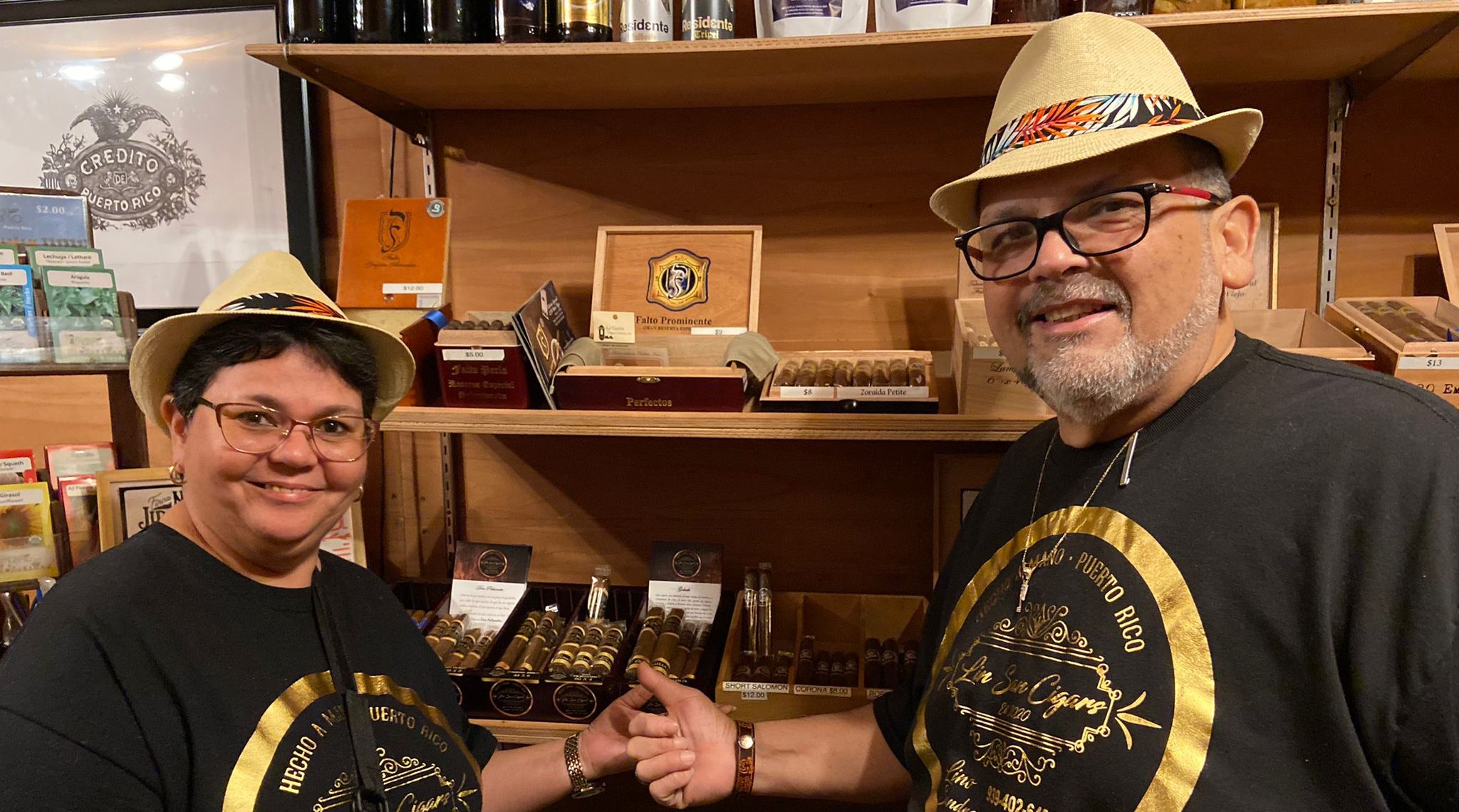
Married for three decades, Lino Ramírez and Sandra Matos share everything as a couple, including their passion for tobacco and the craftsmanship involved in blending and rolling a fine cigar. For the past five years, they have pursued this activity under the name Lin San Cigars, their own brand that combines their names, tastes, and stories through an extensive lineup of over ten different cigar blends.
Read in the magazine (rotate your device for a better reading experience):
Lino recently celebrated one year away from his judicial career, where he worked for 30 years as a deputy sheriff, while Sandra continues her work in education as a preschool teacher.
Having been a smoker since the age of 18, Lino knew something about tasting tobacco, but it wasn’t until the Covid-19 pandemic that he had the chance to discover La Hoja del Chan, a fledgling company that grew during the lockdown period.
“I came across El Chan on social media, tried his cigars, and just weeks after meeting him, we asked for an opportunity to learn the art of tobacco.”
Lino and Sandra began as students of Gaby at La Hoja del Chan‘s original workshop, located in the family home. They learned the art of cigar making, and soon after, they felt the need to venture into the market with their own brand.
On January 7, 2020, within the same workshop that sparked their passion, they launched their brand, which today produces 11 different cigar blends, each with its own story and reason for being –something Gaby taught them.
In this regard, among the many lessons shared by El Chan and Liz with this couple, the importance of doing things with love stands out.
“If you’re not happy or you’re struggling, those feelings are transmitted into the cigar, and nothing will turn out well. That’s why to make a quality tobacco, things must be done well and with love,” they assert.
The Vitolas
Wrapped in Connecticut, Maduro, and Habano wrappers with tobacco from the Dominican Republic, Nicaragua, and Ecuador, each cigar produced by Lin San Cigars tells a story.
According to Lino, in Vieques, the town where his family is from, it is common for families to have nicknames related to birds. His grandfather’s nickname was Pichón, passed down to his father, who recently passed away, and then to him. From this story, Don Pichón was born –a 5-inch, 52-ring gauge Robusto– and Don Pichoncito, a 4.5-inch, 60-ring gauge Shorty.
These cigars are followed by Nuestro Amor, a 6-inch, 46-ring gauge Lonsdale, whose blend was created as a couple under the supervision and participation of Liz and Gaby; Goliat, a 6-inch, 60-ring gauge Toro made with Kentucky fire-cured tobacco inspired by the family’s mini schnauzer.
Additionally, there is La Teacher, a 5-inch, 52-ring gauge box-pressed cigar, created in honor of the nickname Sandra received from the group of cigar artisans during her training; along with four smaller cigars named Capitán, Coral, Isla Nena, and Marshal, the latter inspired by Lino’s years as a deputy sheriff.
Tobacco in Puerto Rico
According to Lino and Sandra, Puerto Rican tobacco has nothing to envy from the major international brands sold in the U.S. market, backed by the training and dedication of artisan cigar rollers who respect the tradition that once placed the island as one of the largest tobacco suppliers from the New World to Europe.
“What is the best cigar? They all are,” says Lino, who believes a good humidor should contain cigars of all kinds –domestic, international, expensive, and affordable– providing a variety that keeps the palate always intrigued.
“At the last Viva la Hoja festival, there were nearly 20 artisans showcasing our products, a sign that the industry is rising, not to mention all the farms now producing tobacco after this production had been neglected due to sugar cane and rice.”
Women and Tobacco
Sandra is one of the 9 certified cigar rollers currently in Puerto Rico, a title she proudly holds as part of the paradigm shift within the industry, where, after a long tradition of male dominance, spaces for women are continually opening at all levels.
“In the past, we were only allowed to remove the stems or work in the fields, but we are proving that we can do things just as well and even better than men.”
Moreover, leveraging her background as a teacher, Sandra uses her skills to bring tobacco knowledge and culture to others.
Los Hijos de La Hoja del Chan
After their certification as cigar rollers, the first group formed by José Gabriel Cruz Ayala, El Chan, sought a way to stay connected and found the opportunity through the creation of a WhatsApp group that Lino named Los Hijos de La Hoja del Chan.
This act, beyond simply giving identity to a means of communication, became the birth of a brotherhood and a family with a place for anyone who wants to join. “What we seek is to make it clear that if we work together, opportunities will arise. Let’s put aside the negativity and work together for the good of Puerto Rico.”
In this sense, Lino believes that the fact their brand continues to thrive is a sign that La Resistencia is alive, with a presence on the island for five years now and a constant participation in birthdays, weddings, corporate events, and more activities where tobacco is regaining its prominence.
“There are those who started, left the market, and remained as personal consumers. We continue strengthening the industry and the legacy of El Chan.”