The unpacking and other preliminary operations of the leaf are, in essence, similar to those performed with cigarette tobacco. However, because pipe tobaccos differ considerably in their smoking qualities and characteristics, and as some types of these tobaccos are still produced according to the traditional methods of their manufacturers, the final production stages vary depending on the specific type of leaf, brand, and factory involved.
The blending can be done before or after the tobacco is cut, and in some processes, it is done at both times. Although most leaves have their veins removed, the veins form an important part of the final blend at one stage or another. For example, the entire stem of Syrian Latakia or fire-cured Latakich tobacco is used, while Indian leaf is de-veined before it reaches English factories.
It is also interesting to note that machinery has not standardized the methods for processing pipe tobacco. Manufacturers, much like the blenders who create custom mixtures for individual smokers, have their own methods that satisfy the specific demands they cater to.
Main Types
The most well-known types of pipe tobacco in manufacturing can be divided into three main groups. The first includes tobaccos known as Flakes, Plug, and Bar Tobacco, which are made from leaf compressed into a cake. The leaf for tobaccos known as Twist and Spun Cut, which form the second group—including the Shags type, many common Virginias, and ingredients used for blending mixtures—is made from unpressed tobacco that is cut by a guillotine-style machine.
The price of each special brand depends on several factors, especially the quality of the leaf used in specific parts of the blend. Naturally, some tobaccos require more complex processes than others, and before presenting some of the existing differences between the various types, it is useful to describe the manufacturing of Flake, as this provides a general idea of the overall process by which pipe tobacco is made.
The Manufacturing of Flake, Navy Cut, and Plug Types
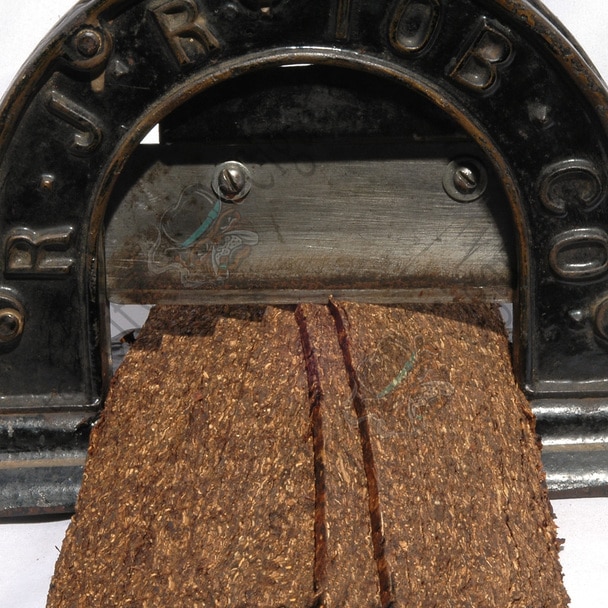
Once the leaf has been prepared, de-veined, and blended by hand, it is put into a mold press and subjected to a hydraulic pressure of approximately 1.5 tons per inch, taking the shape of a plug. These plugs are then placed in retention presses which, depending on the nature and color of the tobacco, can be cooled or heated by steam jackets. The degree of pressure and heat will determine the final color of the blend. When a slicing machine divides the pressed plug into bars of the required width, they pass through a guillotine-style cutter that slices them into flakes.
Flake can be recognized by these characteristic slices, although a few partially broken Flakes can be seen on the market, along with some stocks of tobacco already shredded for the pipe. Plug and Bar tobacco are also made by molding the leaf under pressure, and the preparation of Straight Cuts is also similar, although this term originally meant that the cut had been made across the full length of the leaf. In reality, several terms related to pipe tobaccos are now, if not redundant, little more than an echo of the past. Virginia no longer necessarily implies that tobacco of this type comes only from the U.S. state of Virginia.
The term Navy Cut is an interesting survival that refers to the time when sailors would roll their duty-free leaf into a cigar-like shape, wrapping it in a piece of canvas and tying it tightly with a rope. The solid plug of tobacco that resulted from this operation was then shredded and broken up by hand. Today, however, Navy Cut is produced in a similar way to any other Flake. It must be said, however, that the term Birds-eye still appropriately refers to the small fragments of vein cut on the bias that can be seen in this and some other types of tobacco.
These finished blends leave the factory with a moisture content of 20 percent or more.
Roll, Twist, Negrohead, and Spun Cut
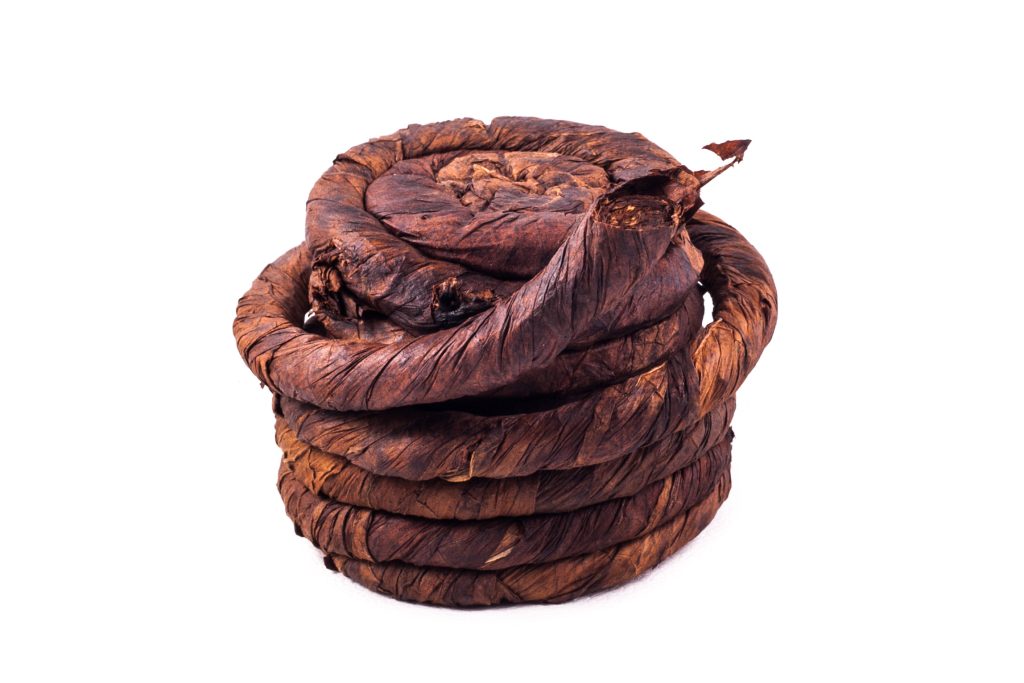
For these types of tobacco, a different series of procedures is necessary. The leaf that can be used as filler is rolled inside a wrapper leaf, and the whole is spun into a continuous rope that can have a thickness of approximately one-sixteenth of an inch to over one inch. For Roll and Twist types, oil is applied to the outside of the rope during this spinning operation so that when the coils of tobacco are rolled and wrapped in canvas, they do not stick to one another.
Once spun, the two mentioned types are wrapped in canvas, which is tied tightly and placed in steam-heated presses where they are kept under strong pressure for several weeks. When the strong black Twist is aged, it is either sent to retailers in rolls of various sizes or cut into a shorter length and packaged. When the ends of the Roll and Twist are braided together, they receive the name, famous in its time, of Negrohead.
Curly Cut and Spun Cut, when made with lower-quality leaf, have a lighter appearance and command relatively high prices. The mixed light and dark leaf that forms the filler is wrapped in a light wrapper leaf cured in steam tubes, and when the whole has been spun by the machine, the tobacco rope is sliced into discs. One of these, which is a cross-section of the original rope, reveals the different types of leaf that have been used.
Shags, Plain Virginias, and Mixtures
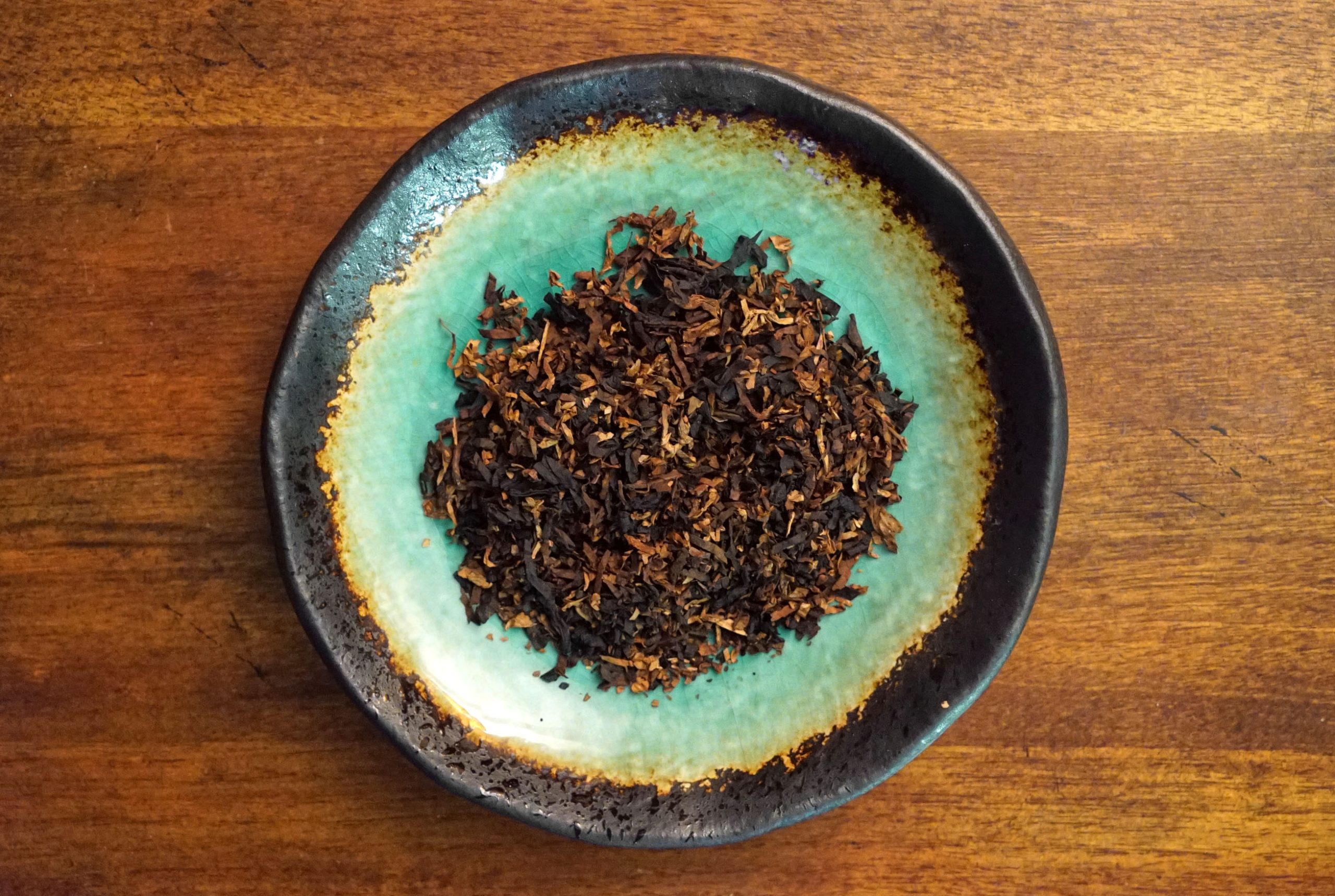
Shag tobaccos, which can be light or dark in color, are not made from plugs. The leaf is cut very fine and subjected to a full manual cooking process. Using gas or steam-heated pans, some of the moisture is removed, and the leaves open up into long, characteristic ribbons. Small bundles are then formed and left to rest for twenty-four hours. Some English classes of Shag are flavored; but artificially added flavor is rarely accepted by the true connoisseur, and such methods are not often found in higher-priced brands.
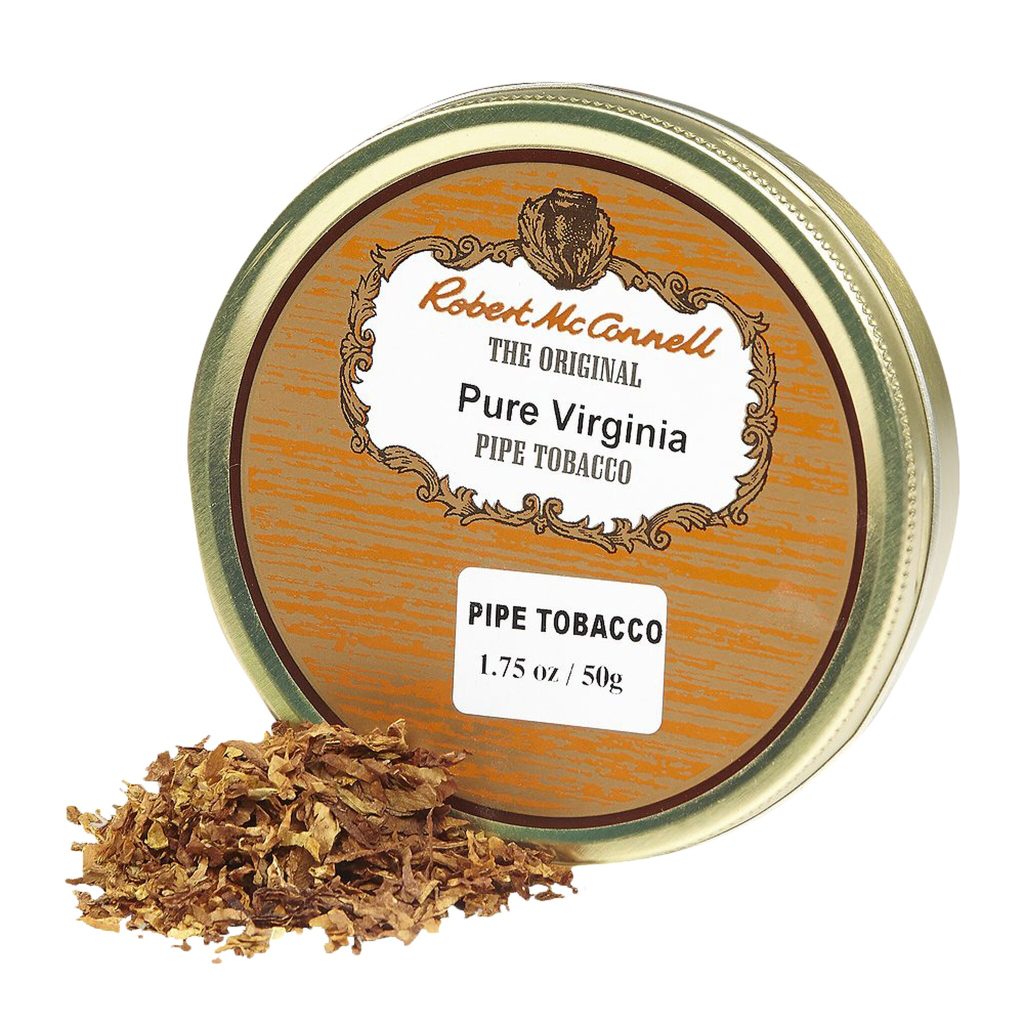
Plain Virginia tobaccos are prepared in a similar way, although these are rarely cut as fine as Shag.
The acceptance of many classes and types of Mixtures means that this type of pipe tobacco, which includes some of the finest varieties that can be achieved, must be set apart. The essence of any good Mixture lies not only in the quality of the leaf but in the final blend of the various ingredients. The base is formed by leaf from the United States or, in the best qualities of English blends, Virginia leaf, with Turkish leaf, some dark stove-cured tobacco, air-cured types to lighten the color, and a little Latakia to give it a more intense aroma being added. In England, tobaccos from the Empire, especially Rhodesia, are used for the making of some Mixtures, and in addition to heat-cured tobacco and Latakia, which counteracts the overly combustible effects of a lighter leaf, a little Perique may be added, whose influence on the blend can be compared to that of pepper as a spice. Finally, the appropriate amounts of the various ingredients are thoroughly combined in a mixing drum.
American Pipe Tobaccos
The existing custom in the United States of increasing the moisture-retaining properties of the leaf and flavoring the tobacco after blending with various forms of sugar, glucose, and molasses has already been emphasized in relation to cigarettes. These combinations, so to speak, have the same acceptance when it comes to pipe tobacco. In other respects, American types such as Plug Cut and Mixtures are similar to the English ones. Most are blended, but a few are made from Burley leaf.
Granulated tobacco is so preferred that it deserves special mention. The lower leaves of the artificially conditioned plant and various blends that include Burley leaf are de-veined and moistened. Granulation, which used to be done by mechanically pounding or crushing the leaves, is now performed by machines, and the tobacco is then treated with flavorings such as tonka beans or the like, and then packaged in small cotton pouches.
Various types of this prepared tobacco are used for both smoking and chewing. Black Fat, for example, which is exported to Africa, is prepared by treating the leaf with fats of mineral origin and then subjecting it to heat and pressure until it becomes a black, oily product with a leathery appearance. This tobacco has a relatively high moisture content, a tendency that applies to many American varieties.