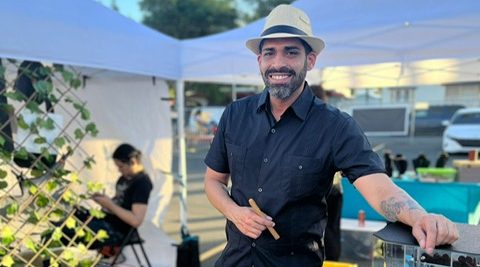
A smoker from a very young age, Héctor González admits that he truly entered the world of tobacco when he met Gabriel Cruz Ayala, El Chan, whose cigars were among his favorite smokes. After taking a cigar-making course with him, and after a year of working with the blends, he now has and promotes his own brand, San Pedrito Cigars, from Caguas. “Because, no matter how long it takes me, I want the brand to be recognized worldwide, not for my last name, but because it’s from Puerto Rico.”
Read in the magazine (rotate your device for a better reading experience):
A turner by vocation and with a job in the pharmaceutical industry, Héctor claims that in the medium term, in less than five years, he will be fully dedicated to his brand, to which he devotes all the time his day allows, and his imagination, as he now has, after two years in business, 11 vitolas in four different wrappers and tobaccos from Ecuador, Nicaragua, Brazil, and Mexico.
Héctor started young, smoking cigarettes at 18, and around the age of 21, he quit to enter the world of cigars. Like many, he started smoking “labels,” meaning well-known brands that can be found in any humidor, and remembers his first cigars, Camacho and Rocky Patel. “But at first, I just asked for cigars based on the smoking time: I want a cigar for an hour, for half an hour…”
From customer to student
Héctor remembers Gaby fondly for several unforgettable reasons. For example, he was his customer, as he smoked some of La Hoja del Chan cigars, which he infused with pitorro, the typical Puerto Rican “clandestine” or homemade rum. “The cigar was super good, one of my favorites.”
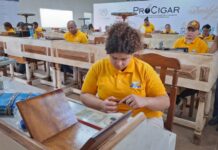
He recalls that for one of La Hoja del Chan’s anniversaries, Gaby invited him as a craftsman since Héctor also makes handmade ashtrays. “He told me, ‘Look, come to learn,'” but it wasn’t until a year and a half later that Gaby set up a cigar-making school, and that’s when Héctor decided to join. “Out of the six people in that group, three of us finished the course, and I’m the only one still making cigars.” In total, 16 people took the courses, but only four continue making cigars: Lino, Jony, Mario, and Héctor.
He highlights that it was a very interesting process in which they learned several techniques, starting with everything related to tobacco, its processes, and its characteristics. In practice, they started with cut tobacco and later with long filler, in different styles, “like the Cuban style or making it in a sandwich form.”
Gaby taught them while keeping up with his work at his workshop, so they learned while producing La Hoja del Chan’s daily output. “He showed us how and what to do while working, and later came to review the work. He gave me a couple of knocks on the head because I left a vein in the filler, and he said: ‘Here you have a plug,’ he tore the cigar and told me to start over. Those were really good moments that I will always remember. I have many videos of him on my phone from when we made the cigars.”
San Pedrito Cigars
After nearly a year of training, Héctor gradually acquired tools that, in Puerto Rico, he claims are very expensive: molds, guillotines, supplies, but not with the intention of creating a brand. “Because it takes time, if I make a cigar for myself and it turns out bad, it’s no big deal, I tear it and make another one, but with a customer, it’s very different because they won’t buy from you again. You have to perfect the recipe and let people try it.”
With tools in hand and a space to work, he began buying tobaccos from various origins, searching for the leaves that he liked most to create his cigar blends. This process took him over a year before he could say, “Now I have something to go public with.” And that’s how San Pedrito Cigars was born. “This was in December 2022, and since then, I make cigars every day.”
What Héctor likes is diversity, so his portfolio is extensive, ranging from a 32 ring gauge to an impressive 60. “I like to buy molds; I have four of each vitola, and I even have old molds that I buy at antique shops.”
Currently, he works with cigars of 5 inches, ring gauges 32 and 34; Lancero, 7 inches, ring gauge 38; Double Corona, 6 inches, ring gauge 44; Pirámide, 6.5 inches, ring gauge 54; and Toro, 6 inches, in ring gauges 48, 50, and 60, with wrappers of Candela, Habano LS, Connecticut, Habano 2000, San Andrés Negro, Maduro, and Barber Pole, from the United States, Mexico, Brazil, Ecuador, and Nicaragua.
In fact, what makes his cigars unique is that he found that using Ecuadorian and Nicaraguan tobacco in the filler gave a unique flavor, which he fell in love with as soon as he tried the blend. “The goal is not to resemble what’s already on the market.”
For now, Héctor does not distribute his brand in tobacco shops or cigar lounges but has instead focused on presenting it at fairs, festivals, and conventions, as well as with clients who contact him directly. However, seeing how the business has developed, he projects that in about two years, he will be fully dedicated to San Pedrito Cigars.
“First, I need a student, someone I can teach, just like Gaby taught me, because I can’t manage all these vitolas by myself. I want to continue his legacy, I want Puerto Rico to be known for the cigars we make here.”
In fact, the brand’s name is in honor of the endemic Todidae bird of the Island of Enchantment, which can be seen from the coastal plains to the high mountains. “Because what I want is not to be known for my last name, but for my cigars to speak for my homeland, for our cigars to speak for Puerto Rico, and to be recognized as Puerto Rican cigars.”
Puerto Rico’s Tobacco
Puerto Rico has a tobacco history that Gaby considered glorious, and from La Hoja del Chan, he worked to spread, promote, and rescue it, as one of his dreams was for tobacco cultivation to rise again on the island and for the once-renowned Puerto Rican Broadleaf to take flight once more.
“But we have a problem, and it’s that Puerto Ricans don’t want to work under the sun, and that’s holding us back because there are people trying to grow tobacco again, but, like a Cuban friend of mine says, they don’t want to work the land; now everyone prefers to work in an office, and that’s a problem for tobacco cultivation.”
However, Héctor believes that it’s a matter of engaging more with field workers about the benefits of this crop, connecting with the government, and, as El Chan desired, creating an association that brings together all tobacco artisans in Puerto Rico. In fact, he recalls that in one of the last meetings with Gaby, they were precisely aiming to get closer to the government to establish a program that would encourage growers to resume tobacco cultivation, with technical advice, and involve artisans and rollers to provide them with raw materials, creating a virtuous cycle that would help boost the industry.
“We need to unite, showcase to the world the great cigars being made in Puerto Rico, because that’s El Chan’s legacy, the one we must continue.”