Gastón Banegas
I’m almost certain that in a previous article I wrote about a certain Navarrita, a notable billiards player who dazzled a lot with his skills on the green baize and well-aligned cue. Enrique Navarra, that was his name, became a two-time world champion in three-cushion billiards in 1969 and 1972. I now clearly remember writing in that article about how this gentleman would make me sweat and embarrass me; how he would scold me and ask me to hit the ball “gently.” Though not his student, he taught me many of “his” tricks that helped him make many people open their mouths in awe during his flawless performances. Back then, at the Real Club on Lavalle Street in downtown Buenos Aires, he would often share his anecdotes and feats related to this art that generates passion and has a nocturnal aroma. I always recall that these adventures would start around the same time, around 11:00 PM, when he would indulge in his favorite whisky, Ballantine’s.
Read in the magazine (rotate your device for a better reading experience):
I also remember writing in that article that I used to drink Chivas Regal with my friends, so the matter became even more competitive. But the truth, which I didn’t mention, is that this is where my taste for this remarkable blended whisky began. Moving closer to the present, I can share my own anecdotes about my encounters with Mr. Ballantine’s. Many of them are certainly amusing, but the important thing, to sum up, is that I’ve learned to appreciate this brand and enjoy having a glass of Ballantine’s 17 from time to time, my favorite among their offerings. And why is it my favorite? Simple: along with Chivas 18, it offers the best value equation in the blended whisky market, in my humble opinion. Awarded gold medals in 2010 and 2011, and again in 2019, this expression has been honored so many times that it demonstrates its consistency and quality over time.
Its main malts are Glenburgie, Glentauchers, Scapa, and Miltonduff, which are then blended with grain whiskies aged no less than 17 years.
A very pleasant whisky to drink, heavier on the nose than on the palate, with subtle flavors of smoke and vanilla cream, and crossed with some citrus notes, it is ideal for a summer evening, and why not, paired with a good cigar. I leave it up to you to imagine which one you’d prefer. Its intense amber color and warm aromas of honey and grains fascinate me, and I can’t help but get excited when I drink it.
But my admiration for Ballantine’s goes beyond that.
I recall that I previously wrote about my favorite distillery: Teaninich, not only because I like its single malt, but also because I’m moved by the story of its founder. Well, Ballantine’s is my favorite whisky brand because I enjoy drinking it, and being curious, I liked the story of its alarm system—yes, you read that right, alarm system.
Aged whisky is a rare and thus very valuable commodity; I’m sure we all agree on that. We can also infer that it can be quite attractive to those with nefarious intentions. These circumstances, you will understand, left all distillers with certain concerns to address. How to protect the precious uisge beatha (water of life) that took so much time and effort to produce.
In the late 1950s, the owner of the brand at the time, Hiram Walkers, decided to build a new warehouse complex in Dumbarton, and security arrangements became a crucial part of the plans. The warehouse complex, practically filled with matured Ballantine’s whisky, became a challenging target to protect effectively and cost-efficiently, as the site where the complex was to be built was about 46,000 square meters.
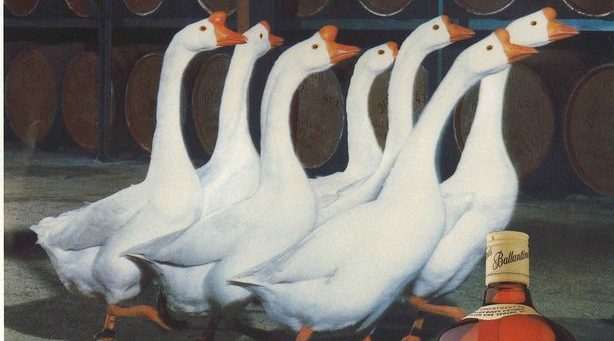
Here’s the interesting part of the story: the engineer in charge of the project, Ronald Cowan, turned out to be a keen observer and bird enthusiast. According to the story, Mr. Cowan told the general manager of Ballantine’s that geese are birds with extraordinary hearing and excellent vision, as unlike humans, they can see the ultraviolet light spectrum.
Geese? Yes, indeed, he emphasized that they have light sleep and are noisily territorial. Moreover, they would thrive eating the grass and excess grains from the surrounding areas. And yes, it was a crazy idea, but wonderfully practical.
So, at the end of 1959, a security detail was recruited with the important mission of protecting the stock of thousands of hectoliters of aged Ballantine’s whisky. By the way, if I may say so, the goose squad, or more glamorously named Scotch Watch, was quite unusual.
The squad started with six birds, which, over the decades, grew to over 100 feathered creatures, becoming a worldwide sensation, featuring in news articles and advertising campaigns.
But all that glitters is not gold, as the saying goes. The task of caring for the birds was very arduous and challenging. The females proved to be excellent sentinels, protecting the warehouse perimeters, but at the expense of not attending well to nesting duties. For a time, common hens had to be “recruited” to tend to the eggs and ensure the geese’s reproduction, to perpetuate the bird population and consequently, ensure the surveillance system.
In the end, the hens turned out to be excellent surrogate mothers, a miracle of nature deserving of its own article.
The goose population also faced threats from local predators: prowling foxes. Although the whisky warehouses remained free from human theft, it was challenging to deal with the four-legged criminals despite various attempts at capture and traps.
During the nearly 50 years of service by the Scotch Watch squad, it repaid its care handsomely, as it naturally contributed to the maintenance of the mowed grass around the warehouse complex, as well as providing the workers with eggs for consumption. Given the availability of food and the need to care for nests and young, these birds had no need to fly and stayed for many years on the Ballantine’s premises.
Over time, the fame of the birds spread so much that they became a tourist attraction. They appeared on TV in BBC documentaries, and merchandising, including ties, hats, scarves, and lapel pins, was developed to capitalize on their popularity. But like all good things, they must come to an end, and the famous Scotch Watch was no exception. As with any corporate order, the last goose caretaker was replaced at the end of the last century by an automatic feeder with little affection to offer, and the advent of technology (closed-circuit surveillance cameras) was the final blow to the Ballantine’s geese squad.
Fortunately, to ensure the story didn’t end badly, the members of the most unique surveillance team were not turned into a Christmas feast: the birds were relocated to Glasgow and placed under the care of the city’s animal protection society. A dignified retirement. Let’s say the geese were retired, and I believe they deserved it. What do you think?
In the meantime, Ballantine’s whisky continues to age in the Dumbarton warehouses, as secure as ever in a much quieter and more peaceful place after the departure of the Scotch Watch, waiting for someone to enjoy it as I do these days and as the great billiards master Enrique Navarra did during those game and chat nights in the 90s at the now-defunct Real Club in the heart of my city. Sláinte mhath, see you next time.
Instagram: @TP5161