Death… a word that, when written or pronounced, sounds as hard and rough as unsanded wood. Yet, at the same time, it could be synonymous with reunion or culmination. In the Mexican context –my culture and roots– it signifies a time for reunions through memory, through actions taken on earth, and a way of experiencing this passage to the underworld. That is to say, what can be understood as a next reincarnation, the smoke of the future, or the roots of a cempasúchil (marigold) flower.
Read in the magazine (rotate your device for a better reading experience):
Master Habanosommelier
How much color can we give to life and our time on this earth? Each of us holds that power, and in the altar de muertos (altar of the dead) that we typically set up at the beginning of November, Mexico reflects the love and magnitude of honoring our loved ones. We await the visit of our deceased relatives and friends –in spirit– and from the very first minute of that day, we are filled with the feeling of knowing they are with us.
Every November, we revive one of the most important and magical traditions of our culture: the Día de Muertos (Day of the Dead). This is because we have been taught never to forget the departed, who live on through memories.
I write these lines thinking of those who accompanied me every step of the way, and whom I am sure I will find again. Especially my godfather Saúl, who left us a few weeks ago, whom I remember always talking about sports and laughing at the jokes of Mi Sofi, as he used to call me.
Pre-Hispanic cultures shared the belief that the entity or spirit that grants consciousness to the human being, upon transcending this plane, would continue its journey in the world of the dead, where it still requires elements that were part of its daily life, including food.
Among the Aztecs, for example, the bodies of the deceased were prepared, dressed, and adorned, and the festivities included offerings of personal objects and food for the soul to travel to the Mictlán (underworld). After the arrival of the Spanish, the tradition was syncretized, and according to the Catholic calendar, November 1st was designated as Todos los Santos/All Saints’ Day (children and beatified), and November 2nd as Day of the Dead (adults).
We celebrate it in different ways: from holding vigils in the cemetery to visit and clean the tombs of our departed, to eating the famous pan de muerto (bread of the dead). And from my perspective, the most important element is the setting up of an altar. The mere act of placing and adorning it is a ritual born from the heart; a path of tears transformed into cempasúchil petals that blend anecdotes and hope.
I decided then to take a Madrid morning to connect with my origins, as the Casa de México Foundation in Spain annually erects an altar with a theme representative of the country. This year’s theme is Cabaret El Recuerdo (The Memory Cabaret): “Life, like the best of cabarets, must be lived by singing, dancing, and loving until the end.” I would add: with everything that fills our soul, including good smoke.
The foundation building’s display windows feature spectacular, life-size Catrinas (elegant skeleton figures), fitting the ambiance of a cabaret –social interaction spaces that combined dance, music, and comedy, experiencing their glory days during the last century– full of color and joy. The joy of our loved ones visiting us!
Once inside, six illuminated Catrinas are observed in the foreground, decorated with neon and glitter, amid papel picado (perforated paper) decorations and large spheres. The essential bottles of tequila also appear, along with a Tzompantli (skull rack) that recalls the Mexicas’ reverence for Huitzilopochtli, god of the sun and war, as well as the patron of México-Tenochtitlan.
Elements that can be found on an altar de muertos include:
Copal: An aromatic resin that represents the purification of the soul. Its scent guides the departed to their offering.
Candles: They are the fire that illuminates the round-trip path.
Papel Picado: Represents the air and the joy of the festivity. When it moves, it signals that the souls are arriving to enjoy their offering.
Water: Represents the purity of the soul, needed to quench the visitor’s thirst.
Pan de Muerto: Symbolizes the Christian Eucharist, but the top features shapes that resemble bones.
Salt Cross: For Mesoamericans, it marks the four cardinal points and is placed to orient the deceased, while for Catholics, it recalls the resurrection.
Photographs: They commemorate the deceased to whom the altar is dedicated.
Catrinas and Calacas (Skeletons): The Catrina skull derives from the character created by artist José Guadalupe Posada as part of his social critique of the bourgeoisie of the time.
Flor de Cempasúchil (Marigold): The flower of the dead that the Mexicas compared to the sun because of its intense yellow or orange color. Thanks to this and its aroma, souls can reach the altar and enjoy the feast.
In the foundation’s hallways, handicrafts inspired by the Catrinas are exhibited, and on the first floor, the ceiling of a room is covered in papel picado. How can we give death so much color? I thought. Perhaps because in it we see all the shades we have put into our lives.
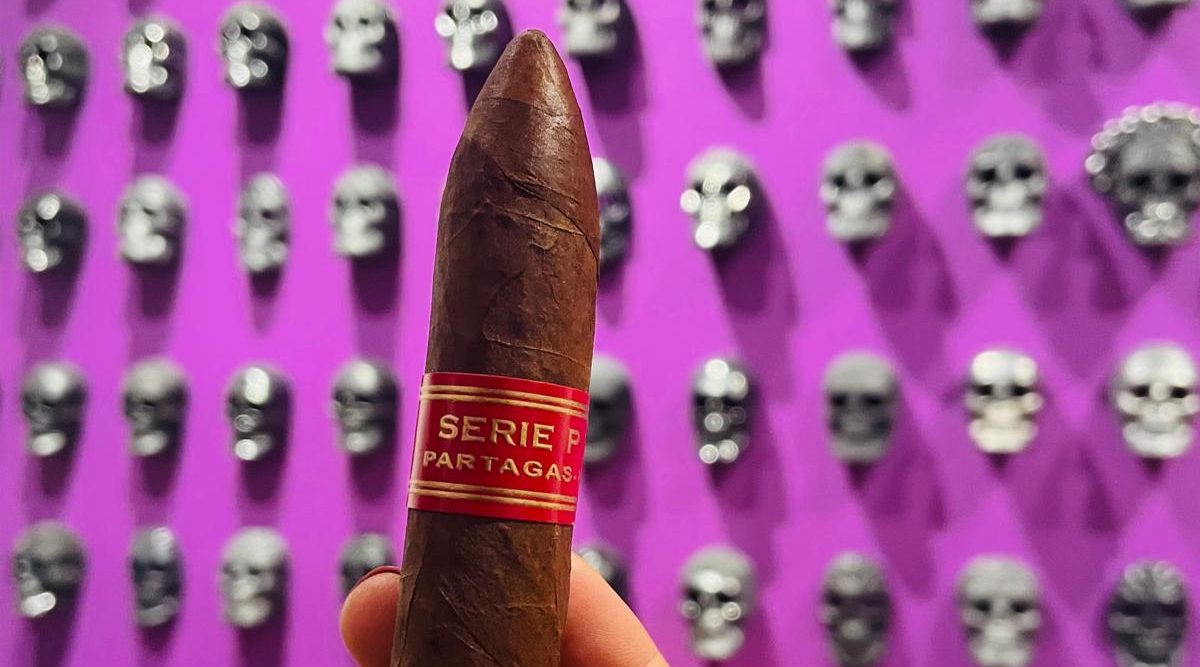
So, to celebrate the occasion, that afternoon I lit a Partagás Serie P No. 2, a figurado-format habano that has become traditional among aficionados. We are talking about a brand that has created rituals in the culture of fine smoke for over a century. Its emblematic red color, imprinted on its band and logo, has left a mark on those of us who have enjoyed its aromas, flavors, and strength, leaving a lasting aftertaste altar on the palate.
Another pair of life-size Catrinas, made from jute fiber, are surrounded by nopal (prickly pear cactus) pads, which refer to Mexican gastronomy. They are the preamble to a long corridor with a wall full of skulls and other crafts made of clay, metal, sugar, cardboard, and paint on tile.
Finally, I entered a room where a gigantic card from the lotería game is displayed across an entire wall (the game consists of being the first to fill the spaces on the card or board, with images from Mexican culture, according to the corresponding cards called out from the deck). There, the Casa de México invites visitors to leave a memory; a moment that generated mixed feelings in me: happiness and nostalgia.
It was a day to immerse myself in Mexico, my homeland, and in my inner self… An entire day that I concluded by joining the tribute with a galera habano, a pirámide 52 x 156 mm, and a caballito (small glass) of tequila. With every third, I honored the journey of my people and the time life allowed me to spend with them, as we reunite to continue advancing together. It was like lighting up the laughter and the memories.