Present in the international market for over 50 years, Te Amo is Mexico’s iconic cigar brand that has successfully brought tobacco products from Los Tuxtlas region in Veracruz to 70 countries around the world.
In partnership with the Turrent family, who have been tobacco leaf producers and exporters since 1880 – across five generations – the art of cigar manufacturing was integrated after acquiring the factory and brand they have maintained since the early 1970s. Their cigars have been enjoyed by iconic figures such as the late María Félix and actress Salma Hayek.
Read in the magazine (rotate your device for a better reading experience):
The brand features an image of a bull and a matador during a pass in the lower area of the bullring, with the name “TE-AMO” inscribed in red, old-style uppercase letters connected by a hyphen: a classic symbol that has made its rounds in rings and packaging globally.
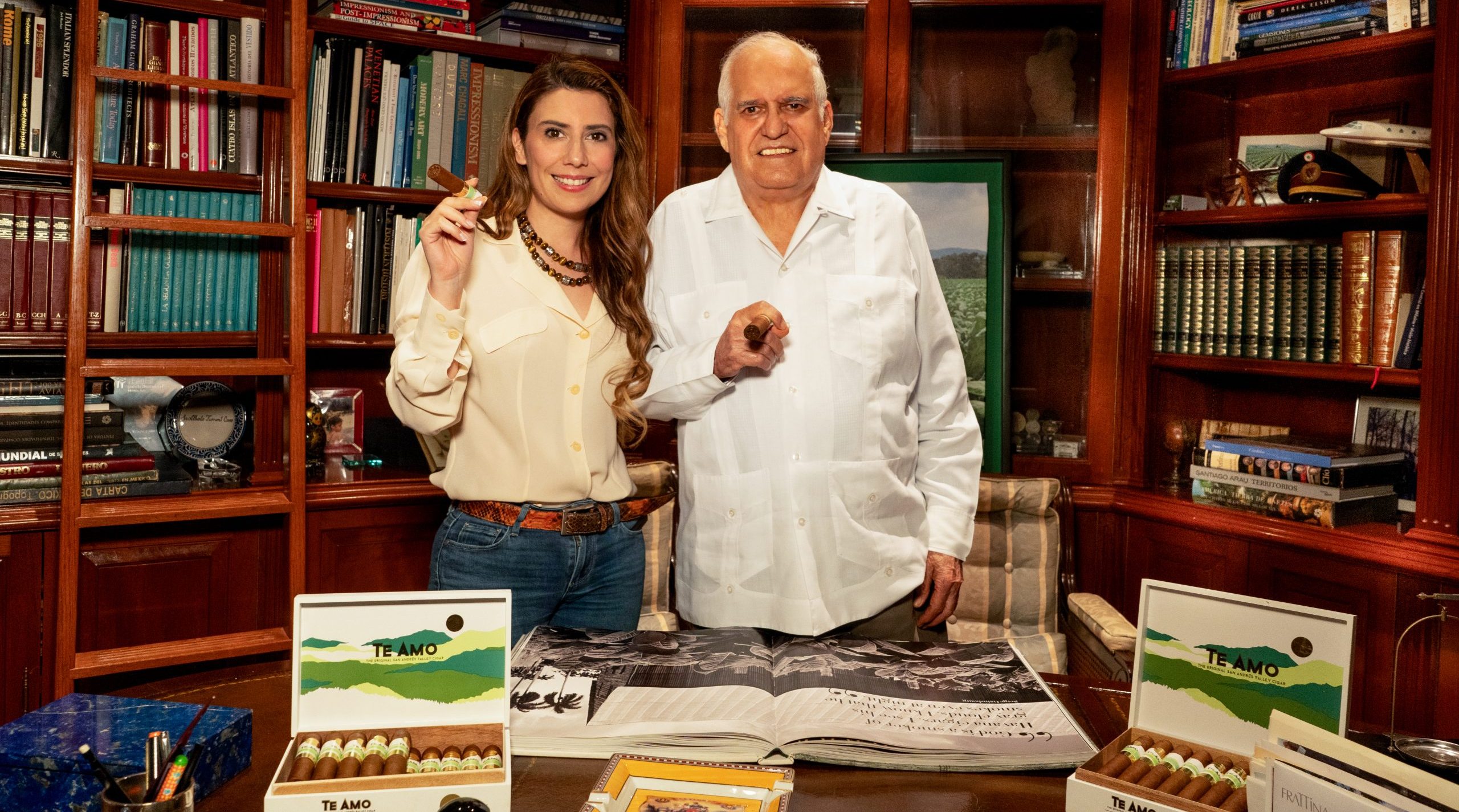
As a tribute to its consumers and in honor of the brand, the Turrent family, led by Don Alberto Turrent Cano, decided to launch the Rediscover Te Amo campaign with a Special Edition of three sizes of a Habana wrapper blend, featuring an image leading to the San Andrés Valley. This campaign combines tradition, lifestyle, and modernity, targeting women and young people – growing sectors in the market.
Origins
Catalan immigrants, some members of the family arrived in Cuba, and others in Mexico. Antonio Turrent was the first to settle in San Andrés Tuxtla, Veracruz, at just 18 or 19 years old. From his marriage to a young woman with the last name Cinta, a son was born, who was named the same and around 1880 started working as a tobacco harvester, as confirmed by Don Alberto about his great-grandfather.
After starting his own family, Antonio had seven children with the last name Turrent Vázquez, all of whom worked in tobacco cultivation, including his grandfather Alberto. In 1901, his father, Alberto Turrent Carrión, was born, who continued the tobacco production and exportation to various countries, as had been done for many decades.
He recalls that his father used to send bales that were transported by rivers to Alvarado, where they were then transferred by train. He also speaks of the demographic growth of San Andrés Tuxtla – always cosmopolitan throughout its history due to tobacco – which grew from about 30,000 to nearly 200,000 inhabitants today, despite migration in recent years.
There have also been changes typical of an evolving industry. For instance, Don Alberto recounts that in the 1930s, they sent tobacco leaves to a German businessman, who owed them money, but when World War II broke out (1939-1945), they lost all contact. “However, in 1951, my father received the check just like that. Deals were made by word of mouth, without contracts… Things were different then.”
With over a century of history, the Turrent agricultural enterprise not only survived difficult times such as the Mexican Revolution and other social movements but also managed to exceed 1,500 hectares planted with tobacco between 1860 and 1925. By the late 1950s, with the embargo imposed by the United States on Cuba, a market flourished in the neighboring country that sought to replace Cuban cigars with quality products.
A Factory
At 82 years old, Don Alberto Turrent claims that the best teacher is experience. He shares that he started in the family business driving a truck and, while very young, was sent to work with tobacco-growing families in Connecticut, USA. His father made him aware of each process, and he gradually rose through the ranks until, in 1975, he assumed full responsibility for the business.
It was during the Cuban embargo that Jewish-American businessman Robert Luzgarde visited Guadalajara, Jalisco, and tried a cigar from the Ornelas brand. He liked it so much that he investigated the origin of the tobacco and, upon arriving in San Andrés Tuxtla, purchased a small factory where six cigar makers worked.
Don Alberto says that the man did not speak Spanish well but somehow found a partner from Nuevo León who helped him set up a small but properly organized factory. They saw the business opportunity opening up in the United States and sought to capitalize on it, but the Jewish businessman died a few years later, and his heirs put the facilities and the budding brand Te Amo up for sale.
His father, Alberto Turrent Carrión, also recognized this opportunity, and by the end of the 1960s, he decided to purchase them, accompanied by a young Alberto Turrent Cano. Thus began the current Tabacalera Alberto Turrent, forging its own legacy in cigar manufacturing through the experience of generations and the capacity to produce raw material.
New Te Amo
Just like other family members involved in pre-industrial or sales activities, Celina and Alejandro Turrent Cabada, Don Alberto’s children, participate in the businesses in different ways: she has focused on social actions for workers and their families, while he manages the cigar factory.
Celina studied Languages and graduated in London, England, at the age of 18. Although arts and photography were her initial choice, tobacco and cigars have always been present in her life. Besides her connection with tobacco fields and farms, she has met producers and directors of major industry companies, as well as women who smoke and inspire her in what she considers “a great family.”
She started in sales but later stepped away temporarily to work full-time at the Museum of Modern Art, where, she says, an exhibition of photographs related to old Te Amo boxes and some posters awakened her desire to do more within the family business.
During this period, her brother Alejandro suggested that she handle the photographic work for Te Amo’s advertising campaign. They were developing what was needed to launch a Limited Edition of a new blend but with a modern image, aiming to project this traditional brand into new market sectors with a growing presence of women and young people.
Fulfilling this task took her down two paths: one that emphasized tradition, lifestyle, and modernity, and another that led her to the fields and its female workers. Celina plays an important role in the Previgen Foundation, which supports those working in the family’s businesses, bringing life to tobacco and Te Amo.
“We carry out various educational and health actions,” she explains, “and we offer women ongoing training in skills outside of tobacco, such as beauty or clothing manufacturing, to open opportunities that improve their family’s economic situation.” Indeed, they received recognition for this work at the recent InterTabac in Dortmund, Germany.
Matacapan Tabacos and Tabacalera Alberto Turrent create nearly 200 direct jobs at the factory and over a thousand indirect jobs, depending on the harvest season, with over 60 percent of the workforce being women. This positively impacts several communities in San Andrés Tuxtla and its surroundings.
A Classic
Since its launch in the 1960s, Te Amo cigars were primarily distributed in the United States, in cities like New York, Chicago, and Pennsylvania. With the purchase of the factory by the Turrent family, the brand’s marketing rights were handed over to the Spanish company Alta Distribución (Altadis), except for its management in Mexico.
According to Don Alberto, the brand’s origin was due to the fact that bullfighting at that time was highly distinctive of Mexico, and its original owners adopted the well-known iconography. Additionally, the connection between bullfighting enthusiasts and cigars was such that hundreds of small tobacco growers would go to Plaza México to showcase their products.
The brand is also credited with creating the Toro vitola, 6 inches, 52 ring gauge – though many producers prefer 54 – a name adopted in the tobacco world similarly to the Churchill. Another size related to bullfighting is called Picadores, which, like the rest of the Classic Line, features a Sumatra wrapper.
Since then, the brand’s image has been maintained with minimal changes until the recent introduction of this Special Edition aimed at the US and European markets, with a blend that took over two years to finalize: Mexican Habano wrapper with three years of aging, San Andrés Negro binder with five years of aging, and Habano Criollo San Andrés and Habano 2000 San Andrés fillers with over five years of aging.
According to Celina, the image change focuses on the greenery of Los Tuxtlas, highlighting the presence of women and the environmental actions of their companies. It offers a smooth medium smoke, available in Robusto, 5 inches, 54 ring gauge; Magnum, 6 inches, 60 ring gauge; and Toro, 6 inches, 52 ring gauge, all wrapped with a white band crowned with a golden sun, under which the valley is illustrated with the phrase: The Original Cigar from the San Andrés Valley.
“Many factories around the world use our tobacco: Davidoff, Padrón… so we wanted to enter the cigar market to leverage our product and launch a Mexican brand.” That’s why, if someone wants to try Mexican tobacco – father and daughter reiterate – they should smoke a Te Amo.