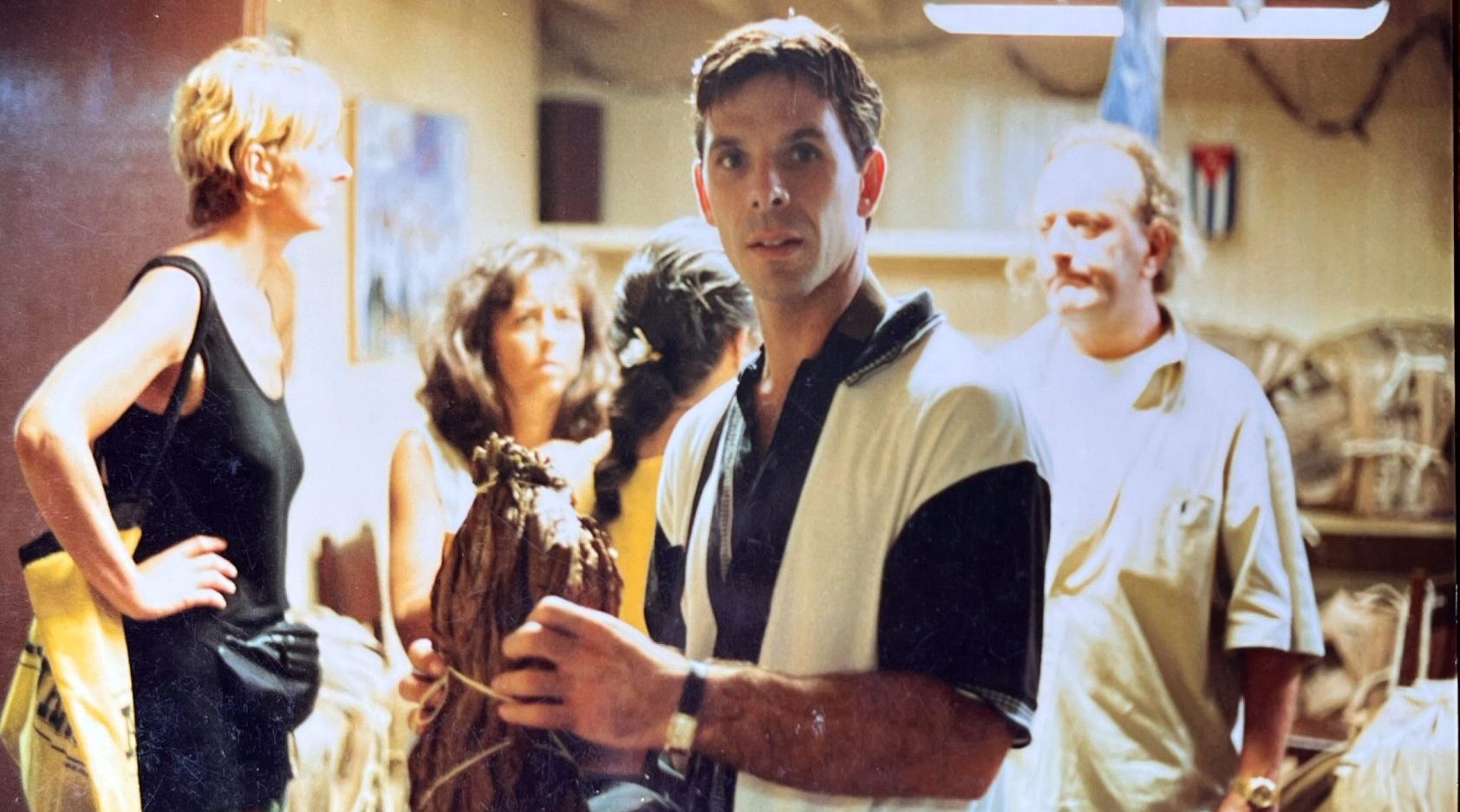
Scott Anthony is not just another true crime author; he has lived everything he writes. Raised on the rough streets of Chicago, he learned the brutal lessons of survival firsthand, rising from a troubled youth to a gang leader in a world marked by danger, loyalty, and betrayal.
Read in the magazine (rotate your device for a better reading experience):
La Fumarosa
In the 1980s, crime was not just an idea for Scott, but a lifestyle defined by drug dealing and violent robberies. A decade later, his criminal activities evolved into a Cuban cigar smuggling operation that took him to Cuba’s capital more than sixty times, moving millions of dollars in the black market.
Border crossings, bribes, and constant danger became his daily reality until the pressure mounted and he managed to flee the country, escaping justice. For five years, he lived as a fugitive, rebuilding his life under false identities and forged documents, relying on his instinct, discipline, and survivor’s mentality. Finally, he straightened his path and settled in Mexico, where he opened gyms, runs businesses with hundreds of employees, and manages world-class fighters.
A lifelong boxer, kickboxer, and martial artist, as well as a devoted Jiu-Jitsu student, Scott is now a husband and father of eight. As a reformed outlaw turned businessman, he channels his past experiences into gripping stories. And although these tales might seem like they belong in a movie, every word he writes is true: a life testimony that mainstream publishers often overlook.
Below, we present excerpts from the book Confessions of a Cuban Cigar Smuggler, by Scott Anthony.
The Buy
I was a man on a mission and had no time to waste. As soon as I got back to Mexico, I asked around and finally made my first contact: Arturo Brigante, a Cuban living in this country who sold cigars to businessmen. He showed up with his assistant. He carried himself like a boss: he made a few quick gestures, and the kid went to the car, returning with two suitcases full of Habanos. All I had was $4,400 in cash. I bought forty boxes from him at $110 each. I was willing to risk it all. That was the beginning.
First Cuban Cigar Run
By the end of the trip, my two suitcases were full. I had seventy boxes of authentic Cuban cigars that I bought in Havana; there was no doubt about their origin. I traveled all the way here while under federal supervision, risking my freedom and my life to make some money. I wanted to get ahead, and this opportunity presented itself, so you better believe I dove in headfirst.
I was there, in front of the Havana airport, about to walk into the unknown. We went to the counter and checked in; everything went smoothly and easily. The process wasn’t fast; they did everything manually and were very careful not to let any national escape through the airport. Once checked in, we had to line up for Immigration. It was a wall of booths with no way to see what was beyond. It was a long process and we were almost late for our flight. The airline was announcing our names. They knew we had checked in, but we hadn’t boarded yet.
There was a checkpoint. Customs agents made everyone pass their bags and belongings through an X-ray machine. As I left Migration and entered the waiting area, hearing my name poorly pronounced over the speaker, I saw our two checked bags there, in the open. They looked out of place, simply wrong. I put sixty dollars (three twenty-dollar bills) inside my passport. I tried not to pay attention to the bags and hoped this was normal. It wasn’t.
I was under pressure now. My flight was about to leave and Customs was calling me over the intercom. A small man, about five feet tall and 110 pounds, around thirty years old and looking quite unfriendly, took me into a room. I pretended not to speak Spanish; I only spoke English. He was taken aback by my U.S. passport and the cash inside it.
When I walked out of the room, it looked like Eduardo needed a diaper change. I smiled a bit and watched as two agents took my bags back inside. We boarded a bus. Back then, there were no jet bridges, only buses that took everyone to the runway to board via stairs.
My First Bust in Cuba
While I was looking for a luggage cart, a young guy approached me and tried to whisper in my ear. I couldn’t really understand him because he was clearly trying to be discreet. But I heard “Raul” and “only two suitcases.” I was lost. What did he say? What was going on? What I thought he had said was that Raul said to only bring two suitcases. I had the van turn around and we drove all the way back to Capi’s apartment. There, we unloaded everything except for four bags –two each. If the van driver wasn’t suspicious before, he surely was now, and all that commotion probably gave us away.
We returned to the airport when it was almost dark, but we still had time to catch the flight if everything went well. There wasn’t much of a line at the Mexicana de Aviación counter. We were walking that way when I felt a tap on my back. I turned around and saw Raul. I told him everything was cool and that we only had two suitcases each. He was cold and distant; he didn’t really look at me, but said, “No, it’s not good. Keep your mouth shut and follow me.”
Several agents surrounded us. We went out through the main airport door and they took us to the arrivals area on the other side. I was calm but alert. What the hell was happening? My suitcases were on a table in the customs area, all empty –about 125 boxes on display for everyone to see. It looked like a mountain. They had experts studying them; there were accountants present, and it was all very formal. After a few hours, it was clear we weren’t going to make our flight.
The ordeal lasted about four hours. Raul finally said they would hold our passports until further notice. They gave me a number to call every day. That was it. We would be held on the island until they decided what to do with us. We went back to Capi’s, who was waiting for us, nervous. He had to leave, but he graciously let us stay in his apartment, knowing this was a mess that could blow up in our faces.
Street Cigars
Let’s get one thing straight right now: a cigar is a fuckin’ cigar. It’s a bunch of leaves wrapped the right way so it burns correctly; that’s it. If those leaves happen to grow in Cuba, then you have a Cuban cigar. If a person is an expert roller, they can make a cigar just as well, whether they’re working at home or sweating in a factory, using stolen leaves or government-owned ones. The tools used to roll a cigar are simple, even primitive, and easy to find.
Finding exactly what I wanted in Havana wasn’t always easy. Certain brands and vitolas were often scarce. On the streets, one hundred percent of the cigars were either stolen or made with stolen products. It’s not like those guys could just take an order from me. The average Cuban didn’t give a damn about cigars; they cared about eating. They sold whatever brand they happened to have in their possession. I had at least fifty different sources to buy from, with new guys offering me deals every day, but I needed quality. That was the hard part. I became a Habanos connoisseur. As I evolved, so did the cigar market. I needed the best, and on the streets, that wasn’t easy. You could find them, sure, but only with persistence and a sharp eye. Some brands were almost impossible to get, both on the street and in the factories.
What most people don’t want to hear is that they’ve bought and smoked street cigars, even though street cigars and factory cigars are usually the same fuckin’ thing. Sorry to burst your bubble, but if you’ve smoked Habanos, the odds that you’ve smoked “street cigars” are close to one hundred percent.
For whatever reason, it bothered me to sell “street cigars” to my customers. It shouldn’t have mattered to me, but it did. I’ve always had a certain kind of honor. I’d rather put a gun in someone’s face to rob them than scam them. I didn’t like lying and cheating to make money. If the cigars are put together right (it’s not rocket science), there isn’t a smoker in the world who could tell the difference –not one. But the profits were much higher than with factory cigars and the inventory was much better. That’s the allure for guys like me from all over the world.
That’s why so many people smuggled and sold street cigars: the damn profits were off the charts. Imagine pulling a box off the streets of Havana for twenty dollars and reselling it for a thousand in the United States. That kind of margin doesn’t just give you money; it gets into your blood. The allure, besides the cash, was the chase, the hustle, and the feeling of beating the system. The adrenaline was so strong that it made every risk feel worth it.
The Big Bust
I had to go through Immigration and Louie went with me. We were outside and there was absolutely no way to see to the other side. We were trapped, waiting. Time barely moved. For a moment, it felt like time had frozen. The airline was already boarding and they were herding us toward the bus that would take us to the plane.
Out of one side of the security checkpoint came a customs agent carrying two of the suitcases. At the same time, I heard Antonio shout: “Scott!, ya valió madre todo! (it’s all fucked).”
At that moment, Eduardo passed through the Immigration gates, crossed security, came straight to me, and said: “They want the invoices.” I had the invoices and tried to give them to him, but the airline people were literally pulling, dragging, and pushing me to get me out of there.
I didn’t say a word. I got on the bus and, at that moment, Eduardo ran toward the vehicle. He looked like he wanted to cry: “Give me the invoices!”
Three weeks had passed since my incident at the Havana airport. Antonio and Eduardo had returned and recovered some suitcases without a problem, but I still had many suitcases left there.
The plane we were boarding was one of those with stairs at the rear; a long, narrow staircase where I moved slowly to buy time. I was really suffering because they kept pushing me and told me, once again: “You don’t know how lucky you are to be leaving, DON’T BE STUPID.” I had told Louie: “Hey, go back there with them,” but he said: “Fuck you, there’s no way I’m going back.” As the plane taxied, we could see the commotion at the airport. Then we saw them getting into cars and jeeps. They were coming for us at the plane. Luis and I watched as we took off by the grace of God. We were on our way back to Mexico City: just the two of us… but without cigars. I had just lost 400 boxes of cigars and a bunch of suitcases. Fuck.
If you want to dive deeper into this gripping narrative and uncover all the twists and turns of this story, be sure to purchase the book Confessions of a Cuban Cigar Smuggler, by Scott Anthony, on Amazon. A journey into the hidden world of the cigar trade that you won’t want to miss!
IG: @SCOTTANTHONYOG
Book available on Amazon and

Barnes & Noble

Suscribe to our Newsletter